
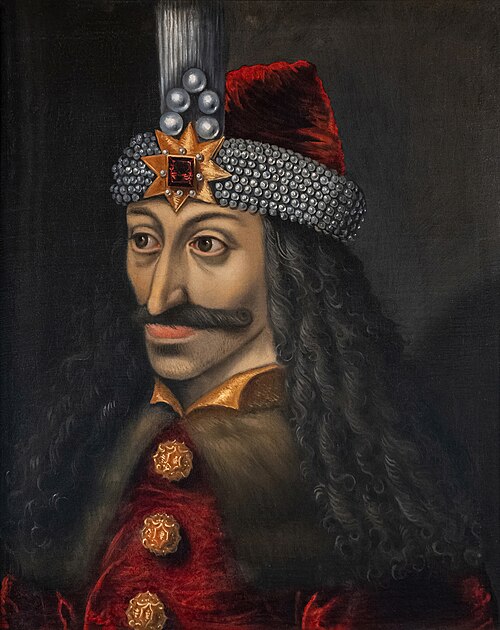
Was Dracula a real person? Yes and no. There was a real person behind the legend of Dracula. He was a 15th century prince who ruled Wallachia, called Vlad III. However, he was not a vampire, and he definitely did die.
Vlad III was born Vlad Dracula, and it is from him that we have the name Dracula. He was the son of Vlad Dracul, who was Vlad II. The name Dracul means “dragon” in Romanian, and the name Dracula means “son of the dragon.” So Vlad II was Vlad the Dragon, and Vlad III was Vlad, son of the Dragon. Vlad’s father, Vlad II, was made a member of the Order of the Dragon in 1431, and it is from this that he took his name. The Order of the Dragon was a collection of knights that fought to defend Christianity from the expanding Ottoman Empire. They were present in several of the crusades. Vlad II was born illegitimately and didn’t have a surname he could use. He was taken in by Sigismund of Luxembourg, the Holy Roman Emperor, and made a member of the Order of the Dragon. Vlad Dracul became the prince of Wallachia, which is where southern Romania is today. He spent the rest of his life trying to defend his kingdom, often unsuccessfully, and he died in captivity in 1447.
Vlad III, or Vlad Dracula, was born in about 1428, and he didn’t naturally inherit the crown of Wallachia. He had to fight for it, and he held it three times throughout his life. Because of this, when he was in control, he was exceptionally brutal to make sure his people and the people he was fighting knew who he was. He is said to have invented monstrous tortures for the people he captured, one of which was impalement. And that is where his most famous name, Vlad the Impaler, comes from. He impaled his own citizens for committing crimes. He impaled people who stood up against him. He impaled merchants who cheated him. And he impaled the Ottomans who tried to defeat him. He is said to have impaled 20,000 Ottomans as a sign to the Sultan, and it was said to be so horrific that the Sultan turned round and left.
Vlad Dracula was undeniably a mass murderer, but he was loved by his people because he brought a relatively stable government, punished criminals, and beat his enemies. He was certainly not immortal, though, and was killed in battle at roughly 45 years of age. He was a brutal ruler in a time of brutal rulers. So, how did he end up being so famous that Bram Stoker based a character on him? The main reason he became this famous is because of the printing press, which had been invented in 1440, and some people whom he had wronged.
People have always liked a good monster story. Look at our fascination with serial killers for proof. In the latter years of his life, stories of Vlad’s cruelty were spreading in poems, and even the pope wrote about how cruel he was. Yet, it was through several German language pamphlets that Vlad’s legend began to spread. They were printed in Central Europe in the 1480s, just after Vlad had died. They were made using the newly invented movable type, so they could be printed in greater quantities. Each pamphlet had ten or twelve pages and they had a woodblock print image on one side and text on the other. The text described in lurid detail all of the monstrous things that Vlad had done. They became popular and became something of a bestseller. The problem was, the pamphlets were commissioned by a group of merchants who had been chased out of Vlad’s lands. They had had their homes burned and had seen their friends impaled. Vlad was undoubtedly cruel, but they took his cruelty and exaggerated it to the maximum. And these accounts lived on long after the real Vlad had died. And it is accounts like this that Bram Stoker came across when he was writing his Dracula novel. Although in Bram Stoker’s working notes for his book, he came up with the name Dracula quite late in the process. He called the main character Count Wampyr at first. When he was on holiday in a seaside town called Whitby, he came across a book called “An account of the principalities of Wallachia and Moldavia.” It mentions Dracula and Stoker believed that the name meant “devil,” which it only does in modern Romanian. He had no real knowledge of the real Vlad III, though. And this is what I learned today.
Sources
https://www.nbcnews.com/sciencemain/vlad-impaler-real-dracula-was-absolutely-vicious-8c11505315
https://www.britannica.com/biography/Vlad-the-Impaler
https://www.livescience.com/40843-real-dracula-vlad-the-impaler.html
https://en.wikipedia.org/wiki/Vlad_the_Impaler
https://en.wikipedia.org/wiki/Vlad_II_Dracul
https://en.wikipedia.org/wiki/Wallachian_Plain
https://en.wikipedia.org/wiki/Order_of_the_Dragon
https://www.dictionary.com/e/dracula-fish
https://www.karwansaraypublishers.com/blogs/medieval-world-blog/dracula-in-the-sources
https://preloprints.com/prints/dracula
Image By Anonymous – Own work, Public Domain, https://commons.wikimedia.org/w/index.php?curid=145990532