
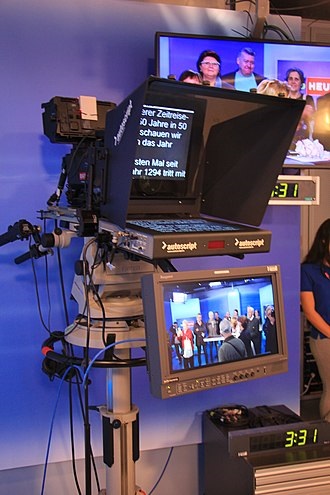
How does a teleprompter work? A teleprompter works by projecting a script onto a mirrored glass panel. This allows the speaker to read the script and maintain eye contact with a camera or an audience, and it prevents the camera or audience from being able to see the script. A teleprompter works because light always travels in a straight line, how much light is reflected can be controlled by the coating on the glass, and because our eyes and a camera lens see bright lights more than dim lights.
The simplest way to think about how a teleprompter works is to think about a window at night. There are two things we need to consider. Light can pass through the glass from either side, and some of the light is always reflected. During the day, when the amount of light inside the house and outside the house is equal, you can see what is outside the house by looking through the window, and someone outside can see what is inside the house. Both sides of the window are as clear as each other. Not all of the light goes through the window, and some of it is reflected, but the light passing through the window overwhelms the small amount of light that is reflected, and we can’t see the reflection. This is different at night. If you have a light on in your room and it is dark outside, more light is going from inside the house to outside of the house than is coming the other way. When this happens, the light coming from outside the house is not enough to overwhelm the reflection from the window, so all that you can see is the reflection. On the other side, the light coming through the window is enough to overwhelm the reflection, so you can see clearly into the house.
A teleprompter either goes in front of a camera lens or sits on either side of a podium. The glass is tilted 45 degrees from its base towards the speaker. The device that has the script on it sits lower down out of sight. The script is projected upwards onto the glass. There are two sets of light rays hitting the glass. The first is from the device that is projecting the script, and the second is from the person speaking, who is being filmed or talking to the audience. The glass has a very thin silver layer to make it slightly more reflective than glass on its own, which is called a beam splitter. The amount of silver corresponds to the amount of light that is reflected and the amount that is passed through. The beam splitter in a teleprompter lets through about 70% of the light that hits it and reflects about 30% of the light. The script projected up at the screen from the device hits the glass, and because of the 45-degree angle and the fact that light always travels in a straight line, it is reflected out at the speaker at a 45-degree angle, making a 90-degree turn. 70% of the light goes straight on, and 30% is reflected, making a reflection that is strong enough to be visible, but not too strong. From the speaker’s point of view, the text is clearly visible on the glass screen because it is a high-contrast image of bold text. If a complicated picture was projected, the speaker would probably not be able to see what it was as quickly as they can read simple text. Conversely, the light from the speaker hits the tilted glass, and 70% of it goes straight on, into the camera lens or towards the audience, and 30% of the light is reflected 90 degrees down towards the device with the script. In the same way that we can’t see out of a window at night when the room is brightly lit, we can’t see the script reflected on the screen because the light coming through it from the other side is too strong and overwhelms it. The person doing the speech can see it because there is not much other light coming through the screen from behind.
TelePrompTers were invented in the 1950s by Hubert Schlafly. He heard an idea from an actor called Fred Barton Jr. Barton was a soap opera actor, and he wanted to find a way to do long speeches without having to memorize all of his lines. With another man, called Irving Berlin Kahn, they founded the TelePrompTer company. Their company ended up becoming a very large cable TV company before being bought out in the 1980s. Their TelePrompTer became extremely popular, and now the brand name has become the name of the product. And this is what I learned today.
Sources
https://www.teleprompter.com/blog/how-does-a-teleprompter-work
https://en.wikipedia.org/wiki/Teleprompter
https://en.wikipedia.org/wiki/TelePrompTer_Corporation
Image By Karl Gruber / Wikimedia Commons, CC BY-SA 4.0, https://commons.wikimedia.org/w/index.php?curid=62953111