
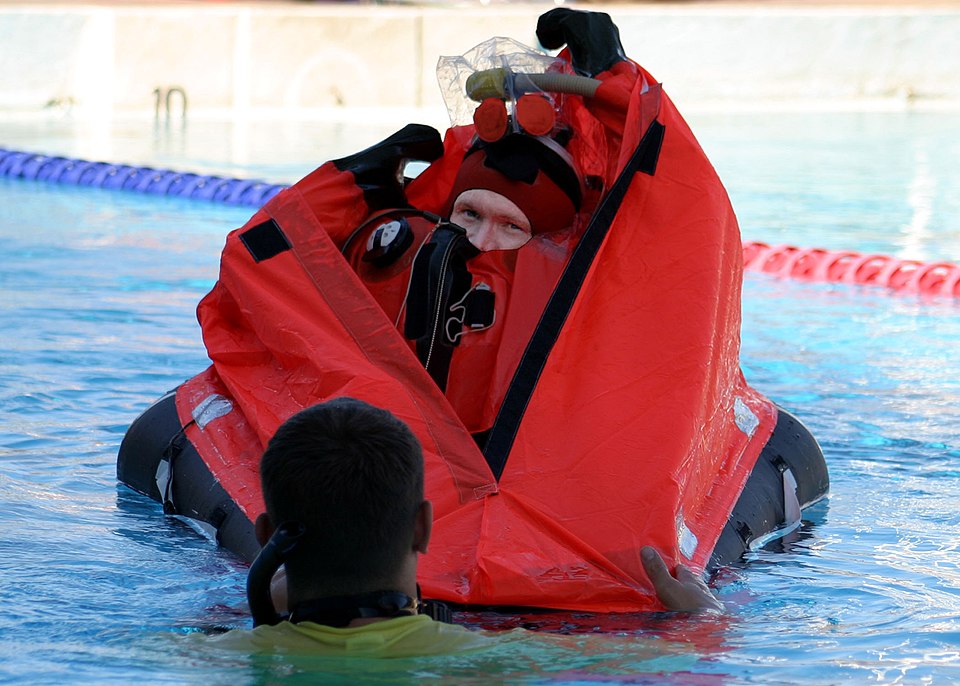
What is a submarine escape system? A submarine escape system is basically a modified deep-sea diving suit with an air supply and a life raft attached. There are also diving bells that can be lowered from the surface to rescue trapped sailors.
The problem with any kind of submarine escape system is that it is almost impossible to escape from a submarine. The Navy perform test drills to train their sailors in how to perform escapes, but, in reality, it is virtually impossible. Since 1939, there have been no successful submarine rescues. The last successful rescue was in 1939, and it used a diving bell called the McCann Rescue Chamber. It was basically a weighted and hollow chamber with an air supply from the surface. At the base was an airtight seal that would fit over the hatch on the submarine. The diving bell was pressurized and weighted at the base to keep it upright and stable. Because it contains air and is pressurized, it doesn’t need a floor because the air pressure keeps the water out. In the 1939 rescue, a submarine called the USS Squalus had a failure in its induction valve, which let water into the forward torpedo tubes. 26 sailors drowned immediately, and the submarine sank to the bottom, 73 meters down. When the front torpedo room flooded, the other sailors were able to shut the flood doors and keep the water at the front of the submarine, giving them a safe space at the back of the submarine. However, at 73 meters, they had no way of getting back to the surface. The McCann Rescue Chamber had only just been invented, and the navy put it to use. They sent it out on a ship and lowered it down to the submarine on a long cable. Once the airtight seal was in place, the sailors opened the hatch, and a few of them climbed into the bell. They closed the hatch and lifted the people to the surface. They repeated this five times and rescued 33 sailors.
The McCann Rescue Chamber seems like a perfect solution, but it has never worked since and is not even considered now. It only worked in 1939 because the submarine was in a known location, 73 meters down. If it had been much deeper, there is no way the diving bell would have reached it. They are also extremely vulnerable to the weather and sea currents because a rescue chamber is a fairly light bubble of air on a long steel cable. The US Squalus was also not that far from the coast, and it was relatively simple for a ship to get to it. This diving bell method would not work with a modern submarine accident because they go much deeper, and they stay much further out from shore. Getting a diving bell to a stricken submarine would be impossible.
That is why the only escape system modern submarines have is an SEIE, which stands for Submarine Escape and Immersion Equipment. This is a thick, whole-body suit with an inner thermal layer and an oxygen supply. There is also a gas-inflated one-person life raft attached to it. If there is an accident on the submarine, they can open an escape hatch. This is a door attached to a sealed chamber with a pressure equalization system. The only way to open a submarine door at depth would be to equalize the pressure between the inside and the sea. Then, once one person has gone through, the chamber needs to be emptied so the door can be opened for the next person without flooding the submarine. Each sailor leaves the submarine and floats to the surface in the suit. Once they reach the surface, they inflate their life raft and wait to be rescued.
There are three problems with escaping from a submarine, which is why there haven’t been any successful rescues. The first is that because submarines are underwater, the majority of accidents result in them rapidly filling with water. The second problem is that the SEIE suits are only good at depths of down to 183 m. Any deeper than that, and the pressure outside the submarine will be too great. As the sea is incredibly deep, the majority of submarine accidents happen at depths greater than this. And, thirdly, if a sailor does manage to swim to the surface, they will suffer from decompression sickness unless they can be put into a recompression chamber very quickly. That is why most navy ships have a decompression chamber on board, and when a submarine has an accident, these chambers are rushed to the accident site, just in case somebody can swim to the surface. And this is what I learned today.
Sources
https://en.wikipedia.org/wiki/Submarine_Escape_Immersion_Equipment
https://en.wikipedia.org/wiki/McCann_Rescue_Chamber
Image By U.S. Navy photo by Chief Journalist David Rush – This image was released by the United States Navy with the ID 041012-N-0879R-007 (next).This tag does not indicate the copyright status of the attached work. A normal copyright tag is still required. See Commons:Licensing.العربية ∙ বাংলা ∙Bahaso Jambi ∙Deutsch ∙ Deutsch (Sie-Form) ∙ English ∙ español ∙ euskara ∙ فارسی ∙ français ∙ italiano ∙ 日本語 ∙ 한국어 ∙ македонски ∙ മലയാളം ∙ Plattdüütsch ∙ Nederlands ∙ polski ∙ پښتو ∙ português ∙ русский ∙ slovenščina ∙ svenska ∙ Türkçe ∙ українська ∙ 简体中文 ∙ 繁體中文 ∙ +/−, Public Domain, https://commons.wikimedia.org/w/index.php?curid=8231490