
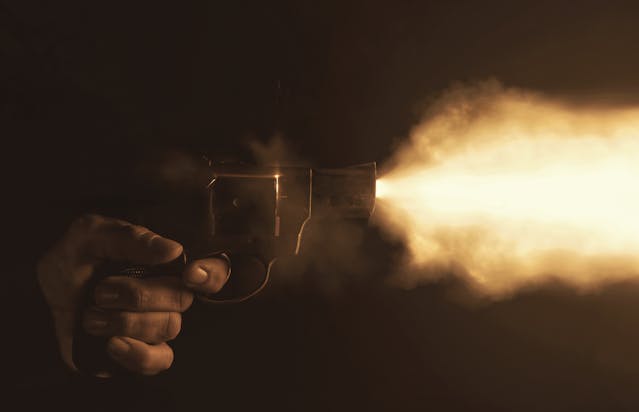
How does a high-speed camera work? This might sound rather obvious, but a high-speed camera works by taking a lot of images very very quickly. High-speed cameras don’t just take more frames per second; they also give each frame a much shorter exposure time, so fast things aren’t blurred.
There are obviously different standards, but a regular movie camera takes images at the rate of 24 pictures a second. Each picture is called a frame, and fps stands for frames per second. 24 fps is common because that is fast enough to trick our brains into seeing motion. Early black and white silent movies were filmed at about 16 frames per second, which is why they appear a little bit jerky. It’s fast enough to be seen as movement, but not fast enough to be smooth. Interestingly, frame rates of 24 per second or higher are the reason why, when you see video of a helicopter, it often looks as though the rotors are completely stationary. That is because the rotors make one revolution in the time it takes the camera to record one frame, so every time it records a frame, the rotors are in the same place.
The reason why you can’t clearly film things moving rapidly is the reason why high-speed cameras are necessary. If you can only film at a rate of 24 frames a second, then you will not be able to clearly film things that move faster than that. A hummingbird, for example, flaps its wings about 80 times a second, so you wouldn’t be able to film that without motion blur. A high-power bullet travels at over a km a second, so it would have gone through the frame of the camera before a picture could be taken.
One reason we see 24 fps as smooth movement because of a trait we have called persistence of vision. It obviously takes a small amount of time for the light from something we see to hit the back of our eyes, get converted into an electrical signal, get transmitted up the optical nerve to the brain, reach the appropriate area of the brain, and to be understood. If you can get another image into the brain just as the first one is finishing its journey, the brain will see it as movement. This phenomenon is also why we see a trail of light after a sparkler has been whirled around in the dark. The real object has moved on, and our brain creates a line of light where it would have been.
A high-speed camera works in exactly the same way as a regular camera, except it takes photographs a lot faster. When a camera takes a photograph, it lets light in through a lens and focuses it on whatever medium it is using to record the light. With modern cameras, that will be digital light sensors. Then the camera uses a shutter to separate one image from the next one, and repeats the process. Mechanical cameras have an actual shutter that closes off the lens. Digital cameras don’t need an actual shutter. They just have software that records the light on the sensors for a specific amount of time, then stops recording, and then starts recording again. You can take high-speed film with a mechanical camera, but it is much easier to use a digital sensor because you don’t have to worry about rapidly moving mechanical pieces. The only limit with how quickly you can switch digital sensors on and off is how quickly you can get a signal to them and how quickly they can reset.
As we discussed, a regular camera opens and closes its shutter, or switches its sensors on and off, roughly 24 times a second. General high-speed cameras, such as the one in your phone, film at about 240 fps. You can get professional high-speed cameras that record at up to 1,000 frames per second or faster. That is fast enough to record a bullet hitting something. If you want to get faster, there are cameras built for labs that can go up to a million frames per second. They are used for studying things like chemical reactions. Then there are the experimental cameras. The world’s fastest camera can film at 156 trillion frames per second. The camera works using a laser that sends out pulses. The pulses divide into wavelengths and each wavelength captures a different part of the image and brings it back to the camera. This takes one single snapshot that can be broken up into different frames by software. It is not really a “camera” by any conventional idea, and they are only used for very special scientific purposes.
There are two problems with high-speed cameras. The first is that the shorter an exposure a camera has, the more light it needs to capture an image. Cameras that record at a million frames per second need so much light that the light becomes a danger. Secondly, the videos they produce are enormous. A camera that saves a 1000 fps video usually needs several gigabytes per second. That starts to add up. And that is what I learned today.
Sources
https://www.sincevision.com/newsinfo134.html
https://en.wikipedia.org/wiki/High-speed_camera
https://wistia.com/learn/production/what-is-frame-rate
https://www.studiobinder.com/blog/why-are-movies-24-frames-per-second
https://en.wikipedia.org/wiki/Persistence_of_vision
https://www.npr.org/sections/alltechconsidered/2009/05/do_digital_cameras_need_shutte.html
Photo by Tsvetoslav Hristov: https://www.pexels.com/photo/person-firing-a-gun-5222282/