
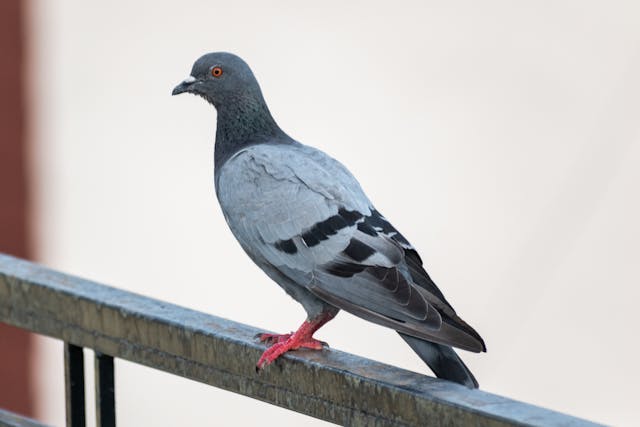
How do homing pigeons know where home is? Homing pigeons know where home is because of their natural GPS system. They also use scents, landmarks, and sounds.
Homing pigeons have been used by people since before we had a regular postal service. The first recorded homing pigeon was used in 1350 BC, over 3,000 years ago, in Ancient Egypt. The fact that this was the first recorded usage implies that they were in use for a long time before that. Until the invention of the telegraph in the 19th century, homing pigeons were pretty much the only way of passing information over long distances relatively quickly. Runners could take messages, but they could only go as far and as fast as a human can run. Riders can take messages on horseback, but, again, their speed and distance are limited by the horse and the rider. Some countries had a system of way stations where a rider could change horses to get a message to their destination as quickly as possible. People could send messages by ship, but again, they are limited to the speed of the ship. The fastest way was by pigeon. A pigeon can fly at up to 160 km/h, but they tend to stay just below 100. And birds in homing pigeon races have flown as far a 1,800 km. So, if you are in a battle and you need to get a fast message back to base, the homing pigeon is the way to go. But how do the pigeons do it? And can other birds be used?
To use a homing pigeon, you first need to train it. You need to train them so that they learn where their home is, but you also need to train them to carry something. Birds don’t naturally fly with something tied to their leg, and it takes a while to get pigeons used to it. Without training, the extra weight throws off their balance. With training, pigeons can carry up to 75 g. The pigeon to be used is carried to wherever it will be needed, and then released. For example, during World War 1, pigeons were sometimes more reliable than the telephone system, so they were carried to the front lines, a message was strapped to their legs, and they were released. Often, they would release a number of pigeons with the same name because some of them would be shot down. Once released, the pigeons fly to wherever their home is.
Nobody knows definitively how pigeons can find their homes, so here are some of the most popular theories. The first is that they can navigate using the Earth’s magnetic field. They are not the only birds that are said to be able to do this. They can sense the magnetic field, or possibly even see it. They have proteins in their eyes called cryptochromes, which react to the strength of the magnetic field. They also have iron in the upper part of their beak, which could have something to do with it. However, no one knows exactly how they can sense it, but it does seem that they can use the strength of the magnetic field to orient themselves.
They also have an exceptionally good sense of smell, and they may very well use olfactory signals to direct them home. This is called olfactory navigation, and so long as they know what home smells like, they can find it. They may also use auditory signals as well. They can hear very low sound waves, and they might use this ultra-low-frequency sound to navigate. Experiments have shown that playing another low sound near the pigeon can disrupt their sense of direction. And, lastly, they seem to use roads and other landmarks as well. The final answer, when we discover it, may be all of these things, it may be some of these things, or it may be none of these things. Different species of pigeons also use different methods.
We always use pigeons to deliver messages, but many other birds are also very good at finding their way. After all, many birds undertake very long migrations every year and go to the same place. The advantage with pigeons is that they are very easy to train, calm, not too big, and have been bred for centuries to be the perfect carrier pigeon. Interestingly, crows may be even better than pigeons, but they are too smart and can pull the message off or just go rogue because it amuses them. And this is what I learned today.
Sources
https://theconversation.com/explainer-how-do-homing-pigeons-navigate-25633
https://en.wikipedia.org/wiki/Homing_pigeon
Photo by Rajesh S Balouria: https://www.pexels.com/photo/close-up-of-a-pigeon-sitting-on-a-railing-17547058/