
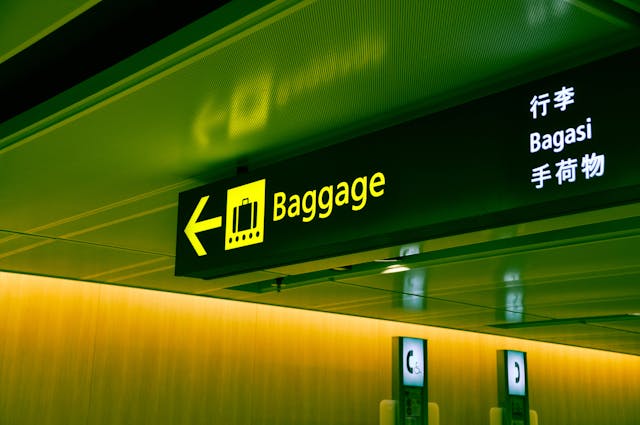
How do airports sort bags? At its simplest, airports sort bags by scanning a ten-digit barcode on each bag and automatically controlling which conveyor belt the bag travels on to get to the plane it needs to be loaded on.
If you have ever had a piece of luggage go missing, you may have gone home cursing the airline and the airport. But, if you knew how many bags airports deal with every day, you might be more inclined to wonder how more bags don’t go missing. For example, the world’s busiest airport is Hartsfield-Jackson International Airport in Atlanta and they process 100,000 bags a day, rising at peak times of the year. That is close to 35 million pieces of luggage. Roughly 3.5 billion pieces of luggage are shipped by 700 commercial airlines and any number of other airlines. Out of all of those billions of bags, only about 24 million are misplaced a year. 24 million bags sounds like a huge number, but it is only 0.7% of the number of bags travelling around the world every year. That is a pretty impressive figure. How do they do it?
The first part of the bag’s journey is check-in. A tag with a unique ten-digit barcode is attached to the bag. The tag is known as an automated baggage tag (ABT), or, more commonly, a license plate, and it is what the baggage system will use to keep track of your bag. The tag is clearly printed on strong plastic backed paper, so it will survive the rigors of the journey. The first digit of the tag is for the type of bag (0= normal, 1= fallback, 2= rushed etc), the next three digits are the airline code (125 is British Airways), and the last six digits are a unique code for your bag. The bag’s license plate is entered into the computer, and the airport’s baggage system can now keep its eyes on the bag. If your bag is going through several international connections before its destination, the license plate is passed along to those airport systems as well.
In order for the baggage system to get the bag to the right plane, it needs a lot of information, and all of that is stored in the airport’s database. It knows what plane the bag needs to be on. It knows what time the plane needs to be loaded by. It knows which gate that plane is at. The only difficult part for the baggage system is to make sure that the bag gets to where it needs to be in time. To do this, they have tens of kilometers of conveyor belts that coil around the center of the airport and then branch out to each hub. The suitcase starts its journey, and the tag on it is read by a succession of cameras. Each conveyor belt is connected to others at several junctions. As the cameras read the license plate, the computer system transfers the bag onto a series of different conveyor belts until it is on the one that reaches the luggage hub for the section of gates that the plane is on. Once there, it is checked by people with barcode readers and loaded onto a cart destined for each of the planes in that sector. Some modern baggage carts are actually driverless, and they head out to the plane once they are loaded.
Once a plane arrives at its destination, the opposite happens. The baggage is taken off the airplane, either in the container or individually, and transported into the airport. The tags of the bags are scanned into the airport’s system so it knows what plane the bag has come off of and which carousel it needs to get to. Then the system makes sure all of the bags get to the right carousel.
So, how do bags get lost? It doesn’t happen very often, but when bags get lost, there is usually a simple explanation. A very common problem is that the tags become damaged. A damaged tag can’t be read properly, and the system is supposed to transfer the bag to a human, but it can sometimes ship the bag somewhere else. The number could also have been input into the computer incorrectly. Then the system thinks the bag is going somewhere else. A lot of the problems come at transfer destinations. If one plane is late, bags can be stuck in an airport because they cannot make the connection, even if the human can. Human error can happen as well. The baggage handler might put the bag on the wrong container, so it gets loaded on a different plane. There are numerous things that can go wrong, but they are all natural errors and nothing sinister. As much as we might think it, the airports are not out to get us. And, they do manage to find the majority of lost bags, which in itself is amazing. And this is what I learned today.
Sources
https://en.wikipedia.org/wiki/Baggage_handling_system
https://science.howstuffworks.com/transport/flight/modern/baggage-handling1.htm
https://simpleflying.com/checked-baggage-journey-analysis
https://news.delta.com/nbc-today-show-how-technology-helps-delta-care-customers-bags
https://en.wikipedia.org/wiki/Bag_tag
Photo by Esther: https://www.pexels.com/photo/close-up-photo-of-baggage-sign-746500/