
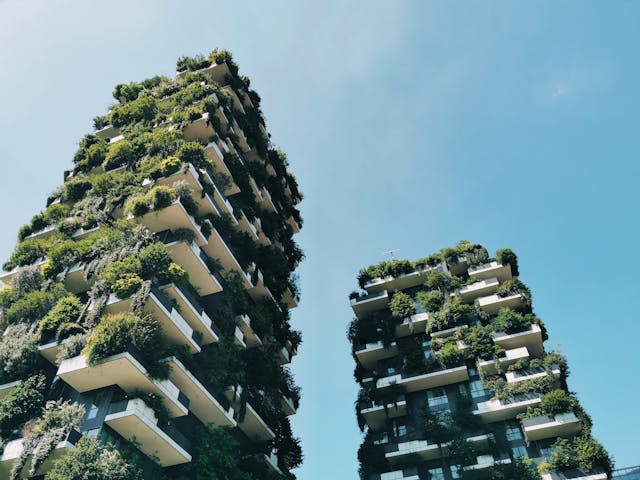
How do green roofs help? Green roofs help by cooling cities and by insulating houses. They absorb heat, absorb rainwater, cool the air around the building, and act as insulation as well.
I suppose the first thing to look at is the fact that the plural of roof is roofs, not rooves. Apparently, rooves is a word, but it is archaic, and the modern plural of roof is roofs. Many other words that end with a vowel and an f, such as hoof becoming hooves, will probably transition to the simple plural of adding an s at some point. This style of making the plural of a word that ends in a vowel and an f with a ves came from the Middle Ages, and v wasn’t a separate letter, just a way of pronouncing f. At the time, it was very difficult to pronounce f and s, so it naturally became ves, which became a rule. Some words end in fs, and some words end in ves, depending on when they came into the English language. Let’s get back to today’s question.
As climate change worsens, people are looking for better ways to construct houses and to reduce the heat that is released back into the air by cities. Because they are mostly black and dark colors, cities absorb a lot of heat, which they then slowly release back into the atmosphere, increasing the overall temperature. This is called a heat island. Green roofs help immeasurably to lower the temperature of the building they are on and the air around them. The surface temperature of a green roof has been measured at 11 ℃ lower than the surrounding roofs or ground on average, but that difference can sometimes be as high as 30 ℃. Black roofs and asphalt can become incredibly hot in the sunlight. Green roofs can also lower the temperature of the air around the building by an average of 5 ℃, but it can even be as high as 11 ℃.
This happens for several reasons. Firstly, plants and trees have large leaves, which cast a lot of shadow. Anything that reduces the amount of sunlight hitting the ground is going to lower the temperature of the ground. Secondly, plants absorb the blue and red wavelengths of the visible light spectrum and reflect the green, which is why most plants look green, preventing the ground from absorbing the light energy. Thirdly, because the plants are absorbing or reflecting the sunlight, it stops heat traps forming. These are the dark roofs that absorb the heat from the sunlight and then re-emit it at night, keeping the overall temperature high.
The last thing that plants do is something called transpiration, which is a form of heat exchange, and this cools down the air. Trees and plants take up water through their roots, and the water travels all the way up through their capillary system, pulling nutrients with it. When the water reaches the leaves, it is released through pores and evaporates. This works in exactly the same way as our sweat. The water turns to water vapor, and that takes a lot of heat energy, which removes heat that would have otherwise warmed up the air.
The plants and trees that go on a green roof obviously have to be planted in layers of soil. This soil acts as insulation, which keeps houses warmer in winter and cooler in summer. The plants and trees also stop heat from coming in and trap a layer of heat from going out in the colder months. Because of all the aforementioned benefits of a green roof, there is less need for air conditioning in the summer.
All of these benefits are to do with heat, but, of course, there are many other benefits as well. Thick foliage on the roof can cut down noise pollution. Plants clean the air, which can make it easier for people to breathe. Plants are extremely relaxing, and being close to nature has been proven to reduce stress and improve people’s mental health. Plants and trees can also be a habitat for wildlife. They also break up the outline of a city and make it look far more appealing. Installing a green roof can have some upfront costs, but these are more than recovered in the savings from heat loss and not having to use the air conditioning so much in the summer. The value of the improvements in mental health is also immeasurable. And this is what I learned today.
Sources
https://www.epa.gov/heatislands/using-green-roofs-reduce-heat-islands
https://www.renewableenergyhub.co.uk/main/green-roof-information/how-do-green-roofs-work
Photo by Sophie Otto: https://www.pexels.com/photo/vertical-forest-residential-skyscrapers-in-milan-italy-19579742/