
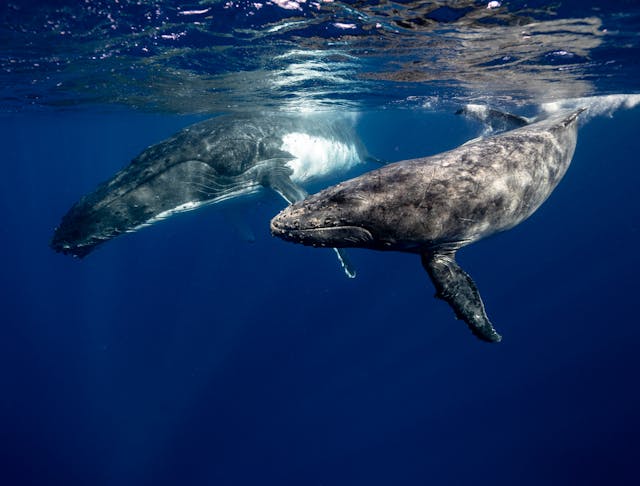
What is a whale fall? A whale fall is when a whale dies and falls to the bottom of the ocean, providing a sudden food source. A whale fall has different stages that can last for several years.
A dead whale can provide an enormous amount of food for other sea life. It is difficult to imagine how big some whales actually are. A blue whale, admittedly the largest species of whale, can grow up to 30 meters long and weigh over 200 tons. To put that in perspective, a bus you would see driving around your city is about 16 meters long, so a blue whale equals two buses parked end to end. However, a fully loaded transit bus only weighs about 20 tons, so you would need ten of them to equal the weight of a blue whale. They need to eat about 6 tons of food a day, and their heart alone is the size of a car. The only reason they can grow so big is that they live in the water, which reduces the pull of gravity on them. The density of their bodies is about the same as the density of the water around them, so they are naturally buoyant. The force of the water pushing them up equals the force of gravity pushing them down. That means they don’t need strong bones to support their weight, and they can grow much bigger than they could if they were land animals. Now, imagine what happens when a 200 ton blue whale dies.
The first thing that happens when a whale dies is not that it sinks. Whales are naturally buoyant, which means they float on the surface even after they have died. However, they use the air in their lungs to control their buoyancy, and after they have died, that air will slowly leak out of them. As air is replaced by denser water, the density balance of their bodies changes, they become denser than the water around them, and they sink to the bottom of the ocean. They can float on the surface for quite a while because of the air left inside them and gases produced as they decompose. While they float there, they are partially eaten by sharks, birds, and, if they are within reach, even land-based animals like polar bears. Eventually, the gases and air will leave the whale, and it will sink. Depending on the depth of the ocean, it can take quite a while for the whale to get all the way to the bottom. Once it reaches the bottom, stage one, the whale fall begins.
The first stage is for the scavengers that live in the depths of the ocean. These are fish like hagfish, sleeper sharks, crabs, and octopuses. They attack the soft flesh on the whale carcass, and they can remove about 60 kg a day. That sounds like a lot, but if you remember how big and heavy a whale is, this first stage can last up to one and a half years. Up to about 30% of a blue whale’s body mass can be blubber, which is a huge amount of stored energy and takes a long time to get through.
The second stage involves much smaller creatures. Once the scavengers have taken all of the flesh and the blubber off the bones, creatures that can find the fats that are in the bones, or that have soaked into the surrounding seabe,d arrive. These are creatures like marine worms, snails, and shrimp. This stage can last up to 4 years or more, depending on the size of the whale. A lot of fat and nutrients from the whale’s body will have soaked into the ground, and there is also a lot of fat left in the bones. A type of worm called zombie worms can burrow into the whale’s bones to get at that fat.
The third stage is for bacteria and the creatures that can eat the bacteria. Sulphophilic bacteria arrive and feed on the bones and the fats they still contain. These bacteria can feed on the whale bones, and other creatures can also feed on the bacteria. They are food for mussels, clams, limpets, sea snails, tube worms, and many other creatures. This stage can last up to 100 years.
There is said to be a fourth stage, called a reef stage, but this is disputed. If the whale bones mineralize, they can form a basis for a reef to form, and all of the life that comes with it.
Not many whale falls have been observed because no matter how large a whale is, the ocean is enormous. The few that have been seen show that a whale fall is like winning the nutritional lottery for all of the organisms that live in the vicinity. A whale fall can sustain life in the area for a hundred years. And this is what I learned today.
Sources
https://en.wikipedia.org/wiki/Whale_fall
https://www.oceanculturelife.com/blog/Whale-Falls-Life-After-Death-in-the-Deep-Sea
https://www.montereybayaquarium.org/stories/from-giants-to-gardens
https://oceanservice.noaa.gov/facts/whale-fall.html
https://uk.whales.org/whales-dolphins/facts-about-blue-whales
https://www.fisheries.noaa.gov/species/blue-whale
https://www.amnh.org/content/download/322380/4992437/file/part-1-text-passage-student-version.pdf
Photo by Elianne Dipp: https://www.pexels.com/photo/humpback-whales-underwater-4666753/