
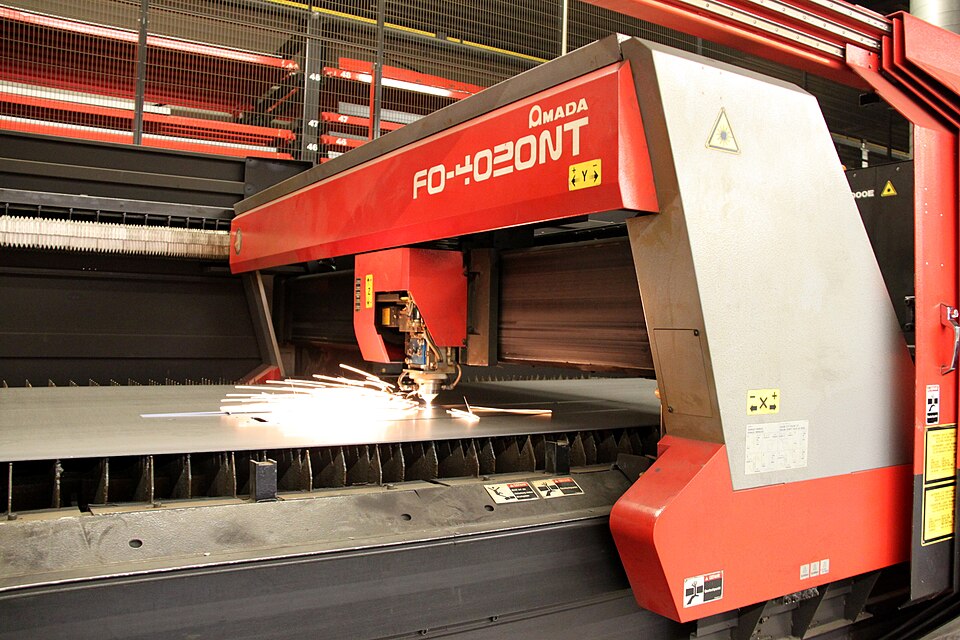

What are fiber lasers? Fiber lasers are lasers in which the light is generated and amplified inside an optical fiber whose core has been doped with tiny amounts of rare-earth ions (such as ytterbium or erbium). The laser beam then comes out of the end of the fiber, which makes the system compact, efficient, and easy to guide.
Fiber lasers have been around since the 1960s, but modern versions became practical once high-quality optical fiber and efficient laser diodes were available. They have a whole range of uses and you will probably have products in your house that have been cut or engraved with a fiber laser. Fiber lasers are very common across a large range of industries. They can be used for cutting, welding, marking, engraving, surgery, telecommunications, and, amongst many other uses, they are even used to melt the metal powder in some metal 3D printers. Without fiber lasers, we wouldn’t be able to have a lot of the things that we own. So, what are they?
A fiber laser is not just a laser that is fired down a fiber optic cable. Let’s start by looking at what a fiber optic cable is and what a laser is. A fiber optic cable is a very thin cable made of strands of glass that can carry data in the form of light waves. Fiber optic cables are usually bundled together in groups, but a single cable is about 9 microns across. A human hair is approximately 100 microns across. The cable has very pure glass and it can guide light along its length using reflection. They can carry light for great distances without much loss.
A laser is a device that can emit a highly concentrated and narrow beam of light. The word laser is actually an acronym that stands for Light Amplification by Stimulated Emission of Radiation. Light is electromagnetic radiation and it is a form of energy. It can impart that energy to anything that it hits. Light coming from our sun hits Earth and heats it up, for example. A laser produces a narrow wavelength band of light and concentrates it into a very narrow beam to focus all of the energy. When the laser hits something, all of that energy is imparted to the object it has hit. Lasers always tend to be the same color because they always use the same wavelength of light.
A laser must always have an energy source. This is where the light is produced. It is called a flashlamp and it converts electricity into light by passing a charge through a gas, which releases a broad spectrum of light. It must have a medium, which selects the required wavelength. And it must have something called an optical resonator, which is a series of mirrors that bounce the light back and forth to give it more energy. Once the energy is high enough, the light is directed out of the end of the laser. To make a more powerful laser, you need more mirrors and a bigger energy source. Lasers are also not very manageable, if you are trying to do delicate work.
A fiber laser doesn’t need to use such a powerful energy source because it is much more efficient. The light is created by something called a pump diode. This is different to the flashlamp pump used by a regular laser. There are two semiconductors that have opposite charges. When an electric charge is passed through, the opposite charges meet and an electron is released. As it is released, the electron releases energy in the form of a light photon. These photons build up and then they are forced into the fiber optic cable. In a flashlamp pump, a lot of the energy is lost as heat. The pump source in a fiber laser is much more efficient. A regular laser amplifies the power of the laser with mirrors, but a fiber laser increases the power of the light by using rare earth elements, such as ytterbium. The rare earth elements in the cable receive an electric current, which excites the electrons around the atoms. These electrons jump to a higher energy orbit. Usually, the electrons want to get rid of that energy as quickly as possible and return to normal, but some rare earth elements have the property that they can hold that energy for longer. When the laser is triggered, photons from the pump source move down the cable. Whenever they pass an excited electron, they trigger it to release its energy, which is does as a light photon of the same wavelength. That means, we go from one photon to two. Each time an electron releases its energy, the number of photons increases, making the laser more powerful. There are mirrors inside the cable as well, which bounce the photons back through the rare earth elements so they can continue to pick up photons. When the photons reach the end of the cable, they exit through the lens and are focused on whatever they are going to be used for.
Fiber lasers are much easier to use than regular lasers because fiber optic cable is flexible and thin. The resultant laser can be very narrow and is very easy to maneuver. And this is what I learned today.
Sources
https://www.arpansa.gov.au/understanding-radiation/what-is-radiation/non-ionising-radiation/laser
https://en.wikipedia.org/wiki/Fiber_laser
https://www.laserax.com/blog/fiber-laser
https://www.ipgphotonics.com/technology/fiber-lasers-101
https://www.omnitron-systems.com/blog/everything-you-need-to-know-about-fiber-optic-cables
Image By Metaveld BV – Own work by uploader, also used for http://www.metaveld.com, CC BY-SA 3.0, https://commons.wikimedia.org/w/index.php?curid=9444193