
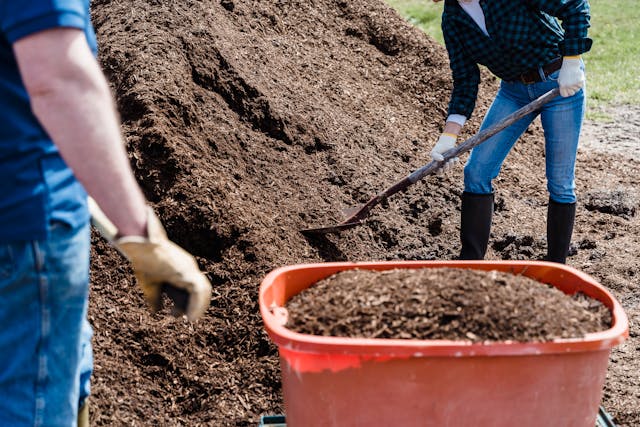
What is compost? Compost is a mix of materials that can fertilize plants and improve the condition of soil. It is also an excellent form of waste management.
It is difficult to get accurate figures on how much food is wasted every year because there is no true way of measuring it. I live in Japan, and it is estimated that in 2023, 4.64 million tons of food was wasted. With a population of roughly 120 million people, that makes 39 kg of food waste per person in that year. I know it doesn’t work out exactly like that because a lot of it will be restaurants, supermarkets, and businesses, but it does show how much food is wasted. As the global population climbs, the problem of food waste is not just environmental. There is technically more than enough food on Earth to go around, but it is not produced in equal quantities in equal places, and there is no sensible way to distribute it at the moment. Malthus said that the population would rapidly surpass our ability to produce food and we would all die, but that never happened. We have constantly found new ways to produce more food. And with the global population predicted to peak at 10.5 billion and then decline, we will probably never reach the point where we can’t feed ourselves, but that does not apply to everyone on Earth.
So, the first problem with food waste is that the people who can afford to waste it don’t think about the people who don’t have food to waste. The second problem is that the majority of this waste is not separated and is buried in landfills. This doesn’t sound so bad because you would assume that organic waste buried in the ground would rapidly decompose, but this doesn’t happen. For organic waste to decompose, the bacteria that feed on it need oxygen and water. In a landfill, organic waste is often wrapped in plastic bags and buried under other waste. That means when bacteria get to it, they don’t have the oxygen that they need. When organic materials decompose in an oxygen poor environment, the bacteria have to digest them anaerobically, which means they produce methane gas. This can cause fires and explosions, but, more than that, it is one of the worst greenhouse gases. Landfills are the third largest source of human-caused methane. Even if there is some way to get oxygen into the landfills, the bacteria will break down the organic matter, but it is all concentrated in one area, and there is no way for the freed nutrients and chemicals to benefit plants or soil. This is where compost comes in.
Recently, a lot of countries have introduced separate recycling systems for organic waste. This is then collected and sent for composting. Many people also compost material in their own houses and spread it on their own gardens. So, what exactly is compost?
When given the right amount of water and oxygen, bacteria will feed on the plant and food waste we leave. They can use the carbon and nitrogen in the waste to make their own cells and function. As they live and die, they release nitrogen, phosphorus, magnesium, and other nutrients. These are all nutrients that plants need to produce their cells and grow. To help them, the food waste has to be chopped up into fairly small pieces. They can break down larger pieces, but they can work faster on smaller pieces. When they break down the carbon, they produce some heat, which helps them digest the waste even faster. Bacteria are not the only organisms that work to break down the organic matter. Worms, beetles, insects, snails, and other organisms can also feed on it. They take out the materials they need for energy, and they excrete nutrients that plants need. That is why having earthworms in your soil is always a good thing. It takes months to break down the food, and composting is a continuous process.
Once the organic waste has been broken down, it can be spread on soil in gardens or farms and it makes the soil much more fertile for plants to grow. By using compost, we not only cut down on food waste, we can also cut down on the amount of chemical fertilizers that we need. As more people become conscious of our impact on the environment, more people are starting to compost. The problem is, though, that it requires money to have the land, the time, and the ability to compost. Obviously, composting is vital, but we also need to work out how to distribute food equally around the planet and how to cut down on food waste. And this is what I learned today.
Sources
https://www.epa.gov/sustainable-management-food/composting
https://en.wikipedia.org/wiki/Compost
https://www.env.go.jp/en/press/press_00002.html
Photo by Greta Hoffman : https://www.pexels.com/photo/a-person-holding-a-shovel-while-shoveling-the-soil-7728706/