
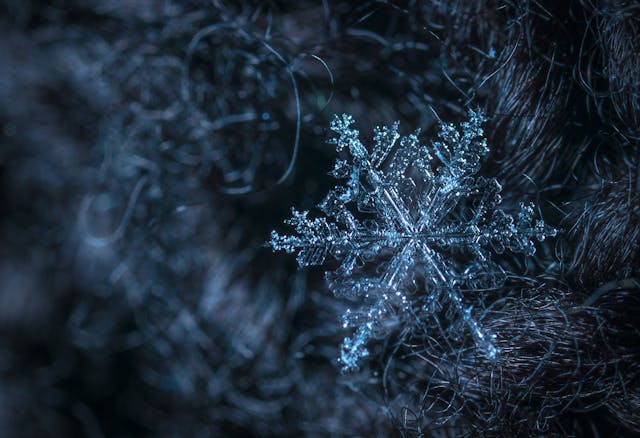
Are all snowflakes really different? Theoretically, yes, all snowflakes are different, but it is an issue of probability, and there is obviously no way to know for sure.
Snowflakes form when the air is cold enough for water droplets to freeze. It is very difficult for them to freeze on their own; it is much easier if they freeze around particles or dust in the air. This is called nucleation, and without a particle to freeze around, snow will not usually form. Water will stay as a liquid, albeit a supercooled liquid, down to temperatures way below freezing. This is because it takes energy to make the initial jump between water and ice. The reason for this is that a crystal of ice has a lot more surface area than water. As we know, when we looked at why soapy water forms bubbles and water surface tension, it takes energy to make a larger surface area. Water molecules, even when they are ice, are strongly attracted to each other. The hydrogen half of each molecule is attracted to the oxygen half of each molecule, and they all neatly connect. The water molecules on the surface don’t have anything to attach to, and this takes energy. With water at the top of the cup, there is no water above it to connect to, only air, so the water molecules there have no choice. When an ice crystal forms in the middle of supercooled water, there are water molecules all around it, and it is far more energy efficient for the ice molecule to turn back into water and give up its larger surface area. It is only once many molecules freeze at the same time, and the volume to surface area ratio goes down, that it makes energy sense. Once this happens, the water freezes rapidly. You can see this if you put distilled water into a very cold freezer. It stays as a liquid even far below zero, but will freeze instantly the second you pour it out of the cup. When you have dust particles in the air, it gives something for the ice to form on because the ice crystal doesn’t need to have such a large surface area surrounded by water. And once one crystal has formed, others will quickly follow. You can also see this in your freezer. Distilled water in a very clean glass jar won’t freeze. Regular water in an ice tray will. This is because there are particles in the regular water, and possibly dust or leftover ice in the ice tray for the ice to start to form around.
Once one ice particle has formed, others will follow, and this is why, statistically, every snowflake is unique. Every snowflake has to begin with a particle, but before we even begin to make our snowflake, no two particles are exactly the same, so we are already into uniqueness. Snow can form around dust, pollen, volcanic ash, sea salt, organic particles, or any number of airborne particles. The size and the shape of that particle will then influence the size of the inner layer of ice that forms around it. The only similarity in all snowflakes is that the inner layer is hexagonal. A hexagonal shape allows the oxygen and hydrogen molecules to attach to each other in the most stable, lowest energy configuration. This is called six-fold symmetry.
As the ice forms, the snowflake gets heavier because ice is denser than air, and starts to descend through the air. It picks up more water on the way down, and that water freezes to the central hexagon. The amount of water vapor in the atmosphere can affect the shape of the snowflake. High humidity causes snowflakes to branch out, which is the shape we generally imagine snowflakes to be. The final snowflake will also be bigger and thicker because there is more water. Low humidity leads to flat, plate-shaped snowflakes. The amount of humidity in the air is not constant all the way from the cloud to the ground, and each snowflake will pass through areas of high and low humidity. The temperature is not constant as well, and temperature changes will alter the size and shape of the ice crystals that form. Wind will blow the snowflakes back up, and they may pass through the same area more than once or travel diagonally, all of which will constantly change the way ice forms on it and its final shape.
From this point out, we start to get into the realm of big numbers. You might think that even with the humidity, wind, temperature, and particle size, snowflakes might end up the same. It is estimated that there are a quintillion water molecules in a snowflake. That is a 1 with 18 zeroes. 1,000,000,000,000,000,000. The chance of two snowflakes being identical is 1:1,000,000,000,000,000,000. Obviously, they could be, but the chances are extremely slim. My chances of winning the lottery this week (with 6 balls out of 49 numbers) are 1:13,983,816. My chances of winning it two weeks in a row would be 1:195,547,109,921,856. And three weeks in a row would be 1:2,734,949,804,479,008,682,496. I would need to win the lottery three times in a row to beat the odds that two snowflakes are identical. So far, I am still waiting to win the lottery once. And that is what I learned today.
https://www.noaa.gov/stories/how-do-snowflakes-form-science-behind-snow
https://www.bbc.co.uk/bitesize/articles/zmqmrj6
https://en.wikipedia.org/wiki/Snowflake
https://news.artnet.com/art-world/nathan-myhrvold-highest-resolution-snowflake-photographs-1939833
Photo by Egor Kamelev: https://www.pexels.com/photo/macro-photography-of-snowflake-813871/