
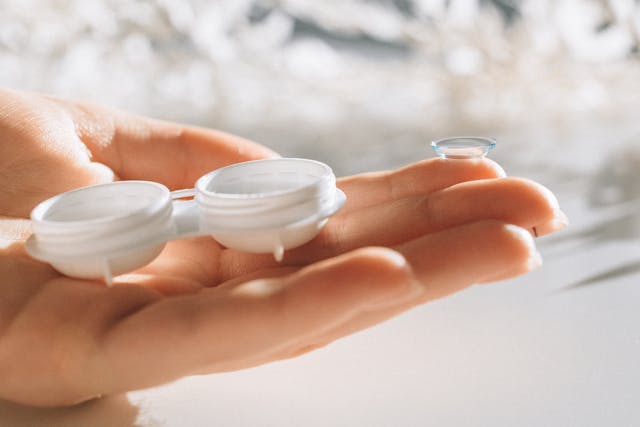
How can you focus on smart contact lenses? Smart contact lenses have sensors that can track your eye movements and the dilation of the pupil. They can automatically adjust their focus until you are able to see them. And they project the image directly onto your retina.
If you are like me, your eyes are slowly deteriorating as you get older. Without reading glasses, I am unable to focus on the screen of my phone or the text on the page of a book. Farsightedness (presbyopia) occurs when the lens in your eye starts to harden. The lens is flexible when you are young, and muscles shape it to focus light on the retina at the back of your eye. As you get older, it hardens, and it isn’t able to move enough to focus light from close-up objects perfectly, so you have hold them further away until they focus. Reading glasses do the job of the hardened lens and focus the light for you. So, how would you be able to focus on smart contact lenses if the images are displayed on your eye?
Smart contact lenses are not as common as smart glasses, but they are becoming more available. Because of their size and the fact that they go directly on the eyeball, a lot more research needs to go into smart contact lenses than smart glasses. Right now, there are many prototypes that are being tested by the main tech giants, and they are working hard to make them available on the market. They fit into your eye just like a regular contact lens, but they contain microprocessor chips and sensors that can do many different things. The contact lens part is made of breathable plastic, just like a regular contact lens. The sensors can measure the temperature of the eye, eye pressure, and even the amount of glucose in the mucus on the eyeball. The microprocessor chips are there to collect, store, and process all of the information from the sensors. There is a power source. This could be a tiny battery, or they could power themselves off the light coming through the eye. All of the parts need to be wired together, and this can be done with graphene tubes, which are only an atom thick but very strong and very conductive. And they have a micro display unit which projects the image that the wearer can see, superimposed over the world around them.
Now, not every smart contact lens needs to have a display unit. A lot of smart contact lenses are under research to be used for biological monitoring. They can track glaucoma, which is an eye condition caused by pressure inside the eye from fluid buildup. This can press on the optic nerve and damage it, causing blindness. They can also track diabetes by measuring the amount of glucose in tears, and they can track the markers for other diseases as well. They can also be used to autofocus. Wearers of contact lenses know that it is very difficult to get bifocal contact lenses, and reading glasses are often necessary. Smart contact lenses could automatically adjust their focus to allow the wearer to look at near things and far things.
If the contact lens does have a display unit, how does it display the image? Current research models have a tiny LED display set in the middle of them. This display is only half a millimeter across, but it contains thousands of LEDs that can display red, green, and blue, allowing it to display images and text right in front of your eye. You could control the contact lens with an external device, or you could control it by using your eyes. The contact lens has motion trackers, and you could move left and right through the screens by moving your eye left or right. Blinking could be the same as clicking.
It seems like an LED screen that close to your eye would be impossible to focus on. The smart contact lens makes the image clear by doing several things. First, it can track eye movements, so the image always stays directly in the center of your eye. Second, the lens could track the dilation of your pupil and the amount your muscles are moving the lens in an attempt to focus. There is a microscopic lens on the contact lens in front of the screen, and by using these signals, the contact lens will know when the image is perfectly focused. And, last, the image from the LED display is projected straight through the pupil to the retina at the back of the eye, then the LED display will adjust the size and style of the image so that it appears to be projected out in front of the person and not very close up. So, even people with bad eyes like me will be able to use smart contact lenses. And this is what I learned today.
Sources
https://builtin.com/articles/ar-contact-lens
https://pmc.ncbi.nlm.nih.gov/articles/PMC10605521
https://www.allaboutvision.com/eyewear/contact-lenses/types/smart-contacts
https://pme.uchicago.edu/sites/default/files/2021-11/SMART%20CONTACT%20LEN_S1.pdf
https://www.mayoclinic.org/diseases-conditions/presbyopia/symptoms-causes/syc-20363328
Photo by Nataliya Vaitkevich: https://www.pexels.com/photo/a-person-holding-a-contact-lens-5843338/