
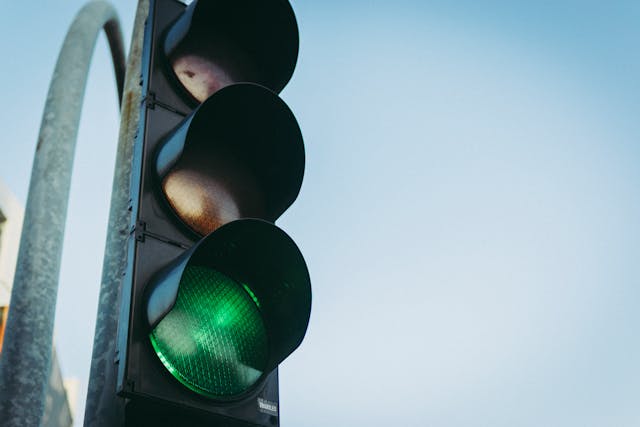
What is a traffic light green wave? A traffic light green wave is a system where traffic lights are coordinated so that lights turn green in sequence to allow cars travelling at a specific speed to pass through without stopping, thereby reducing the overall congestion in the city.
It is difficult to know how many cars there are in the world, and the number of cars owned by families varies by country, but it is safe to assume that as the world population increases, the number of cars increases as well. It is estimated that there are more than 2 billion cars in the world. In developed countries, there are often fewer than 30 cars per 100 people, but this number is increasing as these countries become wealthier. Cars are slowly becoming more efficient, and the number of electric cars on the road is increasing as well, but traffic is an enormous problem. More traffic means more noise pollution and more energy used because a lot of a car’s noise and energy use comes when it accelerates from a stationary position. Even if cars become 100% efficient and there are no emissions from them at all, we still need to deal with the number of cars on the road. Driverless cars could be a solution to that. Driverless cars would be able to drive much closer to each other, and they wouldn’t need roads that are as wide as we need today. It might also be possible to move away from the idea of car ownership and just have a system where you press a button on your phone to get a car. That would go some way to solving the traffic problem.
There tend to be three main causes of traffic congestion, at least in cities. The first cause is an obstacle of some kind. This could be a traffic accident, or roadworks. Anything that narrows the road and causes people to slow down. If cars have to slow down as they approach the obstacle, it will have a knock on effect that will create a traffic jam. This is another issue that driverless cars would solve. As they would all be in contact with each other, moving as parts in a network, the system would be able to redirect cars behind the obstacle to reduce the backlog of traffic. The second cause is sheer volume of traffic. This can be seen during rush hours. If more cars are trying to move in the same system, it will create traffic jams. It’s like trying to pour water into a system of pipes. Once the pipes are full, you cannot pour in more water. The third cause is called phantom traffic jams. If one car slows down for no reason, the cars behind have to slow down, and this concertinas until the cars further back have to stop, and a jam forms. This was actually tested on a circular track in Sugiyama, Japan, in 2007. 22 cars were driven around a 230-meter circular track and told to keep 30 km/h and a safe driving distance. Small variations in speed emerged as drivers reacted to the car in front, and within a short time, the cars started to bunch up, and a traffic jam formed. The fourth cause, at least in cities, is traffic lights. Where roads intersect, the traffic has to be controlled with lights, and these obviously cause traffic jams.
With regular cars, there is not much to be done about the first three causes, but the traffic light issue is improving. These days, a lot of cities use smart traffic light systems. They use sensors, radar, and traffic cameras to get as much information about the traffic flow as possible. Then, AI systems analyze the data and have the discretion to dynamically adjust the traffic lights to optimize the traffic flow as much as possible. Studies showed that in the city of Pittsburgh, smart traffic control systems cut the amount of vehicle waiting time by 40%. One thing that these systems can make use of is a green wave. If traffic lights are set on a simple, let’s say 30-second, timer, then a car driving along a road with a lot of traffic lights will come up against a red light every half minute or so. A green wave can change this. The AI system can change all of the lights along a road so that they become green as a car travelling at the speed limit approaches them. That means the car never has to stop. The system can look at the system as a whole and initiate green waves in other sections so that they intersect with each other. The cars would have to stop occasionally, but far less than if the lights were on a timer. The cars would travel around the city in pulses, called platoons. This is just one thing that a smart traffic light system could do. Green waves have existed for a while, but they are far more effective now that an AI system can analyze the data. The AI can analyze where traffic is building up and change lights to reduce the traffic, while looking at the entire city as a whole. The AI can predict ahead and change lights to fix problems before they appear. It can be proactive and not just reactive. And this is what I learned today.
Sources
https://climateinsight.ca/solution/green-wave-traffic-signals
https://en.wikipedia.org/wiki/Green_wave
https://en.wikipedia.org/wiki/Car_ownership
https://drive.google.com/drive/u/1/folders/10njzNgRMdxyfumENprZRxIryEVt4HPLo
https://www.carpro.com/blog/ever-wonder-what-causes-traffic-jams
https://www.newscientist.com/article/dn13402-shockwave-traffic-jam-recreated-for-first-time
Photo by Davis Sánchez: https://www.pexels.com/photo/black-traffic-light-1727004/