
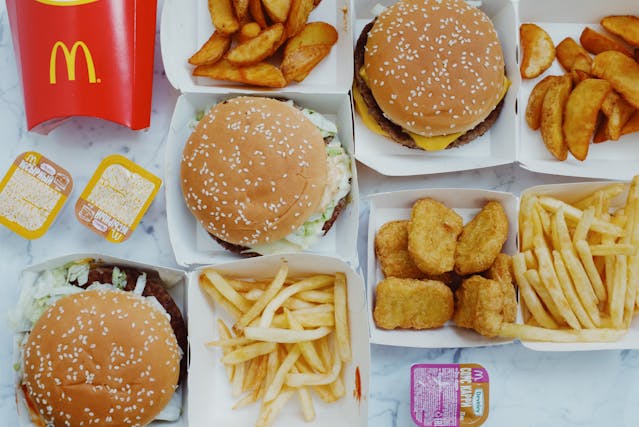
What is the Big Mac Index? The Big Mac Index is an informal way of working out purchasing power parity between different countries. The Big Mac Index was started as a half-serious joke in an article that appeared in The Economist in 1986. The author, Pam Woodall, was trying to find a way to look at purchasing power parity.
Purchasing power is how much of anything a person’s money in one country will buy. This changes over time due to inflation and deflation. For example, a basket of groceries might cost $100 today. Thanks to inflation, that basket of groceries might have only cost $80 three years ago. That means the $100 still has the same value in dollars, but it will only buy 80% as much as it did three years ago. If we then have deflation and the price of that basket of groceries falls to $70, we can now buy 42% more with our money than when it cost $100. This is purchasing power. The value of that $100 changes over time because most central banks aim for yearly inflation of about 2%. The cost and the variety of the items in that basket of goods also change over time. That is why $100 in 1800 in the US feels like it is worth a lot more than $100 today. However, in most societies, wages also increase, so, as a percentage of a person’s yearly wage, the value of the groceries doesn’t change by a huge amount. Problems arise when wages don’t rise as fast as prices, and then we get a cost-of-living crisis.
The same applies in every country and if you compare the purchasing power between countries, you can work out an effective exchange rate between their currencies. This is called purchasing power parity. If that basket of groceries costs $100 in the US and 5,000 yen in Japan, you can say that $100=5,000 yen, or $1=50 yen. If the actual yen to dollar exchange rate is much higher or lower than this (it is three times higher(2025 December)), you can say that the yen is overvalued or undervalued. Now, that doesn’t work for a whole host of reasons, not least the fact that people don’t buy the same groceries at the same store at the same time every week. There are so many factors that affect the cost of groceries in countries that it is an extremely difficult system to use. Pam Woodall was talking about this when she came up with the Big Mac Index.
The easiest way to work out the Purchasing Power Parity is to look at something that has the same ingredients and is sold in the same way across multiple countries. The Big Mac seemed an obvious choice. In 1986, McDonald’s had over 9,000 restaurants worldwide, and they were in the newspapers at the time Pam Woodall was writing for having opened nearly 600 restaurants in 1985. According to the chairman, the goal was to open 600 restaurants a year, every year, and for 400 of them to be overseas. It seemed like pretty soon every country would have a McDonald’s and be able to order a Big Mac. Looking at the price of a Big Mac in multiple countries would give an excellent way to work out Purchasing Power Parity.
A Big Mac contains two 45 g beef patties, sauce (made from mayonnaise, sweet pickle relish, yellow mustard, and seasonings), shredded lettuce, one slice of processed cheese, two slices of pickle, minced onions, and three slices of a sesame seed bun. There are some small variations by country, but generally, if you buy a Big Mac in Beijing, you are getting the same quantities of the same ingredients that you would get if you bought a Big Mac in Lima. That means the cost of a Big Mac can be used to judge the purchasing power of a currency. There are various places that list the yearly Big Mac Index. Currently, and for quite a few years in a row, Switzerland is top. A Big Mac in Switzerland will cost you 7.2 francs, which is $7.99. A Big Mac in the US is $5.79 (6th place). Japan (where I live) is $3.11 (42nd place). And bottom of the list is Taiwan, with a Big Mac costing $2.38. So, if we use that to work out exchange rates, a Big Mac value of $5.79 in the US and $3.11 in Japan would give an exchange rate of $1 to 82.9 yen. The actual exchange rate is $1 to 156 yen. This suggests the yen is undervalued by about 47%.
The Big Mac Index is not meant to be a true exchange rate system and was only ever meant humorously. It is a good way of quickly judging costs between two countries, but it trips up on a few things. Firstly, there are still a lot of countries, especially in Africa, that don’t have McDonald’s restaurants (yet). McDonald’s also doesn’t base their price solely on the ingredients in the burger. They set their prices strategically, based on many factors. Wages are also different across countries. One recent trend has been working out how long it takes a person in a country to earn enough money to buy that Big Mac. That is probably more useful. There are other problems as well, but, as a fun way of comparing countries, it is interesting. It is probably more an interesting look at globalization and the march of McDonald’s than anything else, though. And this is what I learned today.
Sources
https://worldpopulationreview.com/country-rankings/big-mac-index-by-country
https://en.wikipedia.org/wiki/Big_Mac_Index
https://en.wikipedia.org/wiki/Purchasing_power_parity
https://www.economist.com/finance-and-economics/1998/04/09/big-maccurrencies
https://www.investopedia.com/ask/answers/09/big-mac-index.asp
https://en.wikipedia.org/wiki/Big_Mac
https://en.wikipedia.org/wiki/List_of_countries_with_McDonald%27s_restaurants
https://www.nytimes.com/1986/06/08/business/the-rise-and-rise-of-big-mac.html
https://www.snopes.com/fact-check/mcdonalds-100-beef
Photo by ready made: https://www.pexels.com/photo/tasty-junk-food-placed-on-table-4021944/