
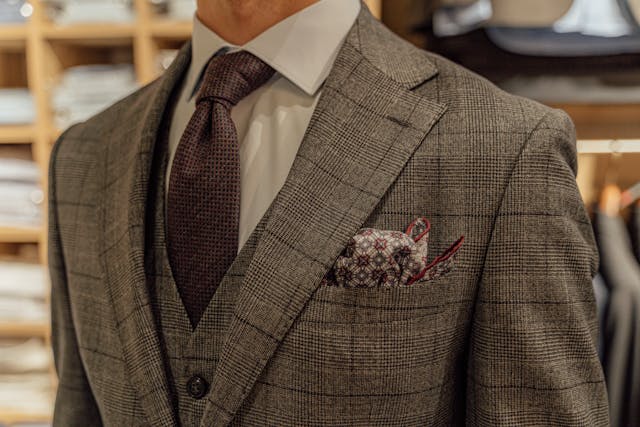
Why is Savile Row in central London famous for tailors? It became the centre for high-quality, custom-made men’s suits in the 19th century, as famous tailoring houses established themselves there and drew others in. Henry Poole & Co began in 1806, but it did not move onto Savile Row itself until 1846, which is when the street started to become closely associated with high-end tailoring.
Savile Row is located in an affluent area in London known as Mayfair. It wasn’t called Mayfair at the time, but the name comes from the May Fair that was held there each spring. That fair ran from 1686 to 1764, and it was abolished after local residents complained that it had become increasingly rowdy and downmarket. Once it was gone, the neighbourhood became more exclusive, which drew in more wealthy residents. Today, Mayfair is dominated by large landowning estates. One of the biggest is the Grosvenor Estate (controlled by Hugh Grosvenor, the 7th Duke of Westminster), but Mayfair is a patchwork, and different streets sit on different historic estates and freeholds.
Savile Row itself was originally called Savile Street. It was built between 1731 and 1735 as part of the Burlington Estate development around Burlington House. The street was named after Lady Dorothy Savile, the wife of Richard Boyle, the 3rd Earl of Burlington.
Today, Savile Row is famous for bespoke tailors. “Bespoke” has come to mean tailor-made suits, but the word originally came from the idea of cloth being “bespoken” or “spoken for” by a particular customer. When we ask why Savile Row is famous for tailors, we need to look at the people who lived in this area. Savile Row was initially occupied by military officers and their families, and Mayfair more broadly attracted aristocrats, politicians, and senior figures who needed uniforms, formal dress, and well-made civilian clothes. Bespoke suits also require repeated visits for measuring and fittings, so having tailors within walking distance of clients’ homes, clubs, and offices made the whole process far more convenient.
By the early 1800s, there were several tailors around the area, but many were not on Savile Row itself. A lot of early tailoring businesses were on nearby streets such as Cork Street. They became famous in a roundabout way. They were there because that was where the wealthy were located, and the wealthy came to them because that was where the best tailors were located. They moved with fashion and were always trying to outdo each other to attract more customers. A famous customer who brought a lot of attention to this newer, cleaner style was Beau Brummell, a friend of the Prince Regent (later King George IV) and one of the first dandies. He is said to have spent hours a day dressing and is often credited with popularising the modern approach to trousers and understated menswear. He spent extravagant sums on clothing and could probably be called the “father” of bespoke tailoring. He emphasised simple, perfectly fitted clothes over the flamboyant fashions that had been the mainstay of the wealthy before then. The French Revolution also made flamboyant aristocratic dress feel risky and outdated, so sober colours and perfect fit became a way to signal status without shouting. In that sense, the new tailoring was both fashion and social strategy.
The first tailor most commonly linked to Savile Row itself is Henry Poole & Co. The business began in 1806 and built its reputation by making tunics and military uniforms for wealthy clientele, as well as high-end civilian clothing. In 1846, Henry Poole opened an entrance onto Savile Row from the firm’s premises in Old Burlington Street, which helped pull top-tier tailoring into the street. Henry Poole is often credited with creating or popularising the dinner jacket (sometimes linked to a commission for the Prince of Wales). The company later became known for royal warrants and elite customers across Europe. Other tailors relocated to be nearby, and over time, “Savile Row” became shorthand for the very best bespoke tailoring.
Henry Poole & Co. are sometimes called the “fathers of Savile Row,” but there was a tailoring connection in the wider area long before Savile Row existed. In the early 17th century, a tailor called Robert Baker became famous for selling a type of stiff lace collar called a piccadill (or piccadilly). If you think of portraits of wealthy people from that era, they are often wearing a large, white, frilled lace ruff around their neck. Baker was so successful that he built a large house known as Piccadilly Hall, and the name “Piccadilly” later became attached to the street itself (and eventually to places like Piccadilly Circus). He wasn’t on Savile Row because it hadn’t been built yet, but he shows that expensive fashion and high-status tailoring were already linked to this part of London centuries earlier. And this is what I learned today.
Sources
https://en.wikipedia.org/wiki/Savile_Row_tailoring
https://en.wikipedia.org/wiki/Henry_Poole_%26_Co
https://en.wikipedia.org/wiki/Beau_Brummell
https://www.londonmuseum.org.uk/collections/london-stories/savile-row-the-heart-of-london-tailoring
https://en.wikipedia.org/wiki/Savile_Row
https://web.archive.org/web/20150116021500/https://henrypoole.com/history/the-story/the-past/
https://en.wikipedia.org/wiki/Mayfair
https://en.wikipedia.org/wiki/Burlington_Estate
https://en.wikipedia.org/wiki/Richard_Boyle,_3rd_Earl_of_Burlington
https://exploring-london.com/tag/robert-baker
https://en.wikipedia.org/wiki/Piccadilly
https://izi.travel/ru/21a1-piccadilly-circus/en?nocache=1739074643
https://en.wikipedia.org/wiki/Piccadill
Photo by Antoni Shkraba Studio: https://www.pexels.com/photo/man-in-gray-and-black-plaid-suit-jacket-5264948/