
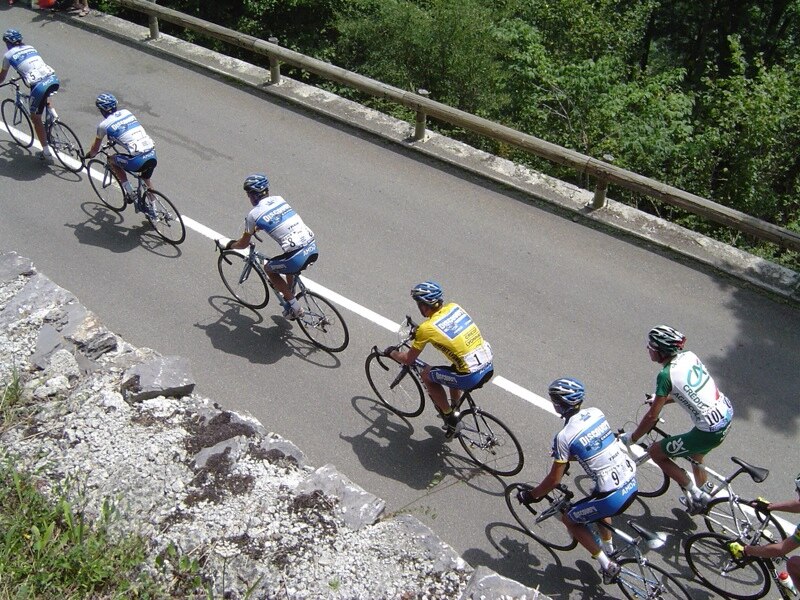
How does slipstreaming work? Slipstreaming works because one vehicle drives closely behind another so that it can ride in the low-pressure wake that follows the first vehicle, reducing the air resistance and reducing the amount of power needed.
Unless you are moving in a vacuum, you are going to come up against air resistance. We don’t feel it at the speeds we can run, but the faster you travel, the more air resistance there is. Air resistance is caused by molecules in the air. These molecules are mostly nitrogen and oxygen, with other gases and water vapor. They are tiny, but they do have mass. When we move, we have to move these molecules out of our way so we can get by. The density of water is about 1,000 kg per cubic meter, and the density of air is about 1.2 kg per cubic meter. Compared to water, there are not as many molecules in a cubic meter of air, but there are still far more molecules than in a vacuum. To move each molecule out of the way as we move through the air takes a minuscule amount of energy because we have to transfer a tiny amount of our momentum to the molecules.
Each molecule in the air only takes a tiny amount of energy to move, but there are a lot of molecules. And, as you go faster, you encounter more and more molecules per second, which requires more and more energy. If you are in a car, the molecules in front of the car compress and form a high pressure area, known as a stagnation zone. A greater pressure requires more energy to move through. This increases the faster you travel. This also explains terminal velocity. A skydiver accelerates at first because gravity is pulling them down faster than drag is pushing up. As their speed increases, drag increases. Terminal velocity is reached when the upward drag force balances the person’s weight, so the net force becomes zero, and they stop accelerating and fall at a steady speed. If you are in a car, you can add more energy to go faster, but there will be a point where the engine cannot add more energy. Designers try to reduce the air pressure as much as possible by making streamlined vehicles. Sharp edges and abrupt changes in shape encourage flow separation and create a bigger low-pressure pocket behind the vehicle, which increases drag. Think of it like a ship. A ship with a flat bow will not be able to sail as quickly as a ship with a pointed bow.
When the air molecules are pushed out of the way by the vehicle moving through them, they move down the side of the vehicle and then flow out behind it, just like a fluid. You can see this in the wake that is left by a ship moving through water. Because the molecules are flowing out past the back of the vehicle, in the gap behind the vehicle, there is an area of low pressure, and this is what slipstreaming takes advantage of.
The amount of energy required to move forwards increases as air pressure increases. Lower pressure air means there is less drag on a vehicle, and it can move more efficiently. If two racecars are driving around a track, one directly behind the other, the front car may be travelling at 100% of its power to travel at 300 km/h, the car behind may only be using 80% of its power to travel at the same speed because of the low pressure area produced by the car in front. That means the second car can either travel further because it is using less power, or it could gain a boost of power to pass the first car because it still has 20% available. This has been tested by Mythbusters. They showed that driving 3 meters behind a large truck increased fuel efficiency by 39%! However, this advantage in efficiency doesn’t make up for the fact that you are driving 3 meters behind a large truck, which is too close for the human reaction time.
Cyclists in long distance races use slipstreaming to help them go further. Cyclists usually travel in teams called a peloton. The cyclist at the front of the peloton is going to be encountering the highest pressure air and is going to need the most energy to push through it. The cyclists behind that rider can take advantage of the lower pressure slipstream and go as fast with less energy requirement. The cyclists in the peloton rotate position so that they all take turns at the front, requiring more energy, and then in the group, requiring less energy and allowing them to rest. If the peloton have a start sprinter, they may sacrifice other riders at the front of the peloton to give the sprinter a speed boost toward the end of the race. And this is what I learned today.
Sources
https://www.universetoday.com/articles/what-is-air-resistance
https://en.wikipedia.org/wiki/Drafting_(aerodynamics)
https://www.trackdays.co.uk/news/what-is-a-slipstream
https://forces.si.edu/atmosphere/02_01_02.html
https://en.wikipedia.org/wiki/Density_of_air
Image CC BY-SA 2.0 fr, https://commons.wikimedia.org/w/index.php?curid=243236