
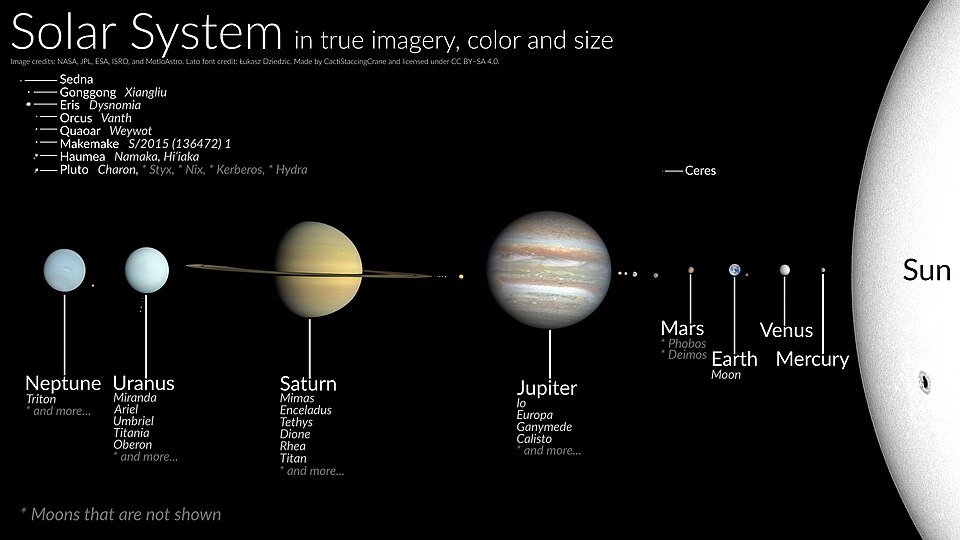
Why did Copernicus decide that the sun was at the center of the solar system? Copernicus decided that the sun was at the center of the solar system because it made the most sense when he observed the motion of the other planets.
Nicolaus Copernicus was born in Poland in 1473. He was very well educated and attended several universities. He was learned in astrology, astronomy, mathematics, medicine, law, and theology. He spent some time living with the principal astronomer of the University of Bologna, Domenico Maria de Novara, who taught him a lot about astronomy and how to make observations. He ended up becoming a church administrator and a doctor, but his loves were mathematics and astronomy. We probably only know his name because of his discovery of the heliocentric solar system, but he did many other things throughout his life. He was a linguist, a translator, and even a famous economist.
Copernicus probably realized that the Earth went around the sun and not the other way around sometime after 1510, although he may have suspected it for a long time before. He did all of his work using his naked eyes because the telescope wouldn’t be invented until 1608. By 1514, had written the outline for his heliocentric theory in a manuscript that was called his commentary (commentariolus). He passed it around to some of his friends to read, but he had no intention of publishing it as it was. He felt that he needed more data. He finally had everything ready by 1540, but, in fact, he wouldn’t actually publish it until 1543, just before he died. He put off publishing it because he feared the reaction it would bring.
Before Copernicus came up with his heliocentric model, the generally believed model was the Ptolemaic model, which had been written down by the Greek astronomer Claudius Ptolemaeus in the 2nd century AD. The theory was that the Earth was the center of the solar system and was stationary. The sun, moon, and each of the known planets (Mercury, Venus, Mars, Saturn, and Jupiter) orbited around the stationary Earth on a circular orbit. The moon was obviously the closest, and it was followed by Mercury, Venus, the sun, Mars, Jupiter, and finally Saturn. All of the stars were fixed points on a sphere that was on the outside of the furthest planet. The main problems with this are that the stars would need to rotate at several times the speed of light to make one revolution a day. They had no concept of the speed of light, but it would have to be an inconceivably high speed. Also, that the planets don’t orbit on perfectly equal circular orbits, taking different amounts of time. Planets have a period called retrograde motion, which is where they appear to move backwards. This happens because the faster moving Earth overtakes them. Mars, for example, appears to orbit at a certain speed, but when we catch up to it and then pass it, its orbit seems to slow down and then reverse for a while before continuing on its path again. The only way that the planets could orbit in this way would be if there were a point in their orbit where they slowed down. Ptolemaeus reconciled this movement by having the planets move around on small circles while they followed the big circle around Earth. When we see retrograde motion from Earth, it is simply the planet moving around its own circle, which would naturally make it go backwards. This did actually work, and it was possible to predict where the planets were going to be. It is one reason why Copernicus’s idea was not taken up very quickly.
Copernicus wasn’t the first person to question the geocentric model of the solar system, but he was possibly the first person to explain it mathematically. He started by looking at retrograde motion. If all of the planets orbited the sun, rather than the other way around, this was very simple to explain. He did still need the planetary circles to make it work, which wouldn’t disappear for a while. This assumption allowed him to lock in the correct order of the planets, which explained their orbits and their motion. He showed that simple geometry could calculate the planet’s distances and orbits. He also showed that the Earth was rotating, rather than stationary, and tilted on its axis. This explains day and night, and the seasons.
Copernicus didn’t publish until just before he died because he was probably afraid of the reaction. He was going against thousands of years of thinking and the scriptures. Once he did publish, there was some criticism, but it actually took a while to appear. When it did arrive, there were four main criticisms. The first was gravity, although people didn’t know it was gravity. The common thinking was that everything fell down towards the Earth because it was the center of everything. If Earth wasn’t the center, then why did everything fall downwards. The second was parallax. This is where you can judge movement because things in the near distance move more than things in the far distance. If the Earth were moving, why couldn’t we see parallax with the stars? Copernicus showed that it was because the stars were much further away than previously thought. The third was why don’t we see things left behind? If the Earth were moving, why don’t we see proof of the atmosphere not keeping up? (We do, but they didn’t know that.) And the last argument was the Bible. The Bible said that God created the Earth and put it at the center of the universe. It also said that Joshua was able to command the sun and moon to stop moving. How could that be true if the Earth was not at the center of the universe? That was probably the biggest argument to overcome. Proof of the heliocentric universe was not found until Galileo used a telescope of his own design to observe the moons orbiting Jupiter and the phases of Venus. However, without Copernicus, he might not have set out on that particular journey. And this is what I learned today.
Sources
https://www.uu.edu/dept/physics/scienceguys/2004Jan.cfm
https://www.history.com/articles/nicolaus-copernicus
https://en.wikipedia.org/wiki/Nicolaus_Copernicus
https://en.wikipedia.org/wiki/Commentariolus
https://en.wikipedia.org/wiki/Index_Librorum_Prohibitorum
https://en.wikipedia.org/wiki/Index_Librorum_Prohibitorum
https://en.wikipedia.org/wiki/Geocentrism#Ptolemaic_model
https://plato.stanford.edu/entries/copernicus
https://museumsvictoria.com.au/article/picturing-the-solar-system
https://en.wikipedia.org/wiki/History_of_the_telescope
Image By CactiStaccingCrane – Own work, CC BY-SA 4.0, https://commons.wikimedia.org/w/index.php?curid=117066753