
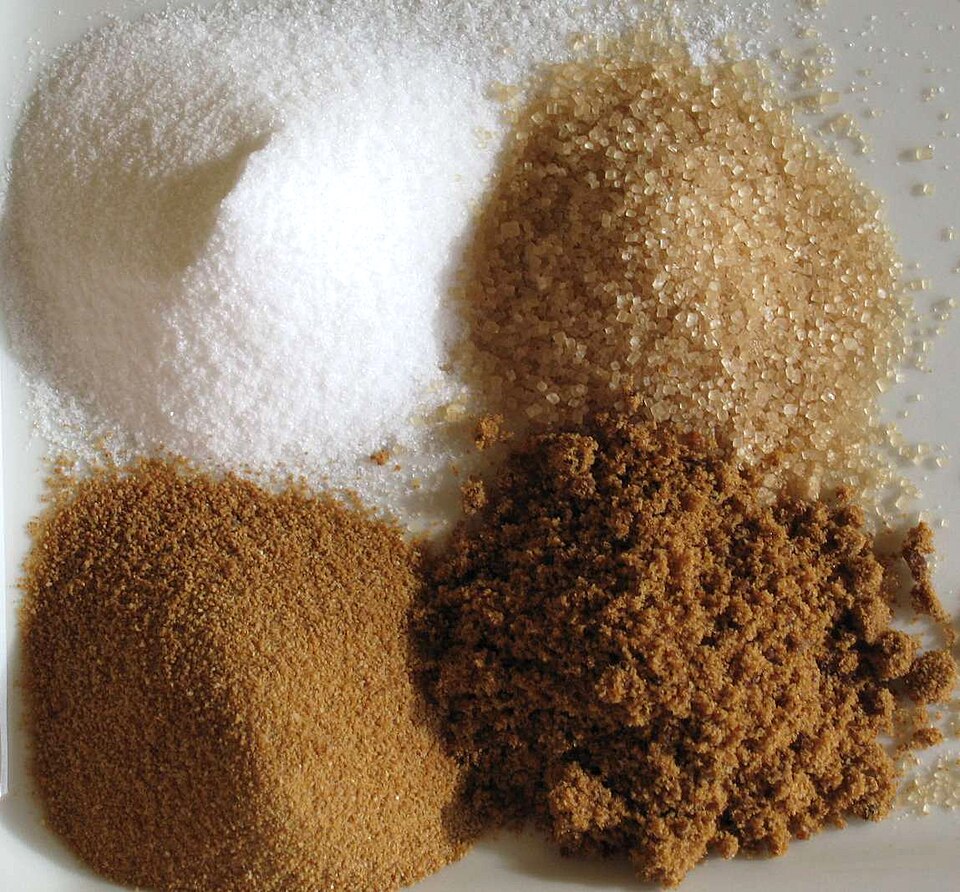
Is brown sugar healthier than white sugar? No, brown sugar is not healthier than white sugar. In fact, they are both pretty much the same thing.
We have become very used to assuming that the brown version of a type of food is healthier than the white version. Brown pasta and brown rice are healthier than white pasta and white rice. The brown version of these foods is usually made from wholegrains, which means that it is not processed as much. To make the flour for pasta, wheat is ground up into a powder. Whole-grain flour grinds the wheat with the bran and the germ still in it. White flour is made from polished grain where only the endosperm remains. That means wholegrain food has more fiber, protein, healthy fats, minerals, and vitamins. That means you feel fuller, eat less of it, and it takes longer to digest. Some companies dye bread or pasta brown so it looks healthier without actually being healthier. Often, people assume that brown sugar and white sugar are made in the same with brown sugar having more roughage. They are not. Both white and brown sugar are made from sugar cane or sugar beet.
All plants produce sugar, but only sugar cane and sugar beet produce it in a large enough quantity to make harvesting them economically viable. Plants make sugar as a result of photosynthesis. They convert water, sunlight, and carbon dioxide into glucose, which plants either use or store as starch or sucrose. Sugar processing plants want this sucrose. The sugar cane and sugar beet are harvested and shipped to the processing plant, where they are both washed. Sugar cane is cut into strips and run through a juicing machine. Sugar beet is cut into V-shaped strips and soaked in water to get the sugar out. Sugar cane is about 70% water, 15% fiber, and 15% sugar. Sugar beet is about 75% water, 5% fiber, and 20% sugar.
Once the juice has been collected, it is filtered several times to purify it and then seeded so that the sugar comes together and forms crystals. In the same way that snow won’t form without a piece of dirt to coalesce around, sugar will stay dissolved in the juice without a crystal to form around. Once the crystals have formed, the sugar crystal and juice mix is spun in a centrifuge. That pulls the sugar crystals away from the remaining juice, which is called molasses. Once they are separated, the sugar crystals are washed, dried, cooled, and bagged. The molasses is also collected and stored. Molasses is a thick, dark syrup.
Molasses is sold separately, and the sugar is produced in different sized grains, along with light brown and dark brown colors. These colors are produced by mixing some of the molasses back into the sugar. Light brown sugar has about 3-4% molasses, and dark brown sugar has about 6-10%. This alters the flavor profile of the sugar, but it doesn’t change the nutritional value of the sugar. The molasses does contain some of the vitamins and nutrients from the original plant, but these are in such a small quantity in the sugar that it makes almost no difference. Other than their flavor and their color, white and brown sugar are pretty much the same thing.
You can get slightly healthier sugars. Muscovado sugar is slightly healthier than regular brown sugar. It is made by cooking the sugar cane juice to evaporate the liquid and produce sugar crystals. It is less processed than regular sugar and contains a few more vitamins and minerals, along with some antioxidants. It also has a strong, bitter caramel taste. However, even these amounts are small, and, in the end, it is still sugar, which can be unhealthy. There is also “raw” sugar, which is less processed. It is taken pretty much as soon as it has crystallized, so it still has some of the molasses in it, and it is less processed than white sugar. It is still sugar, though.
There are healthy sugars, but these are the sugars that have not been taken out of a plant or a fruit. If you eat the whole fruit, you get the sugar, but you also get the fiber, protein, vitamins, and minerals. The sugar is absorbed more slowly into your bloodstream and doesn’t produce blood sugar spikes. You would also have difficulty eating as much sugar naturally as we can get from our store-bought processed foods. A medium sized apple has about 4 teaspoons of sugar in it. A regular can of Coca-Cola contains about 10 teaspoons of sugar. That’s 2.5 apples. You could probably drink two cans of Coke more easily than you could eat five apples. And this is what I learned today.
Sources
https://www.britannica.com/technology/How-is-Sugar-Made
https://www.healthline.com/nutrition/brown-sugar-vs-white-sugar#uses
https://kaynutrition.com/white-pasta-vs-whole-wheat-pasta
https://en.wikipedia.org/wiki/Sugarcane
https://www.healthline.com/nutrition/muscovado-sugar#what-it-is
https://www.bbc.co.uk/programmes/articles/gFmKkxQlHSXG68dYqc1RR7/can-too-much-fruit-be-bad-for-you
By Romain Behar – Own work, Public Domain, https://commons.wikimedia.org/w/index.php?curid=1219848