
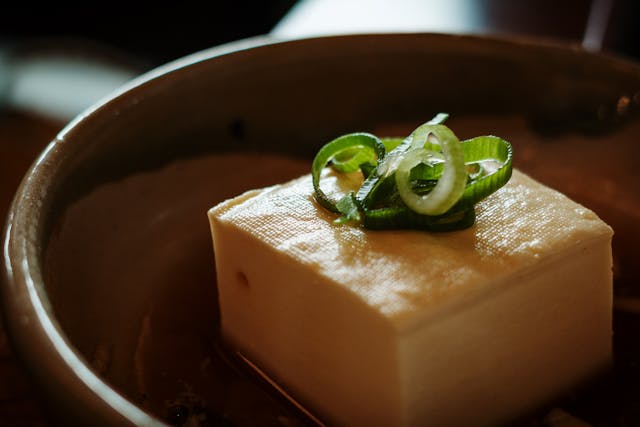
What is tofu? Tofu is made from solidified curds of soy milk. The word tofu came into English from Japanese, which, in turn, came from Chinese. The two characters 豆腐 mean 豆 bean and 腐ferment (or rot). Tofu is sometimes called fermented soybean, but it is not actually fermented. The meaning of rot might be closer because milks tend to coagulate when they rot.
The white liquid that tofu is made from is soy milk, but it is not really milk. Well, it is milk, but it isn’t milk. The dictionary has two definitions for milk as a noun. This is from Merriam-Webster. A) a fluid secreted by the mammary glands of females for the nourishment of their young. B) i) milk from an animal and especially a cow used as food by people. ii) a food product produced from seeds or fruit that resembles and is used similarly to cow’s milk. Nondairy milks, such as almond milk and oat milk, have become very popular recently, and we might think it is a very recent fad, but nut and plant milks have been drunk for thousands of years. The Chinese have used bean milk for a long time, and they didn’t regularly drink dairy milk until fairly recently. Compared to Europeans, a larger percentage of Asian people are lactose intolerant. The ancient Egyptians used milk from cows, goats, and sheep, but they also drank milk made from tiger nuts. Almond milk was popular in the Middle East and made its way to Europe in about the 8th century. So, milk from nondairy sources is not a recent thing.
To make tofu, you first need to make milk from soybeans. Soy beans are soaked in water overnight, and then they are ground as a little more water is added. The resultant milk is then filtered and boiled for about 20 minutes. Once the milk has cooled, the next step is to make it coagulate, which means clump together. There are different substances that can be used to make soy milk coagulate, but the most common is gypsum, which is calcium sulfate. The next most common substance is nigari, magnesium chloride, which is a very mineral-rich salt extracted from seawater. Gypsum is the most common because it is very easy to find and inexpensive. It also adds calcium to the tofu and gives it a smoother taste.
Gypsum makes the soy milk coagulate by reducing the electrostatic repulsion between protein molecules and helps them link together. Soy milk has a high protein content, and many of those protein molecules have a negative charge, which means they repel each other and stay as a liquid. When gypsum is added to the soy milk, it dissolves and releases calcium. The calcium binds to receptors on the protein molecules and turns down their negative charge, which means they don’t repel each other anymore. When they collide, they can stick together, and as the clumps get bigger, more protein molecules can stick to them, and the milk coagulates. This coagulated protein is called curd. If given long enough, the majority of the proteins stick together and form a frame that traps the fats and water left in the milk. This is similar to how cheese is made using renin to coagulate the milk. Once the soy milk has coagulated, the curds are placed in a mold and pressed.
Tofu came from China originally and made its way to Japan and other Asian countries in about 700 AD. It is not clear when tofu made it to Europe, but a letter from James Flint to Benjamin Franklin mentions towfu in 1770, and this is the first English mention. Benjamin Franklin called it “Chinese cheese”. Tofu was first eaten in China about 2,000 years ago. Soybean was domesticated about 5,000 years ago and was a very popular crop in China. A lot of Chinese food is based on soy (soy sauce, for one). The invention of tofu (called doufu) is credited to Prince Liu An of the Han Dynasty in about 150 BC, but this is probably just legend. Most likely, as with cheese, it was discovered by accident when sea salt was mixed in with soy milk, and it started to coagulate. Different types of tofu can be produced depending on the coagulant, length of cooking, pressing, and many other things. The final tofu does have a lot of protein, and it is often used as a replacement for meat. Generally, soy production is thought to be much better for the environment than all of the cattle raised to produce milk and meat. In the future, a balance of the two would probably be best. And this is what I learned today.
Sources
https://www.taifun-tofu.de/en/magazine/the-history-of-tofu
https://en.wikipedia.org/wiki/Tofu
https://en.wikipedia.org/wiki/Soy_milk
https://www.merriam-webster.com/dictionary/milk
Photo by Leongsan Tung: https://www.pexels.com/photo/close-up-of-fresh-tofu-with-green-onions-35132130/