
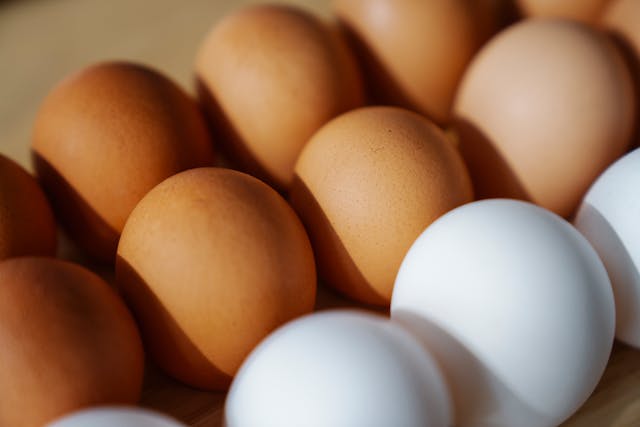
What is the difference between brown eggs and white eggs? There is no difference in the egg itself, but brown eggs come from a different breed of hen and are usually larger than white eggs. As with brown and white pasta and brown and white rice, many of us think that brown eggs must be healthier than white eggs. However, it turns out that the only difference between the two types of eggs is the color.
It takes a little over a day for a hen to produce an egg, and high laying chickens can produce about 6 eggs a week. They can start to produce the next egg thirty minutes after they have laid the last one. The amount they lay and the size of the egg all depend on the age, breed of chicken, and the type and quantity of food they can eat.
The egg starts life in the hen’s ovary, where the yolk is formed. The egg yolk contains water, fats, proteins, vitamins, and minerals. If the egg has been fertilized, the embryo will start to grow in the yolk and consume everything in it as it grows. The eggs we eat haven’t been fertilized, so the yolk is just a good source of nutrients for us. When the yolk is big enough, it is released from the ovary and moves to the oviduct. This is where the white is added to the egg, a process that takes about three hours. The egg white is added as the yolk moves along the oviduct, and it is made up of different proteins that are added in layers. The job of the egg white is to cushion the egg yolk and to give the embryo an extra source of food. It is made up of about 90% water and 10% protein.
The next step in the egg formation is the shell. Before the shell can be added, the white needs a way to attach to the shell, and this is made in an area called the isthmus. A membrane of fine chains of proteins and collagen forms around the white, helping the white fasten to the shell, giving it more stability, and keeping bacteria and microorganisms out of the egg white. Sometimes, you can see parts of this if you try to peel a boiled egg. It is like a white skin that covers the egg. This process takes about two hours.
The next stage is the formation of the shell, and this takes place in the aptly named shell gland. The shell is made of calcium. It takes about 19 hours for the shell to be completely finished, and it is an automatic process. By automatic, I mean that the egg attracts the calcium, rather than the calcium being laid down by the shell gland. This is the same as the way our bones attract more calcium. The calcium needs a point to start growing from, and these form on the membrane that surrounds the white. There are small protrusions in the membrane called mammillary protrusions, and the calcium first sticks to these. From that point, it grows outwards until it covers the egg, and then gets thicker layer by layer.
So, we now have a fully formed egg. The very last thing is to add color to it. Bird eggs are either white, brown, green, or blue. White eggs have no pigment added to them, just like white hair has no pigment. Brown eggs have the pigment added at the very end. You can see this because the inside of the shell is white. The pigment is called protoporphyrin IX, which is connected to the pigment that is in blood. The pigment for blue eggs is added throughout the shell formation process. It is called biliverdin and is the same pigment that shows up in bruises. Green eggs have blue pigment with a layer of brown pigment on top. So, as you can see, the only difference between white eggs and brown eggs is that very last layer of pigment.
So, why are eggs different colors? The breed of chicken is different for one. Plymouth Rocks and Rhode Island Reds are two examples of hens that lay brown eggs. The genes of the bird dictate the color of the egg. As to why eggs are different colors, there isn’t one clear reason. It could be camouflage from predators. Brown eggs might be more difficult to see in a nest that is on the ground, or a cliff, or somewhere visible. Birds that lay their eggs in hidden places, like holes or burrows, wouldn’t need camouflage, so they are often white. White eggs are also easier for the birds to see if the nest is dark. Darker eggs absorb more heat, and white eggs reflect heat, which could be a reason for their color. Distinctly colored eggs could be a way for birds to see if a different bird’s egg has been added to their nests, as in the cuckoo. There are several other reasons, but there is no difference with the egg inside the shell. And this is what I learned today.
Sources
https://www.canr.msu.edu/news/why_are_chicken_eggs_different_colors
https://www.healthline.com/nutrition/white-vs-brown-eggs#egg-colors
https://www.egginfo.co.uk/egg-facts-and-figures/brown-vs-white-eggs
https://www.australianeggs.org.au/farming/how-chickens-make-eggs
https://science.howstuffworks.com/innovation/science-questions/question231.htm
https://starmilling.com/how-eggs-are-formed
https://en.wikipedia.org/wiki/Eggshell_membrane
https://en.wikipedia.org/wiki/Yolk
https://en.wikipedia.org/wiki/Egg_white
Photo by Felicity Tai : https://www.pexels.com/photo/white-and-brown-eggs-in-close-up-photography-7965917/