
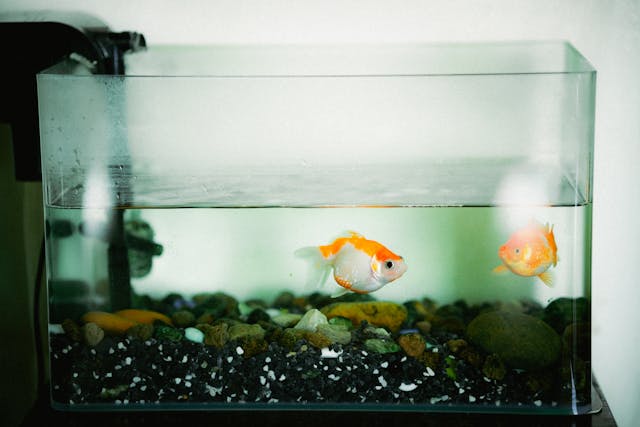
Do goldfish really have a short memory? No, goldfish don’t have a short memory. Although it depends on what we mean by memory. The idea that goldfish only have a very short memory seems to be widespread. It may stem from wishful thinking because we keep them in tiny tanks, and if they have long memories, that would be excessively cruel.
Experiments have shown that goldfish can remember things for a decent length of time, and some things they can remember for their whole lives. You can train goldfish to perform an action in the same way that you can train most other animals. If you only give them food at one end of their tank, they will start to accumulate at that end. If you only give them food if they press a button, they will press the button. This makes sense from an evolutionary perspective because animals that can’t learn where food is will not last very long. The only way goldfish would be able to make the connections between the food and a location would be to file it away in their long term memories. This has been conclusively tested because goldfish were trained to solve a maze by giving them food rewards. Then, months later, they were shown the same maze again, and they solved it with no trouble at all. They must have remembered it. One experiment showed that goldfish could remember the color of a pipe that gave them food over a year after the initial experiment.
Fish can remember places where they get food, but they can also remember places of danger. Studies have shown that carp caught and released by anglers in the Netherlands were much harder to catch again because they tended to avoid the area.
There is another way that we know goldfish, and other fish, can remember for longer than 5 seconds. Wild fish swim in schools, and sometimes there are enormous groups of fish. To us, they all look pretty much identical, but fish seem to be able to identify other members of their school, and that requires memory. Fish don’t really look at distinguishing marks on other fish because there might not be that many. Instead, they use pheromones. That can tell them if another fish is of the same species or is related to them. They also look at the way other fish swim because that movement is unique between species. Fish have been known to recognize and remember human divers who give them food. Experiments have shown that the fish will learn to follow the diver who feeds them more, and they will be able to tell that diver apart from other divers. If different divers get into the water, the fish won’t appear, but if the diver who feeds them gets in, they will all come out of nowhere. They are able to remember these things for long stretches of time.
There are several reasons why we hope that fish have short memories. Firstly, because we keep them in small tanks, and secondly, because we catch and eat them. For these reasons, we also hope that they don’t feel fear and pain. The origin of this thinking is that fish have much smaller brains than mammals and birds, and probably can’t process as much information. That might mean that they don’t have room to store memories or process emotions like fear and pain. However, as I have mentioned, current research shows that fish do have good memories, and it also shows that they can feel pain. Experiments have shown that fish show behavior changes when exposed to pain, and they avoid places that they learn to associate with pain. It is clear that they feel pain, but there is no way of knowing if they feel pain on an emotional level, the way that we do. They also clearly show fear. Some studies have shown that captured fish have an increase in cortisol, the stress hormone, and change their behavior. All of this has led a lot of organizations to think more carefully about how they treat fish, but it is still unclear, and there are convincing arguments on both sides.
Fish have been shown to be very intelligent in other areas as well. Some fish have learned to use rudimentary tools to perform tasks. A fish called a wrasse picks up shellfish from the seafloor and then swims several meters away to smash them open on a particular rock. Fish also exhibit social learning, which is where one fish learns how to do something by watching another. This could be a sign of intelligence. So, your goldfish can remember things, and is probably far more intelligent than you give it credit for, so buy it a larger tank and put some interesting things in it. And this is what I learned today.
Sources
https://www.nausicaa.fr/en/the-ocean-magazine/do-fish-have-memory-goldfish
https://www.bbc.com/news/uk-england-oxfordshire-63242200
https://www.livescience.com/goldfish-memory.html
https://en.wikipedia.org/wiki/Fish_intelligence
https://www.sciencefocus.com/nature/how-do-fish-know-who-they-are
Photo by Thanh Nhan: https://www.pexels.com/photo/fishes-in-aquarium-17751990/