
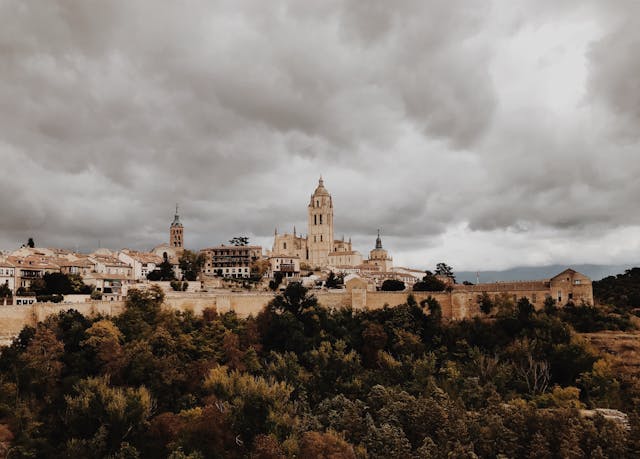
Why did the Spanish Empire end? The Spanish Empire came to an end because of, amongst other things, mismanagement, the economic situation, involvement in too many wars, and overexpansion. The Spanish Empire is generally considered to have come to an end in 1898, but it was the result of things that had been going on for several hundred years before that.
The marriage of Isabella I of Castile and Ferdinand II of Aragon was probably the beginning of the Spanish Empire. Their marriage united two of the largest kingdoms in Spain and produced a fair amount of wealth. They could use that wealth to fund ships and explorers, such as Christopher Columbus. His voyage in 1492 resulted in the discovery of the New World, and Spanish colonization of the Americas began soon after. Spain had the ships to control the Atlantic and the manpower to conquer South and Central America. More and more areas were added to the Spanish Empire until it reached its greatest extent in the late 1700s to early 1800s, with an empire that covered about 10.17% of the world. Their empire consisted of most of South and Central America, Mexico, the Caribbean, parts of what is now the southwestern and southeastern United States, the Philippines, several other Pacific islands, and some African holdings. The empire itself was already weakening by at least a hundred years before this point, but it didn’t start to fall apart quickly until the early 1800s.
There wasn’t a single reason why the empire fell, and all of the reasons are interconnected. One reason that knocked onto all the other reasons was the weakness of the Spanish economy beneath the surface wealth. Spain used its new territories in the New World to increase trade and to increase its stores of gold and silver. In the beginning, all of this new gold and silver was a boon for Spain, and it drastically increased the treasury. They could afford more ships, more sailors, and more soldiers. However, this influx of precious metals, especially silver, helped drive a long period of high inflation and it also caused the Spanish crown to become dependent on bullion. Spain came to rely on that flow and didn’t invest enough in building a strong domestic economy, and the money never seemed to be enough to cover the commitments Spain had taken on. The Spanish monarchs borrowed heavily to pay for armies and ships, and that became unfeasible. They defaulted on their debts in 1557, 1560, 1575, and 1596, and the pattern of borrowing, crisis, and renegotiation became a recurring feature of imperial Spain.
The financial strain came not just from a lack of industry, but from having to pay an expanding army and fight never-ending wars. As the Spanish Empire grew, they needed more and more soldiers and bureaucrats to service it. All of that comes at a cost. Spain could pay the cost to begin with, but it soon became too much for them. This meant they couldn’t keep their ships up to date, and they began to lose supremacy in the Atlantic as well. French and British privateers preyed on Spanish ships and drastically cut the amount of treasure and goods that managed to reach Spain.
The Spanish kings also mismanaged their empire, partly because it was just too big. They weren’t able to control everything, and they had different rules and levels of tax in each territory they controlled. They were not able to project an image of unity and strength. When the economy started to falter, all of these territories were very eager to jump ship. There was a succession of weak monarchs who were not able to hold the empire together. The Habsburg dynasty in Spain also suffered from serious health problems linked to repeated close-kin marriages, and when the last Habsburg king, Charles II of Spain, died with no heir, it threw Spain into the War of the Spanish Succession, which was one of the first big shocks that reshaped Spanish power.
By the early 19th century, when Napoleon came on the scene, the empire was barely holding together. Napoleon invaded Spain in 1808 and the long war that followed badly damaged Spain’s stability and prestige. This signaled to the empire that Spain was not as strong anymore and countries began to try to leave. Across Spanish America, independence movements spread, and wars broke out in many regions, including places like Venezuela, New Granada, and Bolivia. Mexico also broke away in the early 1800s, and by the 1820s Spain had lost most of its mainland American empire. There were also a series of civil wars in Spain.
Then, in 1898, the US and Spain went to war, which is often treated as the endpoint of the Spanish Empire. The US won the war, and Spain lost Puerto Rico, Guam, and the Philippines, and it also relinquished sovereignty over Cuba. There was no way back for Spain. The days of the empire were gone. And this is what I learned today.
Sources
https://history.stackexchange.com/questions/9234/what-caused-the-decline-of-the-spanish-empire
https://en.wikipedia.org/wiki/Decline_of_Spain
https://owlcation.com/humanities/spanish-empire-the-rise-and-fall-of-a-great-power
https://en.wikipedia.org/wiki/Timeline_of_Spanish_history
https://en.wikipedia.org/wiki/Spanish%E2%80%93American_War
https://en.wikipedia.org/wiki/List_of_largest_empires
Photo by Mark Neal: https://www.pexels.com/photo/gray-concrete-building-near-trees-under-white-clouds-2016840/