
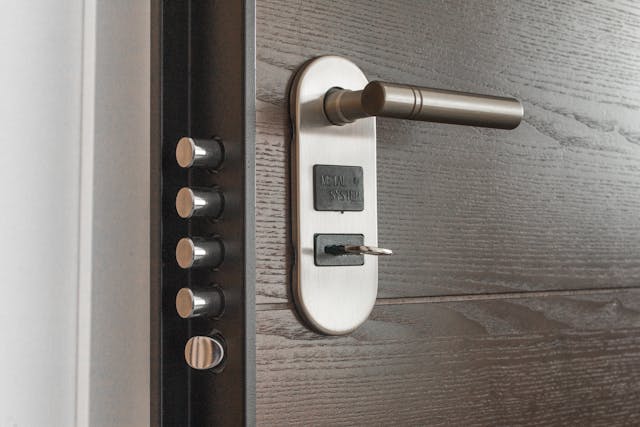
Are there any unpickable locks? There are probably no unpickable physical locks, but some modern high-security locks are very difficult to disable.
If given the right tools and enough time, pretty much any physical lock can be picked. And, if picking it is not possible, it can probably be drilled through, or even removed from the door. The function of every lock is to stay closed until opened, which means that every lock has a weak point. Modern high-security locks are much more difficult to pick, but that doesn’t mean they are impossible. Often, the goal of a lock is not to be completely impenetrable, but to withstand attempts to pick it for long enough that a security team can get to the location. To this end, high-tech locks are usually combined with intensive security systems, such as cameras, and various sensors.
This is also why security standards and rating systems exist. Locks are rated on performance, durability, and strength. They don’t promise magic. Instead, they try to measure resistance under defined conditions: how long a cylinder can survive drilling, pulling, or manipulation, and what kinds of tools and skill levels are assumed. In other words, security is often about buying time. A lock that can delay an intruder for several minutes may be just enough to deter them.
The arms race between lock makers and lock pickers is never ending. Every time a new, more difficult to pick lock is invented, the lockpickers go to work and once they have worked out how to pick it, the lock makers have to start again. This is nicely illustrated with the Bramah lock in 1784 and the Chubb detector lock in 1818. They were both billed as unpickable, and they were, for a considerable amount of time: the Bramah lock for 67 years and the Chubb lock for 23 years. However, there was always going to be a point where they would be picked.
The Bramah lock was invented in 1784 by Joseph Bramah. It had a cylindrical key that was cut with slots of different lengths. These slots fitted into tunnels that contained spring mounted tumblers. When all the tumblers were depressed to the correct depth, the lock opened. There were 18 tumblers, which made it almost impossible to pick because you would have to find the correct depth for all 18 tumblers. Bramah was so confident that he promised to pay $30,000 to anyone that could open it without the key. In 1851, a lock designer called Alfred Charles Hobbs took 51 hours, but he managed to open the lock at the Great Exhibition.
The Chubb detector lock was invented in 1818 by Jeremiah Chubb. It is a tumbler lock, but it is designed to freeze in the locked position if it is tampered with. This makes it impossible to open and indicates to the owner that someone has tried to break in. This lock was also picked by Alfred Charles Hobbs at the same Great Exhibition.
These days there are a few locks that are said to be extremely hard to pick. One of those is a magnetic lock made by a company called EVVA. The lock is very complex, but it also has a magnetic key. On each side of the key there are four small magnets that can be charged differently, creating a unique identity for that particular key. This was marketed as an unpickable lock, but even this has been picked. It is not easy, though, and will take a significant amount of time. It can be picked using a pick with a magnet at the end, some magnetic shielding, and a mic attached to the lock to hear when the tumblers have fallen into place.
There is a lock in China that is also said to be unpickable. It is called the Shi-He Chi-Me U-Lock. It has an obstructed keyway and the key has rounded teeth that go around sharp turns that lockpicking tools can’t make. It is also difficult to keep the lock under tension if the picks are going round corners. If it has been picked, it would take a long time. It is a difficult lock to make and is not very common.
Probably smart locks are the closest you can come to unpickable, merely because there is no keyhole. The lock is opened with a phone or some other smart device. Sometimes even a fingerprint. They are not pickable, but the signal from the phone can be cloned and a fingerprint can be faked. Even these locks can be defeated. And, in the end, there are very few locks that can’t just be broken off the door.
Sources
https://en.wikipedia.org/wiki/Bramah_lock
https://en.wikipedia.org/wiki/Chubb_detector_lock
https://www.lockwiki.com/index.php/EVVA_MCS
https://www.evva.com/int-en/products/mechanical-locking-systems/mcs-locking-system
https://elitelocksmiths.us/faq-items/what-locks-cannot-be-picked
https://www.lockpickworld.com/blogs/news/unpickable-locks-do-not-exist-1
https://paragonlocksmithllc.com/faq-items/what-locks-cannot-be-picked
Photo by Pixabay: https://www.pexels.com/photo/deadlock-with-key-on-hole-279810/