
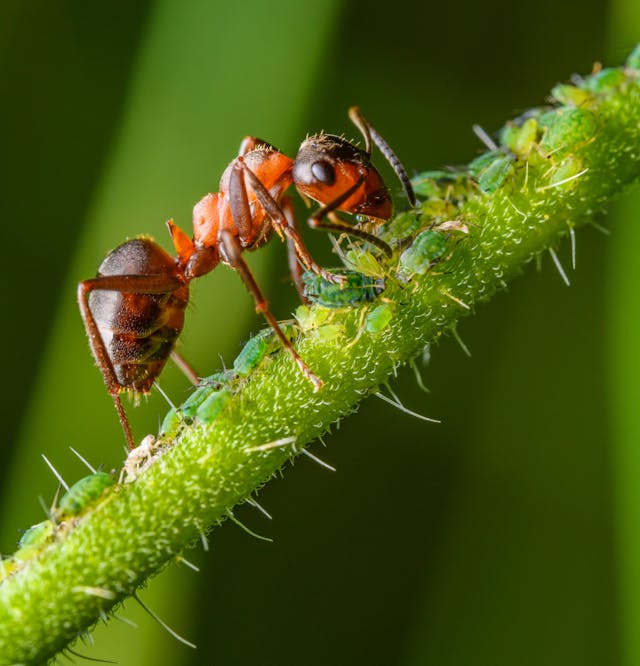
How do ants farm aphids? Ants farm aphids by herding them together, feeding them, and keeping them out of the sight of predators.
Aphids are small insects that suck the sap out of plants. They are usually between one and three millimeters long, and they have specialized mouth parts for cutting into plants and drinking the sap. Similar to mosquitoes, they inject chemicals in their saliva that prevent the wounds in the tree from sealing up and keep the sap flowing. They don’t have to have any sucking muscles because the sap in a plant is under pressure, and just making a hole in the leaf or stem will let the sap force itself out into their mouths. They live in colonies, and one aphid can’t drink much sap, but there are tens of thousands of aphids in a colony, and they can cause severe damage to plants. Unlike most insects, they have soft bodies because their exoskeletons are not fully developed. This is so they can stay flexible enough to maneuver their mouth parts and so that they can grow quickly. After birth, they can grow to full size in about seven days, and if they had a hard exoskeleton, they would have to shed it and regrow. Their soft exoskeleton does leave them vulnerable to predators and dehydration, but that is a trade-off and being able to grow faster is more advantageous. Aphids drink the sap from plants, and they absorb all the sugars from it that they need. The rest of the sugars pass through them and are released as a substance called honeydew, which is very high in sugar. Aphids are unable to produce some amino acids from their diet of just plant sap, so there are bacteria that live inside them and produce those amino acids in return for the free food the aphids drink.
The honeydew that the aphids produce is very high in sugar, and it is the reason why ants have learned to farm them. Ants are omnivores, and they will eat a huge range of food, but they specifically like sweet foods. Anything sweet gives them a lot of sugar, which is a quick and easy energy source. Honeydew is an excellent source of sugar. To get a constant supply of honeydew, ants keep corals of aphids near their nests. Ants can herd the aphids by using chemicals that they produce on their feet. These chemicals tranquilize the aphids and create a line that they won’t cross over. Ants use these chemicals to mark their territory as well. Once the aphids are corralled, the ants can take advantage of all of the honeydew that they produce. The chemicals that they lay down are so powerful that aphids won’t leave, even if they have extracted all of the sap from the plant, and the leaf they are on has died. The ants eat the honeydew that the aphids leave on the leaves, but they can also stroke them with their antennae to get them to produce more. This is called “milking”.
Ants also produce another chemical in their glands that stunts the growth of aphid wings. Not all aphids develop wings, but this chemical prevents those that do from flying away. Ants have also been observed biting the wings off aphids as well. Ants have even been seen eating the occasional aphid to keep them from escaping. Ants will even carry aphid eggs to their nest and keep them over the colder months, bringing them back to their leaf farm when the weather warms up.
This sounds like it is all one-sided and the ants are just using the aphids as slaves, but the aphids do get a lot out of the deal as well. Because of their soft exoskeletons, aphids are very vulnerable to being eaten by other insects. Ants herd the aphids to the underside of leaves to keep them out of sight. They also fight off predators, such as ladybugs. A ladybug is a lot bigger than an ant, but ants have quite an array of attacking mechanisms. They can spray formic acid out of glands in their abdomens. They have powerful muscles that can spray it a long way. Ants also have powerful jaws to bite, and they have the advantage of numbers over a ladybug. The ants can swarm a ladybug and try to knock it off the leaf. It is possible that the chemical footprints left by the ants do tranquilize the aphids, but it is also possible that the aphids know that they are safer within that circle of footprints and might have evolved to stay there. Some proof for this is that aphids that are farmed by ants produce more honeydew than regular aphids, and their honeydew contains more of the amino acids that ants need than regular aphids’ honeydew. And this is what I learned today.
Sources
https://en.wikipedia.org/wiki/Honeydew_(secretion)
https://entomology.mgcafe.uky.edu/ef103
https://en.wikipedia.org/wiki/Aphid
https://www.sciencedaily.com/releases/2007/10/071009212548.htm
Photo by Petr Ganaj: https://www.pexels.com/photo/red-and-milking-aphids-on-a-grass-stalk-17818753/