
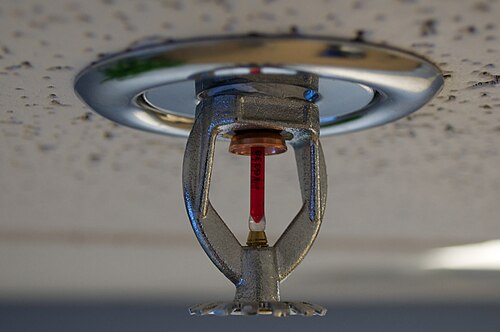
How does a building sprinkler system work? A building sprinkler system is a network of pipes and sprinkler heads that are activated by heat, not smoke.
A sprinkler system is fairly straightforward. A network of water pipes is laid through the building, usually above the ceiling. At predetermined distances, a sprinkler head sticks through a hole in the ceiling. The water supply feeding those pipes is pressurized, and each head is sealed with a small glass bulb (or a fusible metal link). The glass bulb is filled with a heat-sensitive liquid and acts like a plug. It is designed to shatter at a specific temperature. When there is a fire, hot gases collect near the ceiling. When the temperature at the head reaches the bulb’s rating, the bulb shatters and pressurized water flows out through the opening.
Sprinkler heads do not simply spray straight down. A small metal plate called a deflector sits in the water stream and breaks it up into a shaped spray pattern. This helps spread water across a defined area, which is one reason spacing, ceiling height, and head type matter so much. Heads also come in different designs, such as upright, pendent, sidewall, and concealed, depending on the building layout and what the system is meant to protect.
One important detail is that sprinklers usually operate one by one. A Hollywood “all the sprinklers go off at once” scene is usually wrong. Each head responds to the local heat around it, so a small fire may trigger only one or two heads. That is one reason sprinkler systems can be so effective: they start early and focus water right where the fire is hottest, while the fire is still relatively small. The goal is not always to put a fire out instantly, but to control it, keep temperatures down, and slow the spread until firefighters arrive.
A typical system also needs a reliable water supply and control equipment. Depending on the building, the water may come from the city main, an on-site tank, and/or a fire pump that keeps pressure high enough for the required flow. There is usually a main control valve, an alarm valve assembly, and monitoring equipment. When water begins to flow (meaning at least one head has opened), the system can sound a local alarm and send a signal to a building panel or monitoring company. Many buildings also have an exterior connection so firefighters can pump additional water into the system if needed.
There are several common types of sprinkler systems, and the main difference is what sits in the pipes before a fire happens. In a wet-pipe system, the pipes are filled with water all the time. This is the simplest and most common arrangement, and it reacts quickly because the water is already at the head. In a dry-pipe system, the pipes are filled with pressurized air or nitrogen instead. When a head opens, the gas escapes first, a valve trips, and then water rushes in. Dry systems are used in places where freezing is a risk, but they can be slightly slower to deliver water. Some buildings also use pre-action systems, which require a separate fire detection signal before water is let into the pipes, and deluge systems, which are designed to open many outlets at once in high-hazard industrial areas.
There are five different hazard classifications that sprinkler systems are expected to deal with: light hazard, ordinary hazard group 1, ordinary hazard group 2, extra hazard group 1, and extra hazard group 2. With each increasing hazard level, there are more sprinklers over a given area and each sprinkler is designed to deliver a greater volume of water. Light hazards are places where most materials are noncombustible or not very combustible, such as offices, classrooms, and residential areas. Ordinary hazards are areas with more combustible contents and a higher expected fire load, such as workshops, storage areas, repair garages, and some light manufacturing. Extra hazard areas are places with higher levels of flammable liquids, dense storage, or industrial processes that can produce rapid fire growth, such as certain chemical handling, paint processes, or similar high-risk work.
Sprinkler systems that use water are the most common, but automatic fire suppression is broader than water sprinklers. Water is excellent for ordinary combustibles because it cools the fire and soaks nearby materials before they ignite. In areas where flammable liquids are a major concern, foam-water systems can be used to form a blanket over the liquid surface, reduce vapor release, and cool the fuel at the same time. Water-mist systems use very fine droplets to absorb heat efficiently and can be useful where water damage is a major concern. Some settings also use fixed dry-chemical or gas suppression systems, and commercial kitchens often use wet-chemical systems aimed at cooking-oil fires, but these are usually separate “fixed extinguishing” installations rather than standard ceiling sprinkler heads.
For as long as people have lived in towns and cities, fire has been a way of life. Just like forests need fire to clear away old growth and start again, every fire in a city clears away old buildings, allowing for new city plans. Buildings were mostly made of wood, and there was very little city planning, so they were built very close together. As with the Great Fire of London in 1666, if a small fire starts in one baker’s kitchen, there is very little to stop it spreading rapidly. Throughout history, major city fires were common, and they shaped building styles, insurance, and the eventual rise of professional fire services.
There were several attempts to reduce the risk of fire and to put out fires when they started. City planning was attempted in many countries, but it was always hard to enforce. People added on to buildings and built buildings between buildings with almost no consequences. Several cities also attempted to make fire brigades. The first fire brigade is sometimes linked to Marcus Crassus in Rome. He employed firefighters that went around Rome when there was a fire and then negotiated their rates with each homeowner. If the homeowner could pay, they put out the fire. If the homeowner could not pay, they let the building burn.
By the 19th century, fire brigades became common, but cities became larger and buildings grew taller. The fire service was useful, but a first line of defense was needed inside buildings. Fire extinguishers started to appear, and so did sprinkler systems. Early automatic extinguishing ideas go back centuries, and an early example often mentioned is a system described in 1723 by Ambrose Godfrey. However, the modern automatic sprinkler system took shape in the late 1800s, when reliable heat-activated sprinkler heads began to be installed in factories and warehouses and then spread more widely as standards and building codes developed.
Sources
https://en.wikipedia.org/wiki/Fire_sprinkler_system
https://www.charleston-sc.gov/653/How-Fire-Sprinklers-Work
https://www.explainthatstuff.com/firesprinklers.html
Image By Brandon Leon – Flickr: Day 25: Fire Sprinkler, CC BY-SA 2.0, https://commons.wikimedia.org/w/index.php?curid=28858271