
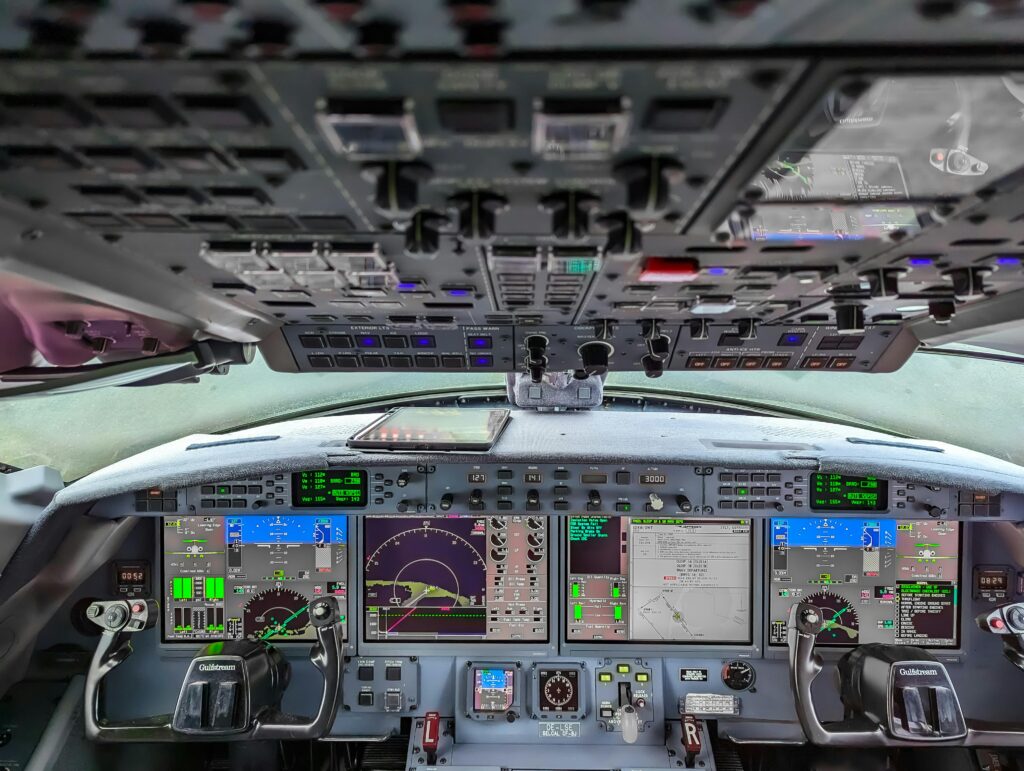
What is a fly-by-wire system? A fly-by-wire system is a way of controlling a plane with electronics rather than with manual flight controls. It is called “fly-by-wire” because all of the pilot’s input is transmitted along electrical wires.
The opposite of fly-by-wire controls is mechanical or hydraulic controls. These days, passenger planes and large planes are usually fly-by-wire. Small, general aviation aircraft are often not fly-by-wire, and many older planes are as well. The Boeing 737 MAX is one of the few passenger aircraft that still uses hydraulic and mechanical controls. Fly-by-wire systems are far lighter, easier to operate, safer, and far more efficient than mechanical or hydraulic systems.
The first plane, the Wright Flyer, was completely mechanical. The plane could be maneuvered along three axes. The pilot lay in a hip cradle that was attached to the wings by cables, which controlled the plane’s roll for turning. When the pilot shifted their weight, the cradle would pull the cables, which would twist the wings and roll the plane. The plane’s side to side motion was controlled with a rudder that was connected to the wings and turned when the wings warped. Then the pitch was controlled with a hand lever that was connected by cables to the plane’s elevators. The system worked, and the Wright Flyer was the first plane that could be controlled along all three axes, but it was very unstable and difficult to fly. That was obviously the first plane, and things improved very quickly regarding controlling the plane. However, the two main problems with mechanical systems are their weight and their inaccuracy. As planes got larger and more complex, longer and longer cables were needed to control all of the systems. The weight of these cables, the pulleys, and all the other parts that went into making a mechanical system started to add up. With any plane, weight is money. The second problem is that they are not efficient. It takes time to make changes with the controls, and it is very easy to go over or under whatever it is you are trying to do.
Fly-by-wire controls work by replacing the mechanical cables with electrical cables. The wire connects the pilot’s control at one end to a hydraulic actuator, which will move the plane’s control surfaces. The system is far lighter than a mechanical system, which makes the plane lighter and saves fuel and money. Fly-by-wire systems are also a lot easier to operate because the pilot doesn’t have to struggle to make the right amount of adjustment. Fly-by-wire systems have a flight control computer, which interprets what the pilot is trying to do and makes the exact changes needed to accomplish that. It doesn’t go over or under but makes the exact necessary change. This makes the system much more efficient, and it takes a lot of the weight off the pilot.
Fly-by-wire systems are a lot safer than mechanical systems as well. Because they take up less space, it is easier to have more redundancies. If one system fails, there is a backup system that can be used. This could also be seen as a disadvantage, though, because if the plane loses all of its power, it would theoretically lose its control systems. To prevent this, the plane has multiple backup batteries and power units that can power the controls using electricity generated from wind. These systems are also safer because the flight control computer can prevent the pilot from making mistakes that might damage the plane. In a mechanically controlled plane, pilots can bank so sharply or climb so steeply that the plane could stall. If the pilot pulls back on the stick to climb, the flight control computer will analyze the urgency of the movement and make the plane climb at a rate that is fast enough to avoid whatever the pilot is trying to avoid, but not fast enough that the plane will stall.
The first fly-by-wire system was introduced in 1934, but its only job was to flare the aircraft when it was getting close to the ground. The first fully electronically controlled plane was a Heinkel He 111 flown in 1941. Planes in the Second World War were all mechanical because they were easier and faster to make, and they were easier to repair in the middle of a desert, miles from anywhere. By the end of the 1960s, a lot of military planes had fly-by-wire systems, but they weren’t added to passenger planes until the late 1980s. The Airbus A320 was the first passenger plane with fly-by-wire controls, and it was released in 1988. By the end of the 1990s, the majority of planes had shifted over to fly-by-wire systems because of all their benefits. And this is what I learned today.
Sources
https://www.baesystems.com/en-us/definition/what-are-fly-by-wire-systems
https://en.wikipedia.org/wiki/Fly-by-wire
https://www.baesystems.com/en-us/definition/what-are-fly-by-wire-systems
https://en.wikipedia.org/wiki/Wright_Flyer
https://www.liverpool.ac.uk/flight-science/fs/fshistory/wright/stability
https://simpleflying.com/last-plabe-america-without-fly-by-wire-controls
Photo by Joerg Mangelsen : https://www.pexels.com/photo/cockpit-of-an-airplane-19101603/