
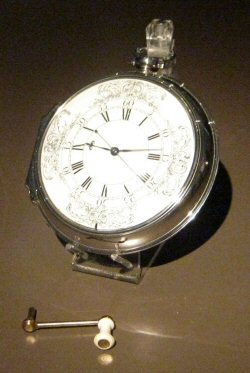
How did John Harrison’s clock allow longitude to be used? John Harrison’s clocks were the first clocks that worked accurately on ships. To calculate longitude, it is necessary to know the time difference between where the ship is and the place it left from. That is only possible with a clock that can keep accurate time on a moving ship.
Latitude is fairly easy to calculate. Sailors only needed to measure the angle of the sun during the day, or certain stars at night. The Earth rotates from west to east, and the apparent angles of the sun and stars change depending on how far above or below the equator a ship is. The angles also change with the seasons and the time of year, but if that is taken into consideration it is not too difficult to work out latitude without modern equipment. Longitude is a lot more difficult.
The Earth rotates once in 24 hours. It rotates 0.25 degrees every minute, and 15 degrees an hour. To work out a position on Earth, it is necessary to know latitude, how far north or south the ship is, and longitude, how far east or west it is. Just knowing latitude can’t help much because each band of latitude circles the Earth and a ship could technically be anywhere along that band. To work out longitude, two things are needed: the exact time at a specific location (such as London) and the time where the ship is. For example, if noon on the ship (measured by looking at the sun) is exactly 9 hours later than noon in London, there is a 9-hour time difference, which equals 135 degrees of longitude. With latitude already known, that gives a clear position.
The problem with longitude was that it wasn’t possible to know the time difference between a specific point and where the ship was, because there were no clocks that would work accurately at sea. There were other methods, but none of them were exact and a sailor’s calculations could be wildly wrong. One method was dead reckoning, which relied on estimating speed and bearing, then adding those estimates up over time. Another was to use a sextant to measure the angle between the moon and certain stars, which could be compared with published tables. This relied on very complex observations and calculations. It was possible to guesstimate longitude, but it would never be consistently precise. Miscalculations don’t matter so much in the wide open sea, but near land they can be disastrous, and many shipwrecks are directly attributable to not being able to work out longitude until John Harrison built his clocks.
The longitude problem had been recognized as significant for a long time, and the British government offered a prize of £20,000 (equivalent to millions of dollars today) to anyone who could solve it. Christiaan Huygens invented a very reliable pendulum clock in 1657, but pendulums expanded and contracted with temperature changes, and they also couldn’t swing reliably on a rolling ship’s deck. Many people approached the longitude problem by trying to find ways to mount pendulum clocks so that temperature didn’t affect them and so they would remain stable. They tried gimbals, friction rollers, and other methods to counter the movement of the ship, but nothing worked well enough.
John Harrison began his investigations by using similar techniques. The pendulum clock was the only clock known to keep good time, so finding a way to make it work on a ship seemed logical. After a few experiments he understood why it wouldn’t work, and he spent the next 40 years of his life trying to make a clock that could. His first clock, H1, made in 1730, used two interconnected balances instead of a pendulum. It was a very large clock. His H2 clock, made in 1737, was an upgrade on this, with improvements intended to keep the two balances more uniform, but the motion of the ship was still too much. He had a major rethink, and his H3 clock, started in 1740 and refined over the next 19 years, was a step in the right direction but still never worked well enough.
Even though H3 was not successful as a longitude solution, Harrison came up with two very important inventions while making it. These are still used today: the bimetallic strip, where two different metals expand at different rates and can be used for temperature compensation, and the caged roller bearing, which reduces friction without upsetting the clock’s timing.
He built his H4 clock in 1759 and moved away from a large sea clock to a smaller timepiece. The balance was much more stable and it ran at a much higher frequency. It was far more accurate than his earlier attempts, and tests on ships showed that it worked extremely well. He made an H5 watch with his son toward the end of his life, with a few improvements, but it was H4 that effectively solved the longitude problem. It was proven to be accurate at sea for long periods of time, and sailors could now carry a clock that kept London time. Then, at noon wherever they were, they could calculate the time difference and know their longitude.
Because the watches were so effective, they were incredibly expensive, sometimes costing a large fraction of the price of a ship. They were also treated as strategic technology and guarded closely during times of war. They gave the British navy an advantage that may have helped expand its empire. Unfortunately, because of political rivalries and the way the prize was administered, Harrison was never simply handed the full longitude prize in one clear award. He received large payments, but only a portion of the prize as it had originally been imagined. And this is what I learned today.
Sources
https://www.rmg.co.uk/stories/maritime-history/traditional-ways-determine-ships-position
https://www.rmg.co.uk/stories/time/harrisons-clocks-longitude-problem
https://en.wikipedia.org/wiki/John_Harrison
https://en.wikipedia.org/wiki/Earth%27s_rotation
image By Phantom Photographer – Own work, CC BY-SA 3.0, https://commons.wikimedia.org/w/index.php?curid=13817140