
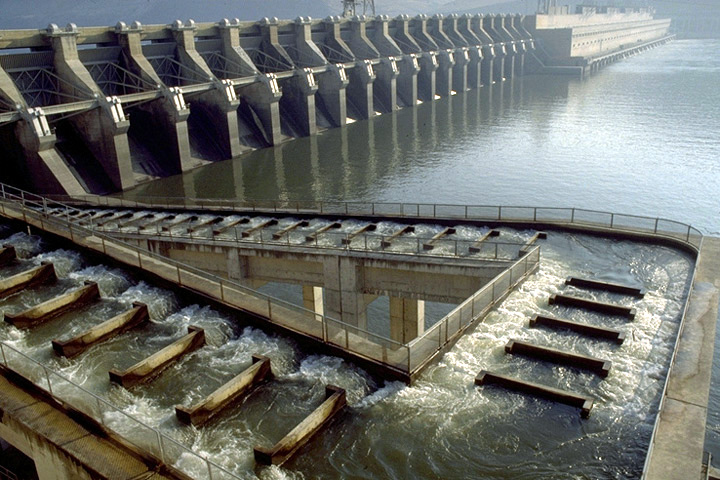
How do fish ladders work? Fish ladders have a series of stepped pools that allow fish to swim back up a river and climb over any human-built obstacles that might be in their way. The idea is to mimic the natural riverbed.
Salmon are the most commonly known, but there are many different kinds of fish that swim back upstream to spawn. As well as salmon, sturgeon, blueback herring, striped bass, and trout also swim back upstream. Some species of eel swim upstream, but they go the opposite way. They spawn in the sea and then swim upstream to grow. These fish have to swim back upstream because they spend their adult lives in the sea, but they have to lay their eggs in freshwater. There is more oxygen in freshwater because it is clean and fast-flowing, which helps their young develop, and there are fewer predators in moving rivers. It takes a monumental effort for the fish to get back to their spawning grounds, and some salmon have been tracked travelling over 1,500 km to get back, and all of it against the current. They can’t eat in freshwater, so this mammoth journey takes up all of their energy. To be able to do this, the fish have to undergo various changes that allow them to live in freshwater for the last part of their lives.
These kinds of fish are called anadromous, which comes from the Greek “ana”, which means upward, again, or backwards, and “dromos”, which means running. We use these Greek roots in many other English words as well. “Ana” can be found in anagram (backwards letter) and anachronism (against time). Dromos can be found in hippodrome (horse running) and palindrome (again running). Interesting, but not connected to our topic.
The fish have to be very strong to swim against the current for the entire journey, but they also need to be able to overcome natural objects in their path. When salmon swim back upstream, they often make jumps of about a meter, but some salmon have been observed making almost 4-meter-high vertical jumps. They need this to be able to clear small waterfalls and other obstacles that might be in their way. To make these enormous jumps, they swim down into the plunge pool under the waterfall. The water from the waterfall enters the plunge pool and goes down before coming back to the surface. Salmon use this returning current to give themselves a boost, and at the very last minute, they flip their powerful tail and curve their body to launch themselves out of the water. If they don’t clear the waterfall or obstacle in one go, they fall back down, rest, and try again. They are very patient. The only things that can stop them from getting back to their spawning ground are birds and bears that wait to grab them as they leap out of the water, or human-made structures that are too tall to leap over.
These taller structures, which are usually dams, have led to the necessity of fish ladders. There are several different types of fish ladders, but their goal is all the same. They need to get the adult salmon from water that is lower than the dam to water that is higher than the dam. The salmon can jump up small distances between pools, and they can swim against a current, but the steps can’t be too high, and the current can’t be too strong. There is another problem, though. The newly grown salmon also have to be able to swim the other way down the river, so that they can get to the sea. There is no point worrying only about one side of the equation because if the fish can’t get back down again, they will die out.
Here are some of the most common types of fish ladders. There are several types that use small pools raised one above another with a small gap. The salmon can jump from one pool to the next until they get over the top. There is one type called a fishway, which is just an inclined slope that the salmon can swim up. It has curves to slow down the current and places where the salmon can rest. There are several different types of lock, which work in the same way as a canal lock. When enough fish swim into the lower part of the lock, the gate closes, and the lock fills with water, raising it to the level of the upper gate. This gate opens, and the fish swim out. One lock can raise fish a great distance, or there can be more than one lock. There is another system that uses a fish elevator. Fish swim into a holding area. Then, either the whole holding area is lifted up to the higher leve,l and the fish swim out, or the fish are moved onto a conveyor belt that carries them up. And, my favorite, there is the fish cannon. Salmon are sucked into a tube using air pressure and then “gently” shot over the dam.
Fish ladders have existed for a long time, but the types we have now are a relatively modern idea because, up until the Industrial Revolution, there was no real need or way to make large dams. People have always dammed rivers for irrigation or drinking water, but they were never extremely large or completely watertight. There were often routes around them for fish to use. It was only after the Industrial Revolution that it became technically possible to build enormous dams that completely sealed off a river. And this is what I learned today.
https://en.wikipedia.org/wiki/Fish_ladder
https://practical.engineering/blog/2024/4/2/how-do-fish-ladders-work
https://oceanservice.noaa.gov/facts/fish-ladder.html
https://en.wiktionary.org/wiki/ana-
https://www.discoverwildlife.com/animal-facts/fish/how-do-salmon-make-it-upstream
Image By USACE – USACE, Public Domain, https://commons.wikimedia.org/w/index.php?curid=400114