
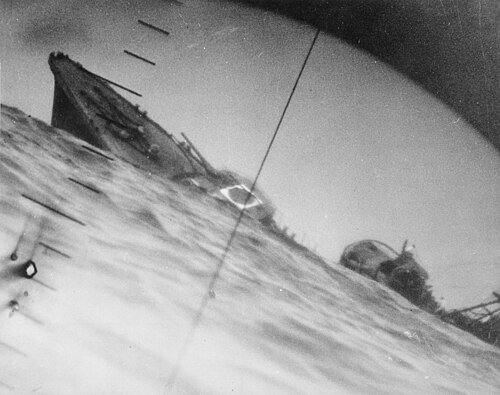
Do submarines still use periscopes? Yes, submarines do still use periscopes, although they now combine them with many other high-tech sensors as well.
At its simplest, a periscope uses two angled reflectors to send light down a long tube. A basic periscope looks a bit like a straightened “S.” The top opening faces whatever is being observed and light enters the tube. A reflector angled at 45 degrees turns that light straight down the main neck. Near the bottom is a second 45-degree reflector, which turns the light again and sends it out through the eyepiece. This setup lets someone look over a wall or around a corner without exposing themselves.
Once the neck becomes very long, as it must be on a submarine, lenses become necessary. Without them, the image would become too small and too dim, and it would be hard to keep it in focus. A periscope therefore includes an optical system inside the tube that relays the image downward in stages, keeping it sharp and at a usable size. Submarine periscopes also need variable magnification, because the operator may want a wide view for scanning and a narrower, zoomed-in view for identification.
Submarine periscopes are also built differently from the simple mirror-periscope often shown in textbooks. They need to be strong, precise, and reliable, so they usually use prisms instead of open mirrors. This can sound confusing because prisms are often associated with refraction (splitting light into colors), but the key trick here is reflection. In many periscope prisms, the light reflects off an internal face by total internal reflection, which behaves like an extremely efficient mirror without requiring a delicate metal coating. The light does refract as it enters and exits the glass, but the main 90-degree “turn” is typically done by internal reflection inside the prism.
Mirrors can lose a noticeable amount of light at each reflection, which makes the image dimmer. They also rely on a reflective coating that can be scratched, degraded, or tarnished over time. A prism assembly is a solid block of optical glass, which can be sealed, protected, and held in alignment more easily. That helps produce a brighter, clearer image with fewer distortions. In a classic layout, a prism at the top and another at the bottom each turn the light path by 90 degrees, guiding the image from above the surface down to the viewer.
Modern submarine “periscopes” have also become more than just optical tubes. Even when an optical periscope is present, it is often paired with cameras and sensors. Many systems include low-light cameras, infrared imaging, video recording, image stabilization, range finding, and multiple magnification modes. The goal is to spot, identify, and measure targets quickly while minimizing how long anything needs to be above the surface.
Periscopes can be very long. Some can reach around 18 meters, allowing the submarine’s hull to stay deeper while only the head of the periscope rises above the waves. That length is useful, but it comes with tradeoffs. When the periscope is raised, it can create a small wake and it can be detected visually, by radar, or by other sensors. Even if the submarine itself remains hidden below, anything sticking out of the sea is a potential giveaway. Because of that, submarines try to keep periscope exposures brief and purposeful.
Traditional optical periscopes also have practical drawbacks inside the submarine. A classic periscope is a rigid mast that has to pass down through the pressure hull and into the control room, which affects internal layout and takes up valuable space. It also creates a penetration point through the hull that has to be engineered and maintained very carefully. Finally, a traditional periscope is inherently a one-person-at-a-time device. One set of eyepieces means one person looking, and everyone else has to wait for a report.
To address these limits, many newer submarines use what are often called photonics masts (or optronic masts). A photonics mast telescopes up from the top of the submarine but does not extend down into the control room. Instead of a purely optical tube, it carries a cluster of sensors at the top, such as high-resolution cameras, low-light cameras, and infrared sensors. It can also include a laser range finder and other equipment for navigation and targeting.
The data from a photonics mast is carried to the control room by cables (often fiber optics) and displayed on monitors. That means multiple people can view the feed at the same time, recordings can be stored, and software can enhance the image. Because the mast does not need to be an optical “pipe” into the submarine, it can be smaller, lighter, and easier to integrate into the hull design.
This does not mean classic periscopes disappeared overnight. Optical periscopes are simple in concept, they can still provide a direct view with excellent clarity, and they do not depend on cameras and screens in the same way. For that reason, some submarines still carry an optical periscope, some rely mainly on photonics masts, and some carry both.
So, submarines still use periscopes, but “periscope” now describes a family of systems. The basic idea—taking a quick look above the surface while staying submerged—remains the same. What has changed is how that look is captured, shared, recorded, and kept as stealthy as possible. And this is what I learned today.
Sources
https://en.wikipedia.org/wiki/Periscope
https://science.howstuffworks.com/photonic-mast2.htm
https://www.spsnavalforces.com/story/?id=438
image By U.S. Navy – This tag does not indicate the copyright status of the attached work. A normal copyright tag is still required. See Commons:Licensing., Public Domain, https://commons.wikimedia.org/w/index.php?curid=2600575