
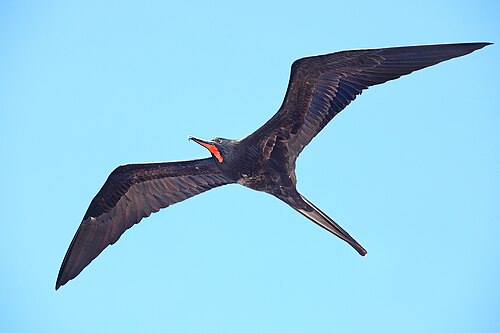
Can birds sleep while they fly? Not all species can, but there are some birds that can sleep while they are flying.
Most birds land to sleep. They perch on branches or buildings, balanced so well that they can stand on two legs without toppling over. Many species also have tendons that lock their feet into a gripping position, which means they can sleep without consciously using their muscles. Even birds that migrate long distances usually come down to feed and rest now and then. However, there are some birds that rarely come down and some, such as the common swift, that can stay in the air for almost a year without landing. How do these birds do it?
Birds that almost never land still need to feed, drink, and sleep. Swifts feed by catching insects in the air and drink by skimming low over water. They also have long, curved wings that make flight more efficient, so they don’t need to consume as much food for the same amount of movement. They sleep by shutting down one half of the brain at a time, a behavior called unihemispheric slow-wave sleep.
Scientists wanted to study this in detail, so they caught 15 frigate birds (birds that can spend up to two months without landing) and implanted EEG sensors in their skulls. These measured electrical activity in the birds’ brains and transmitted the data to the researchers. They also fitted accelerometers, which recorded how fast the birds were flying and how their bodies were moving. With this combined data, the scientists could tell when the birds were sleeping and what they were doing in the air at the time.
What they found was surprising. Frigate birds do sleep while flying, but they often sleep for only about 10 seconds at a time. They repeat these short bursts and end up accumulating roughly 45 minutes of sleep per day, mostly at night. When the birds are on land, they sleep for much longer stretches and can accumulate around 12 hours of sleep in a day. And when they sleep in flight, they usually sleep with only one half of the brain at a time. This is probably so they can keep one eye open and maintain awareness of other birds, reducing the chance of collisions. Occasionally, they will close both eyes and sleep with both halves of the brain at the same time, but this seems to be rare.
Frigate birds also use the structure of the air itself. They ride thermal updrafts that carry them high into the sky, and the researchers found that they tended to sleep during the upward, circling part of the flight and not during the descent. This makes intuitive sense: during the climb, they are more stable, and there is less need for active maneuvering than during the glide back down. Common swifts seem to follow a similar pattern. When they are on land, they sleep for around 12 hours a day, but in the air they rely on brief “micro-sleeps,” often with one half of the brain at a time.
If you or I tried to survive on 45 minutes of sleep broken into 10-second chunks, we probably wouldn’t last more than a few days before the damage started to set in. Frigate birds and common swifts don’t seem to suffer in the same way. In frigate birds, those short sleep bursts can include a tiny amount of REM sleep, which is noticeable because the birds briefly lose muscle tone. It seems these species have evolved to need less total sleep and to cope with extreme sleep deprivation without obvious harmful effects.
So these birds have evolved to sleep while they fly, and to stay aloft for weeks or months at a time. Swifts, for example, have tiny legs that reduce weight and long, curved wings that help them glide, lowering the energy cost of staying in the air. They are so well adapted to an airborne lifestyle that they are not very good on the ground. Their legs don’t support them well, and their wings are so long that taking off from flat ground can be awkward. So what are the advantages of not landing?
There are several real advantages. The first is avoiding predators, although frigate birds don’t really have many predators, so this is probably not the main driver. The bigger advantage is food. Swifts eat insects that are blown around by wind and weather. Just because somewhere has a lot of insects today doesn’t mean it will tomorrow, and being able to keep moving with the food, or quickly find a new patch, is a huge advantage. Staying airborne also allows birds to steer around bad weather systems, which connects directly to how much food they can find. And it can reduce competition because birds that can range widely can spread out more, instead of being crowded into the same safe roosting areas.
We picture a bird constantly flying as though it were a human constantly running, but it isn’t the same. Humans burn a lot of energy when they run. These birds have evolved flight styles and bodies that make long-distance flying remarkably efficient, and for them, gliding and soaring can be close to a resting state. And this is what I learned today.
Sources
https://www.lunduniversity.lu.se/article/watch-bird-can-stay-ten-months-air-without-landing
https://www.audubon.org/news/scientists-finally-have-evidence-frigatebirds-sleep-while-flying
https://www.nationalgeographic.com/animals/article/swift-bird-10-month-migration
https://galapagosconservation.org.uk/great-frigate-birds-sleep-fly
image By Benjamint444 – Own work, GFDL 1.2, https://commons.wikimedia.org/w/index.php?curid=13487246