
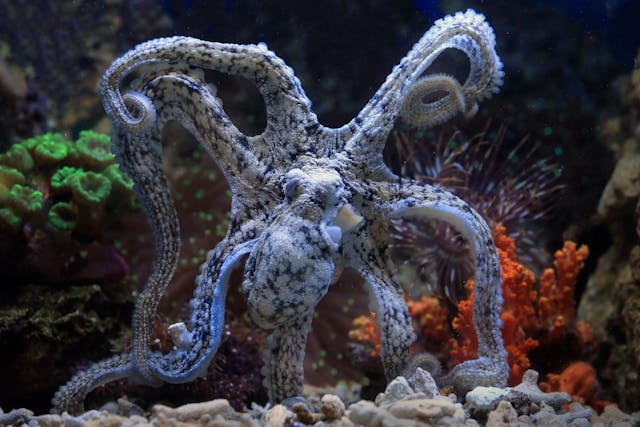
Why does an octopus have three hearts? An octopus has three hearts because getting oxygen from gills is hard work, and its copper-based blood does not carry oxygen as efficiently as human blood. Using three pumps keeps oxygen moving through the gills and around the body.
The job of a heart is to keep blood moving around a circulatory system. Somewhere along the route, the blood picks up oxygen. In mammals this happens in lungs, in fish it happens in gills, and in some amphibians a lot of oxygen can also be absorbed through the skin. The heart then sends oxygen-rich blood out to the organs, and returns oxygen-poor blood back to the place where it can be refilled.
Moving blood sounds simple until the distances get long, or the circulation has to push through a “bottleneck.” If an animal is large, it may need higher blood pressure to supply the brain and muscles. A giraffe is a classic example, because its heart has to push blood up a long neck. But even small animals can face the same problem if their oxygen-pickup step creates a large pressure drop. Gills are excellent at pulling oxygen out of water, but they do it by spreading blood through many tiny capillaries that sit close to the water. Forcing blood through those narrow vessels takes pressure, and water itself contains much less oxygen than air, so aquatic animals cannot afford to circulate slowly.
In many fish, one heart is enough: it pumps deoxygenated blood to the gills, and the oxygenated blood then flows to the body. Octopuses use a different design. An octopus has a main heart, called the systemic heart, and two smaller hearts called branchial hearts. The systemic heart sends oxygenated blood around the body to supply the organs. When that blood returns with most of its oxygen used up, it is directed to the two branchial hearts. These sit beside the gills and pump the blood through the gill capillaries so it can pick up oxygen again. After the blood is oxygenated, it returns to the systemic heart, which sends it back out to the body. In other words, one heart serves the body, and two hearts serve the gills.
Octopus blood is also unusual. Human blood is red because it uses hemoglobin to carry oxygen. Hemoglobin is an iron-based protein, and when it binds to oxygen it changes the way light is absorbed and reflected, giving blood its bright red color. When oxygen has been released to the tissues, the color becomes darker. Hemoglobin is very good at carrying oxygen per unit of blood, which allows humans to supply energetic muscles without having to move enormous volumes of fluid.
Octopuses and other cephalopods use hemocyanin instead. Hemocyanin is copper-based, and when it binds oxygen it gives the blood a blue color. Hemocyanin can work well in cold, low-oxygen water, but it is generally less efficient than hemoglobin at transporting oxygen, especially at warmer temperatures. It also makes the blood thicker, which means an octopus often has to move a larger volume of blood to deliver the same amount of oxygen. That extra pumping demand becomes even more important during activity, when the muscles need oxygen quickly.
Putting these facts together helps explain the three-heart design. The branchial hearts can maintain the pressure needed to push blood through the gills, while the systemic heart focuses on supplying the rest of the body. Separating those jobs helps keep circulation stable: the gills get the pressure they need, and the body still receives a steady flow of oxygenated blood. If the systemic heart had to do everything at once, it would be working against the resistance of the gills while also trying to maintain pressure for the organs.
Octopuses are mollusks (the same phylum as snails and slugs), but they are in a different class, the cephalopods. Many mollusks have hemocyanin-based blood, and many of them have a more open circulatory system. In an open system, the “blood” (often called hemolymph) is not kept entirely inside vessels. Instead, it bathes the organs directly in body cavities, and then it returns to the heart. This is simpler, but it is not ideal for fast delivery of oxygen to the organs and tissue. This is why snails move so slowly.
Octopuses are different because they have a closed circulatory system, more like a vertebrate’s, with blood mostly kept inside vessels. A closed system is good for an active lifestyle. Octopuses chase prey, wrestle with it, squeeze through tight spaces, and use bursts of jet propulsion to escape predators. All of that requires reliable oxygen delivery, and three hearts help meet that demand. When many octopuses swim fast, the systemic heart can slow down or even briefly stop, and they tire quickly. Walking or crawling along the seafloor is often a more sustainable way for them to move.
Some animals do without hearts entirely. Jellyfish have no heart, no lungs, and no brain. Oxygen and nutrients move by diffusion through their thin tissues, which works because their body plan is simple and their metabolism is relatively low.
Sources
https://www.scienceabc.com/nature/animals/why-do-octopuses-have-three-hearts.html
https://animals.sandiegozoo.org/animals/giraffe
https://medium.com/aha-science/why-does-an-octopus-have-three-hearts-40ceaf2e1fa2
Photo by Jeffry Surianto: https://www.pexels.com/photo/octopus-in-an-aquarium-9004403/