
Why do living things stop growing? Not all living things stop growing, but those that do stop for a number of different reasons. Mammals, birds, fish, reptiles, insects, and plants all follow different growth programs, and those programs reflect different body plans and different trade-offs.
Not all living organisms stop growing. Plants and fungi often do not finish in the same way an animal does. Trees, for example, can keep adding new tissue as long as resources are available. They may not grow much taller after a certain point, but they put on new girth in their trunks every year, which is why they have rings. Height is limited by physics and plumbing. As a tree gets taller, it becomes harder to transport water up the trunk against gravity, and harder to keep a continuous water column from breaking under tension. Eventually, the tree must generate more pull than its tissues can reliably manage, which reduces the amount of water reaching the leaves and limits photosynthesis. The maximum height of trees tends to be around 120 meters. Taller trees are also more likely to be damaged by storms, drought, and their own weight. That does not mean a tree is programmed to stop at exactly that height, just that beyond a certain point it becomes impractical and risky.
Mammals tend to stop growing because they have determinate growth, which is a developmental plan that aims for an adult size and then switches to survival and reproduction. It requires a lot of energy to grow, and once a mammal has reached a size that is large enough to compete, feed, and survive, there is often less benefit in continuing to get bigger. Being larger can help in some situations, but it comes with costs. Larger bodies need more food, take longer to build, and often reproduce more slowly. They also have more trouble losing heat than smaller animals do because a large body has less surface area relative to its volume, which makes cooling harder. Size also changes biomechanics. As animals get bigger, bones and joints need to become disproportionately thicker to support the extra mass, and falls, strains, and joint wear become more serious. So mammals do not stop growing because bigger is impossible, but because there is a point where the trade-offs often favor stabilizing at an adult size.
Mechanically, mammals stop getting taller because their long bones grow from growth plates (epiphyseal plates) at the ends. During puberty, hormones shift the body from grow longer toward finish and strengthen. Estrogen plays a key role here in both sexes. As sexual maturity approaches, rising sex hormones lead to estrogen activity in bone tissue, which gradually causes growth plates to fuse, so the bones can no longer lengthen. After that, the body can still change in plenty of ways, but height and limb length mostly stop.
Birds also tend to have determinate growth, and hormones are involved in ending rapid growth. Estrogen contributes to skeletal maturation in birds as well, and thyroid hormones are important for development and metabolic regulation. Birds have some of the same constraints as mammals, but they are built differently: many of their bones are relatively light and some are connected to air sacs, which reduces weight without sacrificing too much strength. This is a reason why dinosaurs were able to grow so large. That said, flight places strict limits on size. Larger birds need more muscle and more fuel, and they must still be able to take off, maneuver, and land safely. Many birds grow very quickly, often in a matter of weeks, because reaching a functioning adult body is urgent. For a bird, surviving long enough to fly well and feed efficiently is often a higher priority than becoming larger and larger.
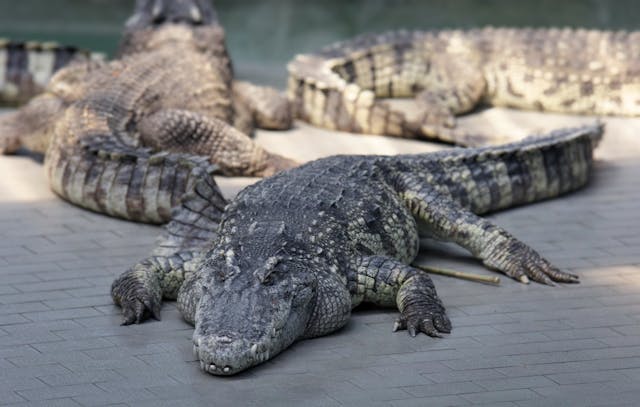
Fish and reptiles are often described as having indeterminate growth, meaning they can keep growing slowly after reaching maturity. They do not necessarily stop, but their growth rate can drop to very small amounts. This is partly because many of them are ectotherms (cold-blooded), so their metabolism and growth rate are strongly shaped by the temperature of their environment. Cold-water fish often grow slowly, while warm-water fish can have higher metabolic rates and faster growth. Many fish reach an adult size fairly quickly and then add only small amounts each year, depending on food supply, competition, temperature, illness, and how much energy is being diverted into reproduction. Crocodiles can continue growing for a long time, and very large individuals are usually older animals that have had consistent access to food. Snakes can also keep growing slowly, although growth varies widely by species, habitat, and diet. So the key difference is not that fish and reptiles have no limits, but that their “limits” are often ecological and physiological rather than a single puberty-driven skeletal shutdown.
Insects stop growing for a completely different reason. Insects have exoskeletons, and each time they grow, they must shed the old exoskeleton and form a new one. Growth happens in stages, tied to molting. Once an insect reaches its adult form, it no longer molts, and that effectively locks in body size. The hormones involved are not estrogen, but ecdysteroids and juvenile hormone, which control molting and the transition to adulthood. Adult insects can still gain mass, for example, by storing fat or developing eggs, but they must do so within the constraints of the final exoskeleton.
This is not to say that animals, plants, and insects cannot become larger over evolutionary time. Mutations can make individuals larger than the average, and the question is whether that extra size confers benefits that allow those individuals to reproduce more successfully than others. Sometimes it does, and the trait spreads. However, just as often, extra size brings extra costs and the lineage does not benefit. In many situations, selection for smaller size can be just as strong as selection for larger size. And this is what I learned today.
Sources
https://a-z-animals.com/articles/indeterminate-growth-do-some-animals-really-grow-forever
https://pmc.ncbi.nlm.nih.gov/articles/PMC3365796
https://www.popsci.com/story/science/ask-us-anything-grow-to-be-10-feet-tall
Photo by 3K: https://www.pexels.com/photo/crocodiles-on-gray-concrete-floor-13287668/