
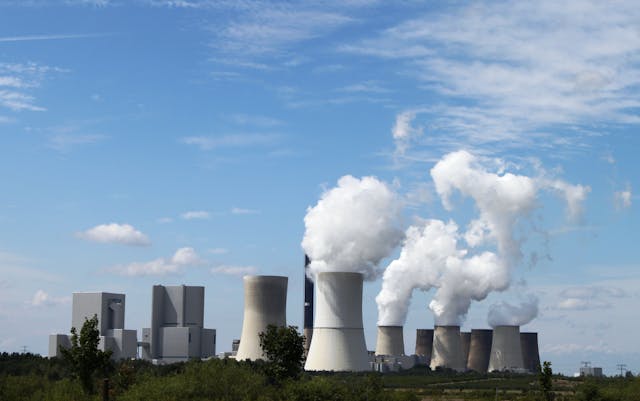
Why do power stations have giant chimneys? The large conical towers that power stations usually have are giant cooling stacks, which are there to remove excess heat after the electricity generation process. When we see them in the distance, white clouds are belching out of them, but this is mostly water vapor that becomes visible as tiny droplets, and it’s generally not harmful, though cooling towers can release small amounts of water drift, which is water that has picked up tiny particles from the power plant. Coal fired power stations also have smokestacks to release smoke from their boilers. Modern plants use scrubbers and filters to reduce pollutants, but coal exhaust still contains CO₂ and can still include harmful pollutants if controls are imperfect.
Coal, gas, and nuclear power stations all make electricity by producing heat. The heat generation methods differ, but they produce heat to boil water. In a nuclear power station, the heat comes directly from the nuclear reaction within the reactor core. In a gas and coal station, it comes from burning fossil fuels. A coal fired power station can burn through 50,000 tons of coal a day. It is ground down into a powder because that makes it much easier to burn than solid coal.
The heat is directed to giant boilers where water is added. The water is heavily filtered because any minerals in the water could cause corrosion to the parts of the machinery. The boiling water produces steam, which is highly pressurized and superheated. It is generally heated to about 550℃, and it has to be pressurized to allow it to reach such a temperature. The steam is then directed to turbines where it spins metal propellers. The heat energy in the steam is converted into electrical energy by the generators. Of course, no generator is 100% efficient, and a lot of the heat is lost to the machinery or remains in the water. Modern power stations, certainly modern nuclear power stations, are thought to be about 35% efficient, which means that 65% of their heat is not used. Purified water is very expensive, and the power stations want to reuse it as many times as possible, so they redirect it back into the power plant. To use it again, they have to remove the heat it is carrying and condense it from steam back into water.
Power stations pick up unfiltered water from rivers or other nearby sources and pump it through a network of tubes. Steam leaving the turbines passes over these tubes in a condenser. The cold water inside the tubes absorbs the heat, and this causes the steam to condense back into liquid water so it can be reused. Because the cooling water is always moving, the warmed water is carried away and replaced by cooler water, sometimes at flow rates of over 10 m³ per second.
Once the cooling water has picked up heat, it is pumped to the cooling towers and sprayed over plastic frames that creates a very large surface area. As the water falls through the frames, a small fraction of it evaporates, and that evaporation cools the rest of the water. The cooled water collects at the bottom of the tower and is pumped back to the condenser, while warm, moist air rises out of the top. When that moist air mixes with cooler outside air, it can form the familiar white plume of tiny water droplets seen above many cooling towers.
You can see this to be true because nuclear power stations also have cooling towers, and they don’t burn fossil fuels to heat the water inside their core. The water vapor is being produced when the excess heat is removed from the steam and the machinery. They don’t need cooling towers, but it is a good way of reclaiming the water they use to cool the plant and cutting down on the amount of water they have to take from nearby sources.
The white clouds coming out of the cooling towers are only clouds of harmless water vapor, but coal fired power stations do have chimneys as well. When they burn coal dust, they produce a lot of smoke and hazardous gases, which are vented out of the boilers. These chimneys are very tall in order to raise the smoke above the height of surrounding settlements. This may help local people, but it does spread the smoke over a much larger area. Modern power stations have multi-million-dollar filters that are supposed to remove all of the particles and gases, but not all of them work 100% of the time. And this is what I learned today.
Sources
https://www.usgs.gov/media/images/cooling-towers-a-power-production-facility
Photo by NGSOFT IT: https://www.pexels.com/photo/boxberg-power-station-under-blue-sky-5793277/