
What was the first mass-produced consumer product? Items have been produced in large numbers for thousands of years, but most were not everyday goods for ordinary people to buy. The first true mass-produced consumer products were most likely textiles in the late 18th century.
There is evidence of large-scale production going back thousands of years. However, many of the best early examples are weapons. The Chinese, for example, made bronze crossbow parts using molds that could produce many copies at once. This allowed more weapons to be made and sometimes made it possible to replace broken parts. There are examples of other kinds of molds as well. It could also be argued that books were mass-produced once the printing press was invented and paper became cheaper. There is a difference between these things and later mass production, though. Earlier societies could make many copies of the same thing, but modern mass production depends more on standardized processes, specialized stages of work, and, eventually, machines that can keep producing the same item quickly and cheaply.
The first mass-produced consumer product was most likely textiles, but there had been a steady move toward standardized production before then. A French gunmaker called Honoré Blanc was important in this development. He came up with ways of making muskets more cheaply and accurately. He used molds, gauges, and jigs to make sure that all of the pieces were the same no matter who was making them. This meant that multiple identical parts could be made. However, it was still slower than later factory production because the work was still being done by hand.
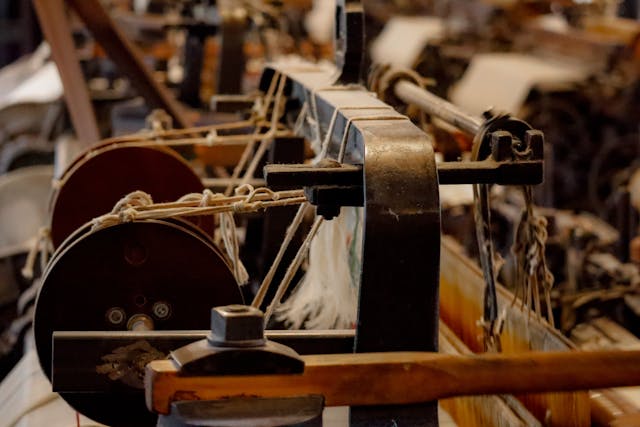
In the 18th century, several inventions turned textile making from a cottage industry into a mass-production industry. The flying shuttle, spinning jenny, water frame, and power loom all made spinning and weaving much easier and faster. Fewer people could make more cloth in less time than ever before. Each invention also created new problems in other parts of the production line, which then led to further inventions. It was a knock-on effect.
But it was not just the machines that made mass production possible. Several factors had to come together, and no one factor mattered more than the others. Some countries had many of the necessary conditions, but not all of them, and that is one reason why mass production developed when and where it did.
You need machinery, of course, but you also need a source of power. Many places used waterpower, but there is a limit to how much energy it can provide. To run large numbers of machines, steam power was far more useful, and that relied on coal. The Industrial Revolution began in the UK partly because there was a large supply of easily accessible coal. Then, large buildings were needed to hold the machines, along with a workforce to operate them. After that, supply networks were needed to get raw materials to the factories. Each of these things depended on the others and also helped the others grow. More coal meant more steam power, which meant more machines, which meant larger factories, which meant more workers, and so on.
But mass-produced consumer goods also need a market. Before urbanization, markets were too spread out and too small to make large-scale consumer production worthwhile. As more people moved into towns and cities, it became much easier to sell the same products to large numbers of people. A wealthier middle class was also beginning to appear, and people needed enough money before they could buy non-essential goods. Transport networks were developing at the same time as all these other changes. Canals and railways made it possible to move goods to other cities, and steamships made it possible to move them abroad.
Mass production of consumer goods increased rapidly from there. It began when it did because technology, energy, labor organization, transportation, and market demand all lined up. Once the system existed and proved successful, it spread to other industries. And this is what I learned today.
Sources
https://libguides.aisr.org/industrialrevolution/corporations
https://www.history.com/articles/industrial-revolution