
What is tuberculosis? Tuberculosis (TB) is a contagious, airborne bacterial infection caused by Mycobacterium tuberculosis.
If you have read any books set in Victorian London, you will have seen character after character die of “consumption.” It killed two of the famous Bronte sisters, as well as two of their other sisters and their brother. In the early 19th century, it is thought to have been responsible for a quarter of all deaths in Europe. The Industrial Revolution was in full swing and people were moving to cities, living in overcrowded and often unclean houses. It was very easy for a contagious disease like tuberculosis to spread in that environment. It is not generally as contagious as the flu, but, if there are enough people in a close area, it will spread.
Tuberculosis is not often seen in developed countries these days, although it is still there. It is more common in poorer countries. Roughly 10 million people become ill with tuberculosis every year. It can be cured, but it still causes well over a million deaths per year. It is estimated that over a quarter of the world’s population have been infected with tuberculosis at some point. In many of those people, the infection stays hidden and inactive for years, which is one of the reasons it is so difficult to eliminate completely.
Tuberculosis is caused by a bacterium called Mycobacterium tuberculosis, and it is thought that it has infected humans since very early in our history. Skeletons have been found that show evidence of TB. The bacterium doubles every 20 hours, which is much slower than most other bacteria. Tuberculosis bacteria spread through the air when people cough or sneeze, and they can stay airborne and alive for several hours before finding a new host. There is also a form called Mycobacterium bovis, which causes tuberculosis in cows, goats, and sheep. It can be transmitted in milk, and a lot of people developed tuberculosis from drinking raw milk.
When a person inhales a tuberculosis bacterium, it enters the lungs and reaches the alveoli. The immune system goes into action and the bacterium is swallowed up by a macrophage, whose job is to digest invaders using enzymes. Rather than being digested, the tuberculosis bacterium takes over the inside of the macrophage and starts to multiply. The immune system sees what has happened and traps the infected macrophage, trying to stop it from spreading around the body. This grows into a small round nodule called a tubercle, which is where the name tuberculosis comes from. In some people, the immune system can keep the bacteria inside these tubercles and the disease never takes off. This is called a latent infection, and the person may not even know that they have it. However, if the immune system cannot contain it, the bacteria can get into the bloodstream and infect other areas of the body. They can severely damage the lungs, and tuberculosis can also spread to places such as the bones, kidneys, or brain. Some of the tissue in the lungs is killed and comes away, causing the person to cough. When they cough up these pieces, they cough up bacteria as well, which spreads the disease.
Tuberculosis can mostly be treated with antibiotics, which is why it kills nowhere near as many people now as it did in the 19th century. Without treatment, it kills roughly two-thirds of people within about three years. The problem in recent years is that several strains of the bacterium have become resistant to the antibiotics used to kill it. If that resistance spreads further, tuberculosis will become much harder to treat.
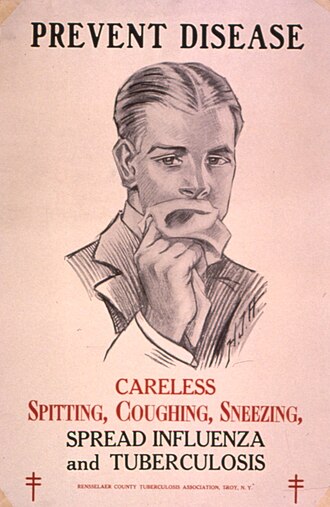
In 1819, a French doctor, Rene Laennec, realized that the tubercles in the lungs were causing consumption. In 1865, another French doctor, Jean Antoine Villemin, showed that tuberculosis could be spread. In 1882, a German doctor, Robert Koch, discovered the bacterium that caused tuberculosis. He later received the Nobel Prize for this discovery. All of these discoveries led to cures and a lot of methods of prevention. The bacterium could be killed by several antibiotics. It could also be controlled and prevented by pasteurizing milk. A vaccination was developed as well. The larger efforts went more into prevention than cure. Pasteurizing milk and food were huge game changers, as were increased sanitation in hospitals and improvements in the cramped places where people were living. There were public campaigns to stop people spitting and to encourage them to cover their mouths when they coughed. It took a long time, but, over the course of the 20th century, the number of cases of tuberculosis declined. Tuberculosis could, in theory, be eradicated. However, that would cost an enormous amount of money, and finding all of the hidden bacteria would probably be impossible. And this is what I learned today.
Sources
https://www.mayoclinic.org/diseases-conditions/tuberculosis/symptoms-causes/syc-20351250
https://www.who.int/news-room/fact-sheets/detail/tuberculosis
https://en.wikipedia.org/wiki/Tuberculosis
https://www.cdc.gov/world-tb-day/history/index.html
Image By Rensselaer County Tuberculosis Association. – U.S. National Library of Medicine Transferred from en.wikipedia, Public Domain, https://commons.wikimedia.org/w/index.php?curid=4352690