
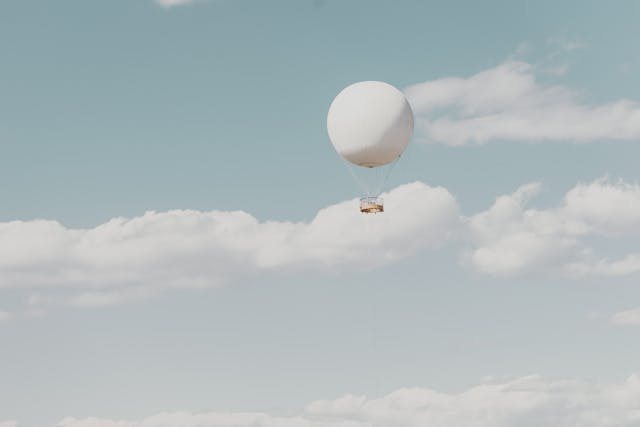
Do we still need weather balloons? Yes, weather balloons are still needed. Satellites can provide a lot of data, but they still cannot sample the atmosphere directly from inside it, and they are far more expensive.
There are thousands of satellites in orbit around Earth at the moment, so it is easy to assume there is no longer any need for weather balloons. Weather balloons have been around since the end of the 19th century, although hot air balloons were invented almost a century earlier. One reason weather balloons were not used sooner is that automatic recording equipment had not yet been invented. Léon Teisserenc de Bort launched some of the first weather balloons in France in 1896, and he used hundreds of them. He made numerous discoveries about the upper air and helped identify the tropopause and the stratosphere. The tropopause is the boundary between the troposphere (the lowest layer of the atmosphere, where most weather happens) and the stratosphere. It occurs at roughly 9 km over the poles and about 17 km over the equator, although it varies. Despite these discoveries, early balloon work was limited by the instruments available at the time, and finding the balloons after they landed was often challenging.
What are modern weather balloons and what do they do? Weather balloons are made of strong, flexible latex. They are filled with hydrogen or helium, loaded with an instrument called a radiosonde, and released. Hydrogen is commonly used. Balloons ascend at variable rates depending on the amount of gas inside them; 300 meters per minute is a common speed. Some modern balloons use valves or vents so gas can be released if a slower ascent is needed. As the balloons get higher, the air pressure drops and they expand dramatically. They often reach about 30–40 km, because the balloon stretches so much that it ruptures. The basic idea is to let the balloon go as high as it can until it bursts.
A bursting balloon scatters pieces of latex that drift down and eventually land somewhere on Earth, sometimes ending up in the oceans. In some systems, gas can be vented for a more controlled descent, but many flights still end with a rupture. The radiosonde is attached below the balloon, usually with a parachute. The parachute is not there to save the radiosonde from damage so much as to reduce the risk of it injuring someone on the ground. Radiosondes are generally treated as disposable. If found, many have a return address printed on them, but the majority are never recovered. That is not a problem for the weather data, because the information has already been transmitted back to the weather center. Each unit is not that expensive (often quoted at around $25), but the larger concern is the environmental cost of dropping equipment across the landscape. For that reason, people are experimenting with biodegradable parts and better recovery systems.
As the weather balloon ascends, the radiosonde keeps a record of its altitude and position and takes measurements of temperature, humidity, atmospheric pressure, and wind speed and direction. This kind of vertical profile is often called an upper-air sounding. Wind is measured indirectly, because the balloon drifts with the air currents and its changing position reveals how the air is moving at different heights. In the early days of weather balloons, the operator had to find the balloon to recover the data, but these days the data is beamed back in real time. All of this information gives the weather center a snapshot of the column of air directly above the launch point, which can give a much better idea of what the weather is likely to do next. The data is also used to check and adjust computerized weather models. Weather balloons are extremely common, and many launch sites send up balloons at fixed times each day. The USA and Canada together launch roughly 100,000 of them a year.
So, wouldn’t it be possible to replace them with satellites? Satellites are an amazing way to gather enormous amounts of information about Earth, but they cannot do what weather balloons can do. Satellites can detect ground temperature, cloud heights, the amount of water in the atmosphere, and many other things, but they have difficulty producing the same kind of direct measurements through many altitudes, the way a weather balloon can. Also, even though there are huge numbers of satellites in orbit, they are extremely expensive and getting access to one is not easy. Repositioning satellites for specific weather needs is tricky as well. There are dedicated weather satellites in space, but the data they gather is used in conjunction with the data gathered by weather balloons. And this is what I learned today.
Sources
https://en.wikipedia.org/wiki/Weather_balloon
https://en.wikipedia.org/wiki/Radiosonde
Photo by ROMAN ODINTSOV: https://www.pexels.com/photo/white-hot-air-balloon-flying-in-the-cloudy-sky-7539903/