
Why did people start using wallpaper? People first started using wallpaper to insulate their houses, but only the rich could afford it. Later on, wallpaper became cheaper and people used it because they couldn’t afford tapestries to cover their walls.
Wallpaper, along with paper itself, was invented in China. The earliest known wallpaper was used in China in 200 BC and it was made out of rice. This is not the same as the rice paper that we eat today. It was made with bark from the sandalwood tree, along with other ingredients, including rice, and is called Xuan paper. It took a long time to make, having over 100 steps, but it was strong and soft. There are still Chinese books surviving today that were written on this kind of Xuan paper. Another property it had was that, when it was hung on the walls of a house, it helped insulate the building. The paper was expensive and only really the wealthy could afford to hang or paste it to their walls. Sometimes they would also hand-paint designs on the paper to make the house more colorful and decorative.
It took a thousand years, but papermaking slowly journeyed along the Silk Road to the Middle East and finally into Europe in about 1200. Europeans started using wallpaper in the early Middle Ages, but it was still quite expensive and not everybody could use it. However, wallpaper was cheaper than the tapestries it was designed to replicate, which gave it a useful place in the market.
In the Middle Ages in Europe, wealthy people tended to live in large stone houses which were very cold. Stone is a heat sink, which means it is very good at absorbing heat. If you ever spent the night lying on a stone floor, you would know that the stone very quickly absorbs the heat from your body. A castle could be cold even if there was a fire burning because so much of the heat would sink into the stone. To keep castles warmer, wealthy people used carpets and hung tapestries on the walls. The tapestry prevented a lot of the heat in the room from being absorbed by the stone walls. The tapestries were also very decorative and were expensive because they were handmade, often by highly skilled craftspeople.
The next tier down of nobles also lived in cold houses, but they couldn’t afford the tapestries to cover their walls and keep them warmer. Instead, they bought large sheets of paper painted to look like tapestries. They either hung or glued them on the walls. Paper was still expensive, but it was cheaper than a tapestry. These coverings sometimes came in pieces, but they were meant to be assembled into a single image, not arranged in repeating patterns like the wallpaper we have today. During Henry VIII’s reign, war with France cut off access to many of the tapestry makers, and even the wealthy began to turn to wallpaper as a practical substitute.
Over the next couple of centuries, wallpaper was printed using block printing. A design was cut into a wooden block and stamped onto the paper. The designs were often taken from a known tapestry, so wallpaper still tried to imitate older, more expensive wall coverings. The price of paper slowly dropped and wallpaper became more common. Woodblock printing also became more detailed, and very colorful patterns of wallpaper became available. It was still a long process to woodblock-print wallpaper, though, so it did not suddenly become cheap overnight.
In the mid-18th century, a machine that could print wallpaper automatically was invented in France and wallpaper entered a new era. A machine that could produce continuous lengths of paper was invented, and wallpaper was also sold in rolls for the very first time. The designs became beautiful and often very complex. Britain also had a wallpaper industry, but it was heavily taxed, which allowed the French to become the most prolific producers of wallpaper. The tax was repealed in the early 19th century and that, along with new printing technology and new ways of mass-producing paper, increased Britain’s ability to produce wallpaper. It became much cheaper and working-class people could afford it for the first time. It gave them a way to brighten up the small, cramped houses they were living in, and wallpaper became extremely popular in Victorian England, when people often wanted busy, colorful interiors.
Today, there are endless varieties of wallpaper available and we take it for granted, but it has only been relatively recently that ordinary people have been able to hang wallpaper on their walls.
Sources
https://www.bbc.com/culture/article/20181106-the-surprising-story-of-wallpaper
https://en.wikipedia.org/wiki/Xuan_paper
https://en.wikipedia.org/wiki/Traditional_Chinese_house_architecture
https://en.wikipedia.org/wiki/Wallpaper
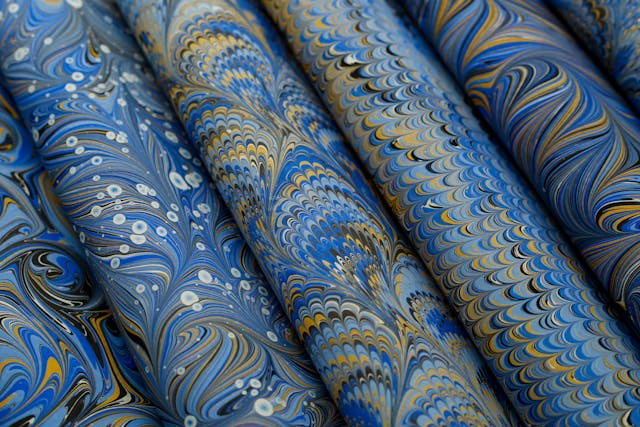
Photo by betül nur akyürek: https://www.pexels.com/photo/abstract-blue-and-gold-marbled-paper-rolls-35985298/