
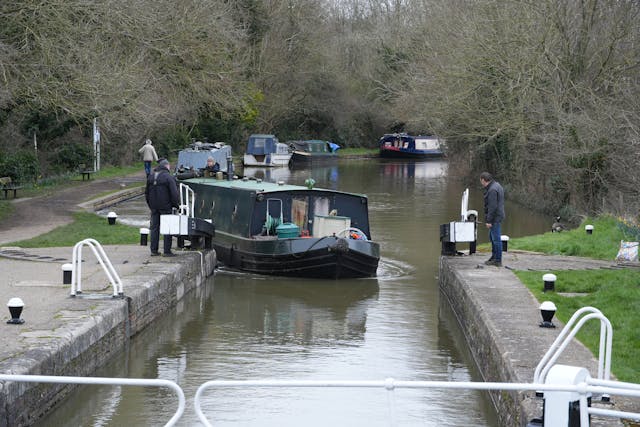
When did people stop using canals? Canals began to die out in the early 1900s as they were replaced by faster railways and more powerful trucks.
The building of canals in many countries peaked in the mid 19th century. Britain had a denser network of canals than any other country, and at the peak, there were 6,400 kilometers of networked canals. The majority of these canals were built between the 1770s and 1830s in a period that became known as the “Canal Mania”. After this period, the existing system was still heavily used, but not many new canals were built. Up until the First World War, shipping by canal was the most common way of moving freight around the UK, but that gradually began to change.
The English word “canal” comes from via French, from the Latin word “canalis”, which means “a water pipe, groove, or channel”. When early humans invented boats, they sailed on the sea, on lakes, and on rivers. The problem with those is that you cannot control where you are going. In civilizations going back as far as Mesopotamia, people cut canals for irrigation purposes, but they were probably not used for shipping until roughly 500 BC. Both China and Egypt developed canals for navigation. Between then and the 7th century AD, China developed a network of canals. However, it was not until the invention of the canal lock in the 10th century that canals flourished. Locks allow canal boats to ascend and descend, which means canals can reach many more places and become much more useful.
The first real canals were built in Europe in the 12th century, and they slowly began to spread, but it was the discovery of coal and its use as a power source for steam engines in the late 18th century in Britain that really revealed the need for canals. Up to that point, shipping things by canal can be useful, but there are not many things that cannot also be shipped by horse and cart. Canals don’t reach many cities, so a cart is going to have to be used at some point, so people didn’t see the need to use a canal. Coal is very heavy, and shipping it long distances by horse and cart is impractical.
The first canal for coal in Britain was commissioned in 1759 by the Duke of Bridgewater to get coal from his mine to Manchester. He thinks that he will be able to ship more coal, more quickly, and therefore increase his profits. He is right, and this starts the “Canal Mania”. As more canals are built, more mines are dug, and more coal is shipped, leading to a need for more canals. Technology also increases as well, with improvements in locks, iron bridges to span unspannable gaps, and improved engines for the canalboats. The increased canal network connected far more cities than before, and it became much easier to ship coal and anything else by canal. The Industrial Revolution allowed the canals to be built, but the canals allowed the Industrial Revolution to take place. The one couldn’t have happened without the other.
Everything began to change with the invention of the steam locomotive in the early 19th century. In the beginning, trains were not fast, not powerful, and not reliable, but they improved rapidly. Very quickly, it became obvious that trains could transport far more gross weight and much more quickly than a canalboat ever could. Once people realized that, investment money was thrown at the railway network, and it expanded rapidly. Canal companies could no longer compete, and they had to cut their prices to retain customers. By the 1850s, the amount of cargo transported on the canals had fallen by two-thirds, and a lot of the people who worked on the canals lost their jobs.
Some canals continued to be profitable, but the second nail in the coffin was the invention of the automobile in the late 19th century. As with trains, in the beginning, they were not powerful or reliable, but that very quickly changed. The First World War introduced a need for trucks that could carry large loads from train stations to where they were needed, and that technology came back to civilian life after the war finished. Now, thanks to trains and trucks, there was no need to use a canal at all. This was a similar story in any country that had used canals.
The canals fell into disuse, and some of them were filled in. In Britain, at least, the canals were adopted by the British Waterways Boards in the 1960s, and they closed down all the canals that couldn’t be saved and worked hard to rebuild those that could. Slowly, the canals turned into a leisure industry, which is mostly what they are used for today. And this is what I learned today.
Sources
https://www.historyworld.net/history/Canals/506?section=ToThe18thCentury
https://www.etymonline.com/word/canal
https://en.wikipedia.org/wiki/History_of_the_British_canal_system
https://en.wikipedia.org/wiki/Canals_of_the_United_Kingdom
Photo by Malcolm Stirling: https://www.pexels.com/photo/people-standing-around-barge-on-river-20506551/