
When were streets first named? Nobody can pinpoint exactly when streets were first named, but, presumably, people started to give streets names from the very earliest cities.
Among the world’s first cities were Jericho and Çatalhöyük. They were both formed in about 7500 BC and began as a collection of a few hundred people, before growing to a few thousand. These cities were rare and it was only in about 4000 BC that cities started to become more common. Farming methods had improved, and the increased quantity of food meant that cities could become larger. There are many advantages to living in cities over living as small groups of people, not least the ability to share labor and safety. However, cities require a more stable source of food. These first cities most likely had some kind of naming system for their streets, but they had no system of writing. I think it is safe to assume that they had names for their streets because it is always necessary to differentiate parts of a city. Even if these names were just nicknames, referring to something near the street, something about the street, or where the street led it, it can be considered a street name, albeit an informal name.
The first actual evidence for street names comes from Mesopotamia in roughly 1800 BC. These street names are listed in house sale and property boundary documents that were written on tablets. Pieces of land are listed and described with a date and what borders them on each side. These might be neighboring houses, they might be canals or rivers, and, sometimes, they are named streets. One of these is called Broad Street of the Orchard. That is obviously a name that began as a descriptor nickname and evolved to be an official name. There are a lot of examples from Mesopotamia because they left a huge number of legal tablets concerning the details of everyday life. We can also assume that because a street name is first found in this document, they were in common usage at the time. In places where writing was on papyrus, wood, or plaster, the same names may have existed but didn’t survive.
Following civilizations continued the practice, but there was never a standardized system. Romans had many named neighborhoods and streets (vici), but naming wasn’t standardized the way it is today, and signage was limited. They also did it far more frequently in wealthier areas of the cities than they did in poorer areas. They also didn’t always mark the names on the streets. The few times they did, we can still see them inscriptions, but they are few and far between. Most of the names were only known to local people or only written down when legal documents demanded them. Cities tended to be smaller than today, and people didn’t travel as far, so addresses usually only needed to mention someone’s house.
Street names started to become fixed in Medieval Europe. This was partly because cities were expanding faster than ever before, and partly because governments were becoming better at accurate record keeping. Most of these records were to do with tax and it was necessary to know where people and businesses and were so they could be taxed correctly.
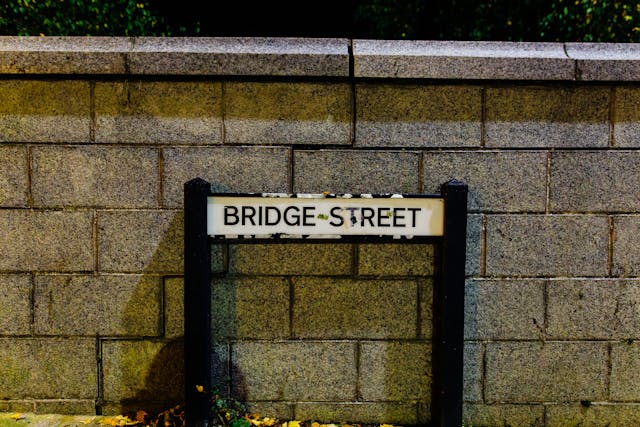
Most of these street names were to do with an industry in that area, such as Fish Street and Butcher Row, or a destination, such as London Road, or something that was located on the street, such as Church Street or Bridge Street, or for a wealthy family that owned property there.
In the 18th century, along with the increase in the size of cities, the number of maps being produced, and the amount of government record keeping, there was a major push to put names on streets using signs. Paris might have been the first city to do this, with tin plates being used in 1728. Then, over the next hundred years, many European cities followed suit. In the 18th century, street signage and house numbering spread together as governments tried to make cities easier to manage.
These days, cities are still expanding, so there are a lot of street names named after famous people or famous events. Cities often have more than one street with a similar name, as well. However, if you go to cities with a long history and find streets in the center of the city, or where the old city used to be, you can often get a sense of the history of the place by reading the street names. And this is what I learned today.
Sources
https://en.wikipedia.org/wiki/History_of_cities
https://en.wikipedia.org/wiki/%C3%87atalh%C3%B6y%C3%BCk
https://en.wikipedia.org/wiki/Jericho
https://en.wikipedia.org/wiki/Street_name
https://history.stackexchange.com/questions/14390/when-did-streets-get-names
https://scholarlypublications.universiteitleiden.nl/access/item%3A2966310/view?
https://www.jstor.org/stable/4199973?
Photo by Kelly : https://www.pexels.com/photo/bridge-street-signage-3129809/