
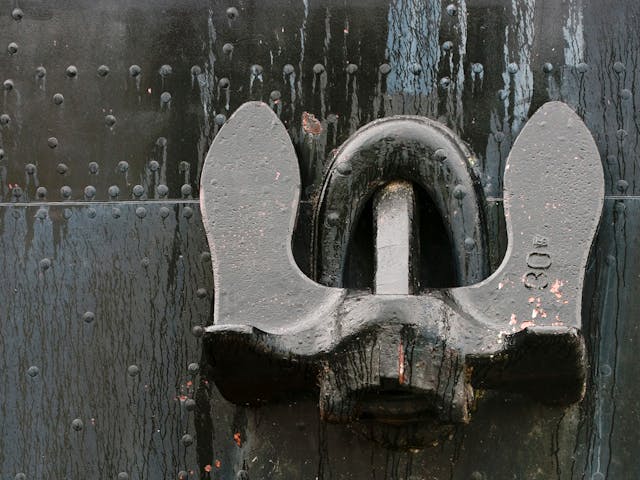
How does a ship’s anchor work? A ship’s anchor works because the anchor digs into the seabed and the heavy chain creates a huge amount of resistance while keeping the pull on the anchor low and steady. Most people think that when ships rest at anchor, the only thing holding them in place is the anchor itself digging into the seabed, but a lot of the holding power also comes from the chain.
When a ship has stopped and wants to stay in place, the captain gives the order to lower the anchor. Without the anchor, the ship will be at the mercy of the wind and current unless it uses its engines to hold position. The anchor is designed to keep the ship attached to one point on the seabed. The anchor has to be very heavy, and working out the correct size and weight is a complex calculation. The calculation takes into consideration the size of the ship, its displacement, the type of seabed, the wind, the sea current, and the weight and length of the chain. Some of the largest ships have anchors that weigh over 30 tons. The anchor has to be heavy enough to sink quickly and set properly, but its holding power is not just about weight. The shape matters too. It needs to be able to dig into sand, mud, or gravel and stay buried when the ship moves with the wind or tide.
There are also several different types of anchor to cope with different seabeds and different kinds of ships. The traditional type is the admiralty anchor, or some variation of it, and this is the shape most people probably imagine when they think of an anchor. It has a central shank with two curved arms and flukes that can hook into the seabed. A lot of large ships use something called a stockless anchor. It is similar in general purpose, but the flukes are hinged, which makes it easier to store in the hawse pipe at the bow of the ship. The hinged design also helps it settle into the seabed more easily when the direction of pull changes a little as the ship swings with the wind and current.
The anchor is obviously very important because it fixes the ship to a point on the seabed, but when it comes to keeping the ship steady, the chain is just as important. Depending on the size of the ship, the links of the anchor chain can weigh 150 kg each, and on very large ships they can be much heavier. The total length of the chain is also dependent on the size and displacement of the ship, as well as the depth of the water.
An anchor chain is measured in shots. Each shot is 15 fathoms, or 90 feet, or about 27.4 meters in length. A fathom is 6 feet, which is supposed to be about the length of a person’s outstretched arms, and it comes from the Old English fæðm, meaning “outstretched arms” or “hug.” The shots are traditionally marked so that sailors can tell how much chain has been paid out, although the exact color system can vary. As an interesting aside, this is where the phrase “bitter end” comes from. The bitt was the strong post that the anchor cable or chain was secured to. In bad weather, all of the anchor chain might have to be let out, right down to the bitter end.
The chain is incredibly heavy. On a modern aircraft carrier, one shot of chain can weigh about 9 tons. Once the anchor has caught in the seabed, more chain is paid out than might seem necessary. This is important because the weight of the chain pulls it down into a curve known as a catenary curve. Part of the chain lies along the seabed, and the rest curves upward toward the ship. This produces a lot of drag and friction, which helps resist the movement of the ship. More importantly, it means the pull on the anchor is mostly horizontal rather than upward. Anchors hold best when they are pulled sideways through the seabed, because that keeps the flukes buried. If the chain pulled sharply upward, the anchor would be much more likely to break free.
The slack and weight in the chain also act like a shock absorber. If the ship suddenly surges because of a wave or a gust of wind, the force is first taken up by the heavy chain lifting off the seabed and straightening slightly. That reduces the sudden jerk on the anchor itself. In other words, the chain helps the anchor hold, and the anchor helps the chain do its job. The system works because the two parts work together.
The main disadvantage of the anchor-and-chain system is that the enormous weight has to be lifted back up and stored on the ship. On a very large ship, the anchor and chain together can weigh well over a hundred tons. The ship has to be strong enough to support that weight, and all of that metal also reduces the amount of cargo space and carrying capacity available. Even so, it is still one of the simplest and most reliable ways of holding a ship in place. And this is what I learned today.
Sources
https://www.boat-ed.com/blog/what-is-a-boat-anchor-and-how-does-one-work
https://en.wikipedia.org/wiki/Anchor
https://en.wikipedia.org/wiki/Catenary
https://en.wikipedia.org/wiki/Stockless_anchor
https://www.usni.org/magazines/naval-history-magazine/2017/december/anchors-chains-and-stoppers
Photo by ChurchArt Online: https://www.pexels.com/photo/iron-shoe-soles-on-metal-wall-13181244/