
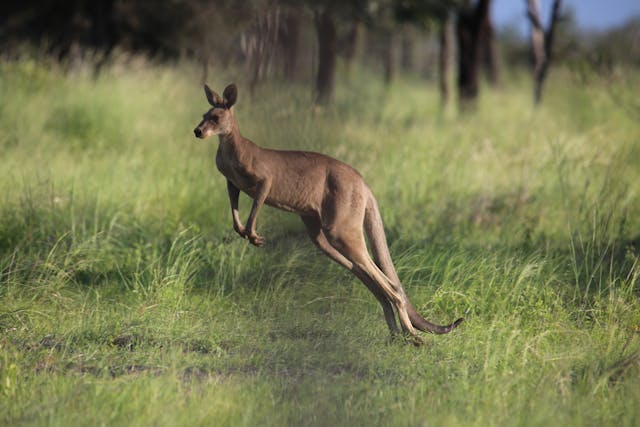
How can kangaroos hop so fast? Kangaroos can hop so fast because they have very large tendons in their legs that act like natural springs.
Kangaroos are native to Australia and there are four species. Those are the red kangaroo, antilopine kangaroo, eastern grey kangaroo, and western grey kangaroo. The largest and the fastest species is the red kangaroo. Adults can grow to be about two meters tall and weigh about 90 kg. They have a top speed of about 70 km/h, but they can’t sustain that for more than a short distance. Their comfortable hopping speed is about 25 km/h. Once a kangaroo reaches that speed, they can move with far more energy efficiency than an animal that has to run.
If you wanted to move at top speed, hopping would be the furthest thought from your mind. Humans are not built to hop because we are relatively heavy compared to the amount of energy we can produce. We also have brains that limit the amount of force we can produce so that we don’t injure ourselves. Every time we take one hop, our muscles need to produce the power to lift us off the ground and propel us forwards. Once we land, to take the next hop, the muscle in the other leg has to produce the same amount of power. There is never a point where we don’t have to produce power to move. This is not the same for kangaroos.
The rear legs of a kangaroo seem to be shaped like an L, but there is more to the leg than that. There are four parts. The top of the leg has a lot of muscle and is difficult to see when they are standing up. It becomes clearer when they are moving. This extends to the first joint, which is the kangaroo’s knee. The next part is the lower leg down to what looks like a backwards knee but is actually an ankle. Like many animals, the kangaroo runs on the balls of its feet and its toes, while the rest of its foot is in the air and can be mistaken for a lower leg. Then there is the top part of the foot going down to the ball of the foot and the toes. Kangaroos have long claws which they can use for fighting but which are more useful for gripping the ground when they hop, giving them traction and allowing them to put more force down into the ground.
The muscle at the top of the kangaroos’ legs is used for small movements or when it begins to hop. Down the back of the lower leg going into the top of the foot is a very thick and very elastic tendon. This is the secret to the kangaroo’s ability to hop. The muscle, called the gastrocnemius muscle, produces a tremendous amount of force to start the kangaroo on the first hop. When the kangaroo lands, the front foot takes the impact and bends, stretching the tendon. Almost 70% of the energy is transferred into the tendon, which acts like a spring, contracting and then expelling the energy. With each hop, a large amount of energy can be reused, which means the muscles don’t have to work very hard to keep the kangaroo moving. At speeds of about 25 km/h, they can basically keep hopping forever because they are running on cruise control. If they need to go faster than that, they can, but their muscles have to add the extra energy. They also travel several meters between hops when traveling at speed. Their strong tendons and muscles mean they can jump high as well. The red kangaroo can jump up to 3 meters high.
Their tail also plays a very important role in their ability to hop. It balances them, and it also acts as a counterweight.
Kangaroos are the only large mammals in the world that move by hopping. There are other animals that can hop, but it is not their primary source of locomotion. There is a theory that kangaroos evolved this ability because of the hot, flat desert they live in. Their efficient hopping ability means they can travel vast distances to find food and water without expending a lot of energy. They also don’t overheat because they are not using all of their muscles. And this is what I learned today.
Sources
https://www.bbc.com/news/science-environment-47130734
https://www.discoverwildlife.com/animal-facts/mammals/how-why-do-kangaroos-hop
https://animals.howstuffworks.com/mammals/kangaroo-hopping.htm
https://a-z-animals.com/blog/how-fast-are-kangaroos-discover-top-speeds-and-agility
https://en.wikipedia.org/wiki/Kangaroo
Photo by Tharshikan Sivapprakasam: https://www.pexels.com/photo/kangaroo-leaping-in-rockhampton-grasslands-30069929/