
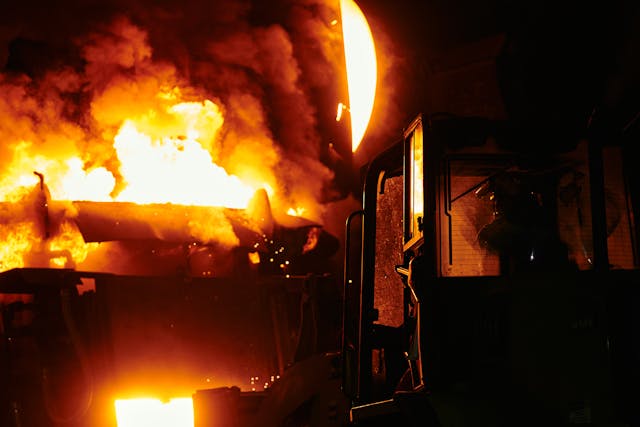
How did people first learn how to smelt metal? They probably learned through a gradual process of experimentation, observation, and learning from the results. Copper was the first metal to be smelted on a large scale, at least by around 5000 BC. The discovery of smelting is probably one of the most important discoveries of all time. It stands up there with fire, the wheel, and the printing press. It changed society on every level and led to the metal-using world we have today.
Smelting is the process of heating a metal ore to extract the metal inside. The word comes from an old Germanic word meaning to melt or make liquid. However, smelting is different from melting. Melting simply means turning a solid into a liquid. If a piece of copper is heated until it becomes liquid copper, that is melting. Smelting is different because it requires a chemical reaction. The ore is not already pure metal. The metal is locked inside a mineral, usually joined to oxygen, sulfur, carbon, or some other element. Smelting uses heat and chemistry to separate the metal from the rest of the rock.
These days, metal ore is mined by machines on an enormous scale. A metal ore is a naturally occurring rock or sediment that contains enough metal to make it worth extracting. Once the ore has been mined and separated, it is processed in huge industrial furnaces. It is difficult to visualize the amount of metal we use today. Iron ore is the most important metal ore because almost all of it goes into making steel. Bauxite is also extremely important because it is the main ore used to make aluminum. There are many other ores as well, but iron dominates modern metal production. That makes sense because iron is one of the most common elements in Earth’s crust, and steel is strong, useful, and relatively cheap.
Modern smelting is fast and efficient, but it didn’t start out that way. The process looks like magic, so how did people first learn to do it? The discovery of smelting probably wasn’t one single lucky accident. It was a long process of people trying things, noticing results, and slowly improving their methods.
People knew about some metals long before they learned how to smelt ore. Some metals exist in native form, which means they can be found naturally as metal. Gold, silver, and copper can all occur this way. Ancient people found these metals, polished them, and used them as ornaments. They also shaped them with stone hammers. Native copper, for example, can be hammered into beads, tools, or simple objects without needing to be smelted first.
It was not a huge step from hammering metal to realizing that heat made it easier to shape. People had already been using fire for thousands of years. They used fire for warmth, cooking, hardening wooden tools, and changing the properties of stone and clay. Trying heat on native metals was a logical step. They would have noticed that metal became softer when heated. Later, they would have found that some metals could be melted and poured into molds. This was a huge leap forward because it meant people could make more complicated shapes.
However, the heat of a normal campfire is not enough to smelt copper ore properly. It can soften some native metals, and under the right conditions it might melt small amounts of metal, but smelting ore takes more heat and more control. That took a few more steps, and those steps were a game changer.
One important step was pottery. People had been making bowls and utensils out of clay for a long time, but sun-dried clay is fragile. Fired clay is much stronger. The invention of kilns allowed people to reach higher temperatures and control fire more carefully. This was originally useful for pottery, but it also taught people how to build hotter and more controlled fires. Kilns also helped people make vessels strong enough to handle heat and, eventually, molten metal.
Another important clue was color. Some copper minerals are brightly colored. Malachite, for example, is green. Ancient people used colorful minerals for decoration and pigments, so they would have noticed stones like malachite. If green copper ore was heated in a hot enough fire with charcoal, something surprising could happen. The carbon from the charcoal could pull oxygen away from the copper mineral, leaving metallic copper behind. To someone seeing it for the first time, it must have seemed as though the rock had turned into metal.
That may have happened accidentally at first, perhaps when copper minerals were placed in a hot kiln or mixed with other materials. However, an accidental discovery is not the same as an invention. The real invention was learning how to repeat the process. People had to learn which rocks worked, how hot the fire needed to be, how much charcoal to use, how to keep air flowing, and how to separate the metal from the waste material. That took observation, memory, and repeated experiments.
This is probably why smelting developed gradually and in more than one place. It was not one person suddenly inventing metal. It was many people over many generations learning from fire, clay, stone, colored minerals, and native metals. Each discovery made the next one more likely. First came the use of native metals. Then came heating and hammering. Then melting and casting. Then, finally, the chemical step of extracting metal from ore.
Iron smelting came later because iron is harder to work with than copper. Iron ore needs higher temperatures and more difficult furnace conditions. Even when early smelters could make iron, it was not easy to melt in the way copper could be melted. That is why the Copper Age and Bronze Age came before the Iron Age.
Smelting changed everything. It allowed people to make stronger tools, better weapons, ornaments, trade goods, and eventually machines, buildings, wires, vehicles, and the modern world. It began with people staring into fires and wondering what would happen if they tried something new. And this is what I learned today.
Sources
https://en.wikipedia.org/wiki/Smelting
https://www.britannica.com/technology/hand-tool/Early-metals-and-smelting
https://www.weforum.org/stories/2021/10/all-tonnes-metals-ores-mined-in-one-year
https://en.wikipedia.org/wiki/Malachite
https://en.wikipedia.org/wiki/Iron
Photo by Willians Huerta: https://www.pexels.com/photo/industrial-metalwork-and-molten-steel-at-night-36398099/