
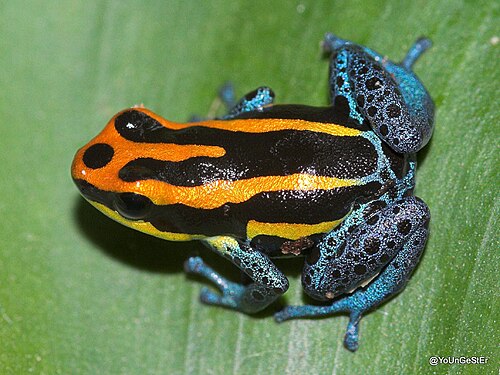
How do warning colors on animals work? Warning colors on animals work by being easy to see, easy to remember, and unpleasant enough that predators learn not to make the same mistake twice.
Many animals are either trying to hide from predators or trying to creep up on prey. That is why so many animals use camouflage. Prey animals have shades, colors, and patterns that break up their outline and help them blend into whatever background they live in. Predators also have camouflage, but theirs is so prey animals don’t see them coming. Camouflage that makes an animal blend in with its surroundings is called cryptic coloration.
And then there are animals that go in the opposite direction. They don’t try to hide. They advertise. When animals use colors, patterns, smells, sounds, or behavior to signal that they are dangerous or unpleasant to eat, it is called aposematism. These animals might be toxic, venomous, bad-tasting, covered in spikes, or able to spray foul-smelling chemicals. They are not something the average predator wants to eat, and their colors help show that.
Aposematic animals often use colors that contrast sharply with each other. The black and white of a skunk, the yellow and black of a wasp, or the blue and black of a poison dart frog are all good examples. These colors are not designed to blend in. They are designed to be noticed. Bright colors against black are very easy to see, and strong patterns are easy to remember. This is important because warning colors only work if the predator can learn the connection between the color and the unpleasant result.
Skunks are a good example. A skunk can spray a concentrated oily liquid from glands near its tail. The spray contains sulfur-based chemicals called thiols, which are some of the same types of compounds that give natural gas its warning smell. The spray usually doesn’t do permanent damage, but it can sting the eyes, cause temporary blindness, make an animal feel sick, and leave an extremely powerful smell. To our not very powerful noses, that smell can be unbearable for days. To an animal with a much stronger sense of smell, it can be a serious problem. The scent can make it harder to hide, hunt, or mate.
Skunks do not want to spray unless they have to. It takes time to replace the chemicals after they have sprayed, and the spray is their last line of defense. Before spraying, a skunk will usually give warnings. It may stamp its feet, raise its tail, hiss, or turn around. The black and white pattern helps as well. A predator that has had one bad experience with a skunk is likely to remember that pattern and avoid it in the future.
Poison dart frogs are another example, but their defense is different. Many poison dart frogs have toxins in their skin. The golden poison frog is one of the most poisonous animals on Earth. Wild golden poison frogs carry batrachotoxin, a powerful neurotoxin. It affects sodium channels in nerve and muscle cells, which can lead to paralysis and death. They do not simply make this poison from nothing. Many poison frogs get their toxins from the small insects and other animals they eat in the wild. That is why poison dart frogs raised in captivity often become much less toxic.
This is why poisonous and dangerous animals need warning colors. If an animal eats a poisonous frog, the predator may die, but the frog is still dead as well. That is not a successful defense for the individual frog. The best result is for the predator to recognize the warning before it attacks. The frog is basically advertising the consequences of eating it.
A lot of aposematic animals use two-tone colors because they are easy to see and easy to remember. They often have a bright color with black. The bright color stands out from the background, and the black makes the contrast even stronger. Spots, stripes, and sharp lines are useful because they make the animal look different from leaves, bark, grass, or mud. It is the exact opposite of cryptic coloration. Cryptic animals try to disappear into the background. Aposematic animals try to stand out from it.
Reds, oranges, and yellows are especially common warning colors. One reason is that they are very visible against green leaves and plants. Experiments with ladybirds have shown that red and orange warning colors can stand out strongly to bird vision, and red is also fairly stable as light changes through the day. That matters because a warning signal needs to be reliable. If a color looks completely different in sun, shade, or cloudy weather, it becomes harder for predators to recognize. Red works well because it is not only visible, but also dependable.
There is also another related strategy, and that is mimicry. Some animals are not dangerous or poisonous, but they have evolved to look like animals that are. This is called Batesian mimicry. A harmless red milk snake can look very similar to a venomous coral snake. A hornet moth looks like a hornet even though it is a moth. Predators that avoid coral snakes and hornets may also avoid milk snakes and hornet moths. They are borrowing another animal’s warning signal.
Warning colors work because predators are not just seeing colors. They are learning from experience. A bright pattern says, “I am not worth attacking.” If the signal is clear, memorable, and backed up by a real defense, predators learn to leave that animal alone. And this is what I learned today.
Sources
https://www.frontiersin.org/journals/ecology-and-evolution/articles/10.3389/fevo.2014.00025/full
https://kids.frontiersin.org/articles/10.3389/frym.2024.1270515
https://en.wikipedia.org/wiki/Aposematism
https://en.wikipedia.org/wiki/Honey_badger
Image By V2, first published on his homepage youngester.com – Picasa – Ranitomeya amazonica, CC BY-SA 3.0, https://commons.wikimedia.org/w/index.php?curid=12754822