
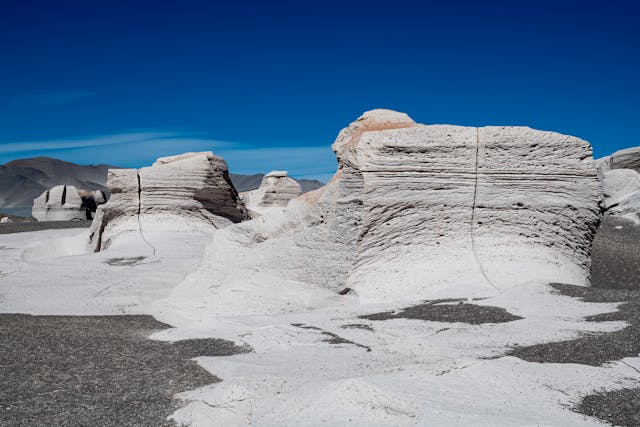
Why does pumice float? Pumice floats because it has a very low density. This is because of all the gas-filled holes inside it.
Whether or not something floats depends on how much water it can displace. Objects float in water if they are positively buoyant, which means they can displace more water than their own weight. Let’s break that down. If an object is put in water, there are two main forces acting on it. The force of gravity pulls the object down, and the water below the object pushes it back up. This is called the upward buoyant force. If the upward buoyant force can balance the force of gravity before the object sinks completely, the object will float.
Let’s look at an example. Let’s take two objects that are both a cubic meter. We’ll use a cubic meter of wood and a cubic meter of gold. The weight of wood depends on the type of wood and how dry it is, but a cubic meter of wood is roughly 500 kg. A cubic meter of gold weighs about 19,320 kg. A cubic meter of water weighs a shade under 1,000 kg. So, for a cubic-meter object to float, it needs to weigh less than the 1,000 kg of water it could displace. Wood does, and floats. Gold does not, and would sink extremely quickly.
Ships float because they can spread out their weight and displace much more water. If that same cubic meter of gold was hammered into a large boat shape with a hollow in the middle, it would still weigh the same, but it would take up a much larger space and could displace much more water. If it displaced more than about 19 cubic meters of water, the upward buoyant force would be enough to hold it up and it would float. Then, if it filled with water, it would become much heavier for the same shape, and it would sink again. That is why boats float, and also why they sink when they are filled with water.
Pumice floats because it is not very dense. It has a large volume for its weight, and this is because it is full of holes. Pumice can sink eventually, but it often takes a while. When pumice falls into the sea, many of the holes are full of gas and they help keep the water out. Some of the holes are also tiny, so surface tension can stop water from entering them straight away. This lasts for a while, but over time, the gas is forced out and water moves into the holes. At a certain point, the buoyancy of the pumice declines enough that it no longer floats.
Pumice comes from volcanoes, and it is both rock and volcanic glass. That sounds confusing, but they can be the same thing. A rock is a natural solid material made of minerals, glass, or both. The difference is that most rocks have a crystalline structure, while glass has an amorphous structure. Rock is usually made of minerals, and those minerals have atoms that form in repeating patterns. In glass, the atoms are not in a neat order. They are frozen in a more random arrangement. This happens when molten material goes from a hot liquid state to a cold solid state so quickly that crystals do not have time to grow.
Pumice is made of gas-rich lava that cools extremely quickly. Inside the volcano, gases are dissolved in the molten rock because of the high pressure. Sometimes, this makes the magma very frothy. When the volcano erupts, the pressure suddenly drops. The dissolved gases expand, the lava foams up, and then it cools and solidifies before the bubbles can escape. Because it cools so rapidly, many of the minerals are not able to settle into a crystalline pattern, and much of the material becomes volcanic glass. The result is a light, hole-filled rock that is almost like hardened volcanic foam.
Pumice has many uses, and most people probably think of it as the rock in the bathroom used to scrape dead skin off feet. It is good for this because it is abrasive and soft at the same time. However, the biggest use of pumice is actually in concrete. It is also used in cinder blocks for building. Pumice is mined, but it is more environmentally friendly than some other forms of mining because it mostly sits on or near the surface. And this is what I learned today.
Sources
https://www.britannica.com/science/pumice
https://en.wikipedia.org/wiki/Pumice
https://www.geologyin.com/2024/02/why-pumice-floats-on-water.html
Photo by Jose Luis Vanasco: https://www.pexels.com/photo/striking-white-rock-formations-in-desert-landscape-35406944/