
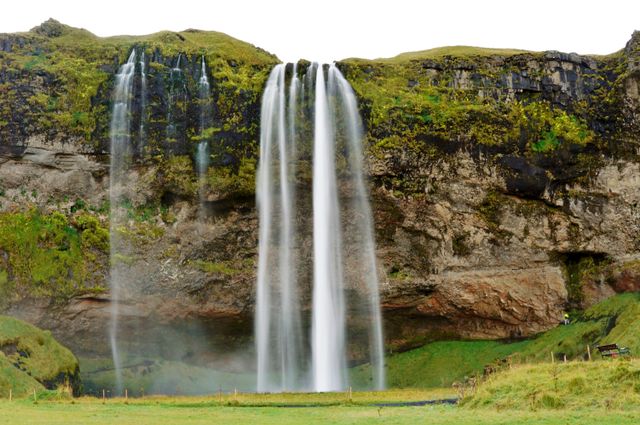
Why do waterfalls move upstream? Waterfalls gradually move upstream because they erode the rock beneath them.
You might think a waterfall will always stay where it is, but waterfalls can gradually move upstream, sometimes to the point where they disappear forever. Take Niagara Falls, for example. Niagara Falls is probably the most famous waterfall in the world. The one most people think of when they imagine Niagara Falls is actually called Horseshoe Falls, because it is in the shape of a horseshoe, and it is on the Canadian side of the waterfall. The other main waterfall is smaller and is on the American side of the border.
Niagara Falls is on the Niagara River, which drains water out of Lake Erie, the fourth largest of the Great Lakes, into Lake Ontario, the smallest of the Great Lakes. The river flows over a rock cliff at the point of the waterfall and drops about 50 meters. A huge amount of water goes over the falls every minute, although the exact amount changes because some water is diverted for hydroelectric power. Niagara Falls has become an enormous tourist destination, and towns have grown on both sides of the border to support the industry.
However, the waterfall is still eroding. In the past, Niagara Falls eroded much more quickly than it does now. Today, because of water diversion and engineering work, the current rate is much slower and not completely clear. One common estimate is about 30 cm a year, and it may become even slower. That doesn’t sound like much, but over long periods of time, it adds up. In 100 years, the falls might only move about 30 meters, which would not change the tourist towns very much. However, over tens of thousands of years, the change could be enormous. If erosion keeps going, the falls could eventually work their way back toward Lake Erie and stop existing as the waterfall we know today.
This demonstrates why waterfalls move upstream. Niagara Falls formed after the end of the last ice age, about 10,000 to 12,000 years ago. The ice sheet over North America slowly receded, and a huge amount of meltwater became trapped in the hollows that became the five Great Lakes. This water overflowed from the lakes, forming rivers, and one of those rivers was the Niagara River. The river flowed over a hard layer of rock, but underneath that hard layer were softer rocks that could be eroded more easily. Given enough time, even strong rock can be worn away, and the falls have moved many kilometers from where they first started.
Why do waterfalls erode the rock under them? Waterfalls usually form when rivers flow over different types of rock. There might be a hard layer of rock on top and a softer layer underneath. The softer rock erodes more quickly, leaving a height gap between the two surfaces. The water keeps flowing over the edge, and a waterfall forms.
Rivers erode in several ways. The first is through all the particles that they carry. As a river flows from its source, pieces of rock break off and get carried along. These pieces hit other rocks, becoming smaller and smaller until they are sand and gravel. These particles scrape along the bedrock of the river, in the same way that sandpaper scrapes against wood. The second way is by dissolving some of the minerals in the rocks they are flowing past. The third way is through the sheer force of the water. Water can get into cracks, loosen rock, and split pieces away. More powerful rivers erode rock more quickly, but, given enough time, even the slowest river will erode the ground it flows over. This is one of the reasons the Grand Canyon has become so deep.
Waterfalls erode and move upstream in the same general way as rivers, but the main action happens at the bottom of the waterfall. When the water crashes into the plunge pool, it does not just fall quietly. It hits with enormous force. The water also carries sand, gravel, and broken stones, and these smash into the rocks at the bottom. Over time, this makes the plunge pool deeper and larger.
As the plunge pool grows, it starts to undercut the rock behind the waterfall. If there is a hard layer of rock on top and a softer layer below, the softer layer is worn away first. Eventually, the hard rock above is left hanging with nothing to support it. Then it cracks, breaks off, and falls into the plunge pool. The waterfall has not really walked upstream, but the edge has collapsed backward. Then the same process begins again. The water keeps falling, the plunge pool keeps growing, the softer rock keeps eroding, and the unsupported rock keeps breaking away.
This is called waterfall retreat, or headward erosion. It is why some waterfalls slowly move upstream over time. It is also why waterfalls are not permanent features in the landscape. They seem fixed because human lives are short, but on a geological timescale, they are moving, changing, and sometimes disappearing. Niagara Falls looks eternal, but it is really just one stage in a very long process of water cutting through rock. And this is what I learned today.
Sources
https://en.wikipedia.org/wiki/Niagara_Falls
https://en.wikipedia.org/wiki/Waterfall
https://education.nationalgeographic.org/resource/waterfall
https://www.niagaraparks.com/visit-niagara-parks/plan-your-visit/niagara-falls-geology-facts-figures
https://www.bbc.co.uk/bitesize/guides/z6jx382/revision/2
Photo by Kt Ktgbk: https://www.pexels.com/photo/stunning-view-of-seljalandsfoss-waterfall-in-iceland-30423523/