
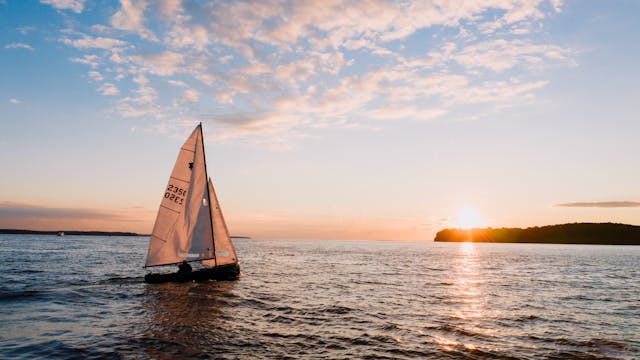
How do sailing ships sail against the wind? To sail against the wind, sailing ships use a combination of techniques. They angle themselves to increase aerodynamic lift, they use an underwater keel, and they use a zigzag motion called tacking.
No one knows when sails were discovered, but the earliest known image of a sail is on an Egyptian vase dating from roughly 3500 BC. There is some evidence that sailing boats might have been used even as early as 6000 BC in Mesopotamia, but experts are divided. Some think that sailing boats were in use even earlier than this and some think later. The boat depicted on the Egyptian vase was a boat that had a square sail made of papyrus. It was used for sailing against the current up the River Nile. Before sailing boats, there were only oars to move a boat through the water and that depended on a lot of manpower. Oars can easily move a boat, but they are very limited in speed and distance, and you need to carry a large crew, which makes the boat much heavier and reduces the available space for trade. Sails improved boats because they could move under the power of the wind and they could go much faster and much further. The only problem with a sailing boat is that it relies on the wind.
Most places on Earth have wind almost all of the time. However, that wind is not always going in the same direction that the sailing ship wants to go in. As long as there is some wind, ships have a technique to keep moving. There is a belt near the equator called the doldrums, where winds can become very light or disappear for long periods. Sailing ships could become trapped there for days or weeks. These places are called the doldrums and if a sailing ship happens to get stuck here, the only thing they can do is use oars to get out. Ferdinand Magellan’s ship, the Victoria, was stranded in the doldrums for 20 days in 1521. Sir Walter Raleigh’s ship, the Destiny, was trapped there for 40 days on his expedition to South America. Ships stuck here have no idea when they will get out, and rations can often run out.
So long as there is wind, ships can move. Wind pushes a boat in two ways. The first way is simply through direct force. The wind pushes the fabric of the sail and forces the boat forwards. If the wind is blowing from behind the boat, this is the method used to move a sailboat in the direction of the wind. The second way is by using the sail as a wing and gaining lift. This is the method used when the wind is not blowing from behind the boat.
An airplane wing creates lift because its shape and angle change the speed and direction of the air flowing around it. This creates lower pressure on one side and higher pressure on the other. A sail can work in a similar way when the wind is coming from in front of the boat. Obviously, the boat cannot sail if the wind is coming directly at it, but if the boat sails across the wind at a 45 degree angle, the sail splits the wind into two. The back side of the sail is curved and this produces areas of low pressure and high pressure and produces lift, which pulls the boat horizontally. The boat can only sail at 45 degrees towards where it wants to go, so it sails across the point it is heading for, then turns and sails back in a zigzag. This is called tacking. They have to sail a lot further than if they could just go straight, but they can sail against the wind.
The problem with this method is that the wind strongly wants to push the boat sideways. To prevent this, boats have something called a keel. The keel is a piece of the boat at the very bottom that sticks out into the water. The keel helps to balance the boat and also keeps it stable when the wind is pushing the sails. It also acts to stop the boat from being pulled sideways when it is tacking. The keel has a shape like a knife. The blade of the knife easily cuts forward through the water, but the large surface area resists movement to either side. The sail tries to pull the boat sideways and forwards, but the keel blocks most of the sideways movement, so the boat moves forwards. This allows the boat to sail against the wind. Although, of course, the invention of the steam engine and then the combustion engine made sail boats a thing of the past. Today, sails are mostly used by hobbyists, for sport, for training, and on some traditional boats, although there is also renewed interest in using wind power to help cargo ships save fuel. And this is what I learned today.
Sources
https://en.wikipedia.org/wiki/Keel
https://en.wikipedia.org/wiki/Sail
https://www.boatsetter.com/boating-resources/how-to-sail-against-the-wind
Photo by K : https://www.pexels.com/photo/sailboat-on-the-sea-10179159/