
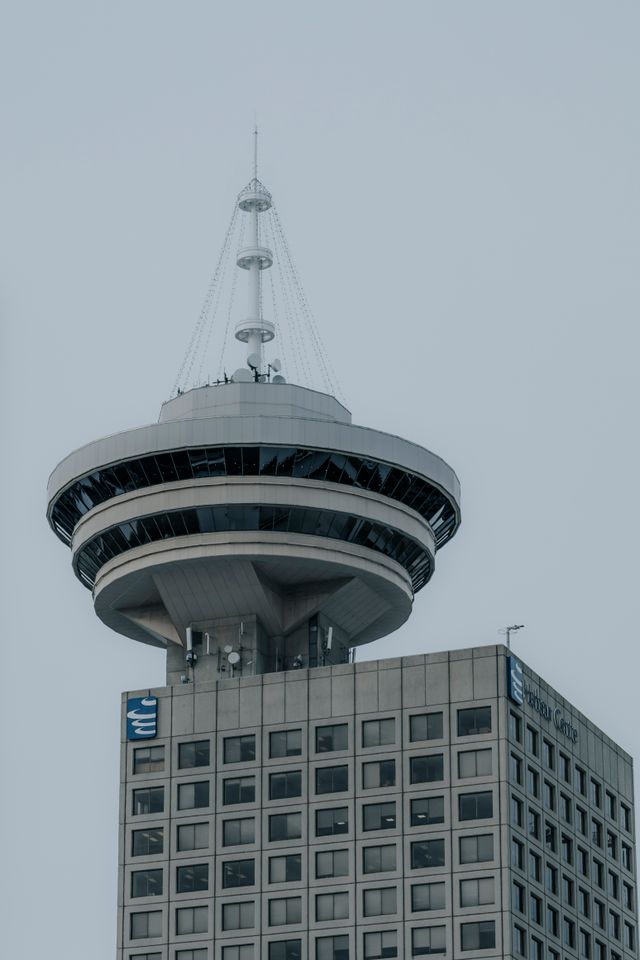
How does a revolving restaurant work? Only the outer dining platform rotates. The central core stays still.
Revolving restaurants are usually located on the roof of buildings or at the top of towers. Diners can sit at tables around the outside of the restaurant and enjoy their meal as it slowly rotates. This allows them to get a 360 degree view of the city they are dining in. It usually takes about an hour for the restaurant to complete one revolution. There is a kitchen at the center of the restaurant where the meals are produced and they are carried to the table by the waiting staff, as with any restaurant.
One might wonder how it is possible to have a kitchen at the center of a revolving restaurant. How do the water pipes and electric cables not get twisted up? Well, the answer is that only the very outside of the restaurant rotates. The center is static and attached to the tower or building the restaurant is located on. The kitchen is usually supplied by a dedicated elevator that can bring ingredients up and another to take trash down. It is no different to the kitchen at the top of a non-revolving restaurant tower.
The rotating part of the restaurant is basically a carousel that rotates around the static core. The carousel rests on steel wheels or roller bearings and it is turned by a motor. It doesn’t take a lot of power to keep the carousel turning because there is relatively little friction. The electric motor runs through a series of gears to reduce the rotational speed. The idea is to have the restaurant rotate about once an hour. This speed is slow enough that the patrons don’t realize they are rotating and it reduces motion sickness. The speed can actually be adjusted. A lot of restaurants time their meals so that a complete serving takes one rotation. If the restaurant wants a higher turnover, they can increase the speed of the restaurant slightly to get customers out faster. The motor needs to be smooth enough that the patrons don’t feel the restaurant moving, but it also needs to reduce vibrations. Both the vibrations felt in the restaurant and the vibrations on the rest of the building. Too much vibration could damage the building and the rotating discs support.
The core of the revolving restaurant is static so there is no worry about the pipes and cables becoming twisted, but it is still necessary to get power to the revolving part. There will be lights on walls, and possibly even plug sockets and things like drink machines, although most of the power hungry machinery would be in the non-revolving part of the restaurant. Getting power to the lights and other devices in the revolving part is fascinating because you obviously cannot just use a cable. After a few revolutions, the cable would be snapped. Revolving restaurants use something called a slip ring. These are not only for revolving restaurant, but anything that spins and needs power, such as wind turbines, or fairground rides. The slip ring has two parts: rings and brushes. The ring is attached to the rotating part and is a long, continuous piece of conductive metal that goes right around the restaurant. On the non-rotating part of the restaurant are brushes attached to the end of the power cables. The brushes are made of a conductive material as well. The brushes constantly stay in touch with the ring as the restaurant rotates and they supply it with a continuous source of electricity.
Revolving restaurants are not as common now as they were in the past. There are still over a hundred of them around the world, but the novelty has worn off. They cost more than a regular restaurant to maintain, and there have been a few mechanical failures which have turned people off them. The first revolving restaurant was built in Dortmund, Germany, in 1959. It was built on top of the Florian Tower. They grew in popularity until the late 1980s when they began to decline.
There is actually some archaeological evidence that Emperor Nero had a rotating dining room. It was written about by the historian Suetonius. In 2009 archaeologists found the remains of a mechanism that was probably powered by water and could have allowed the floor of Nero’s main dining room to rotate. Flowing water could have turned a wheel that rotated a platform built on bronze spheres or rollers. And this is what I learned today.
Sources
https://grokipedia.com/page/Revolving_restaurant
https://www.macton.com/revolving-restaurants
https://en.wikipedia.org/wiki/Revolving_restaurant
Photo by Raghav Khera: https://www.pexels.com/photo/low-angle-shot-of-vancouver-lookout-11455846/