
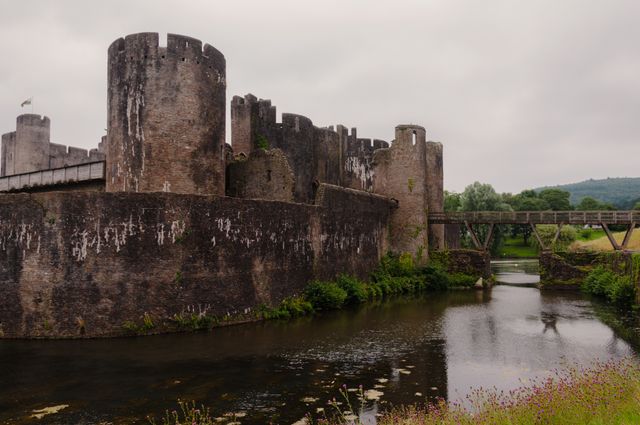
When did castles stop using moats? Castles stopped using moats in the 16th century, and the whole design of castles changed to reflect new technology in warfare.
If you have ever visited the ruins of an old castle, you probably noticed that you need to cross a bridge to get into it. The bridge spans a ditch that may be filled with water, or may be empty. That is a moat. The word mot comes from the French mote, which means a mound or a hill. In Norman French, the meaning shifted from the castle built on a raised embankment to the ditch that surrounded it. The Normans brought this word into Old English.
Fortifications have used ditches and dugouts around them for thousands of years. At some point, presumably, one of those ditches became filled with water and someone realized how much better it was at keeping people out than a simple ditch. Moats have existed since then. The Ancient Egyptians appear to have been the first people to use a moat to protect a fortification. Most civilizations surrounded their cities with high walls, but the Egyptians surrounded theirs with a wall and a 3 m deep ditch that was filled with water. There are several examples of this.
The use of a moat makes logical sense. As walls got taller, thicker, and stronger, attacking civilizations started to come up with ways to knock the walls down or to climb them. If you can stop people from getting close to your walls with something like a moat, it adds an extra level of protection. You could still use siege weapons, but they needed to cross the moat. Most things like siege towers or battering rams only worked when they were directly up against the wall, and a moat gave them more of a challenge. And even if the walls were breached, people needed to cross the moat to enter the fortification. A deep moat also made tunneling into a castle difficult because the water would collapse the tunnel. Well guarded drawbridges helped. No moat is ever going to completely keep out an army that is determined enough, but it is one extra thing they have to deal with.
Castles stopped using moats when warfare changed. The introduction of gunpowder into Europe in the 14th century changed everything. It took a while, but within a hundred years, fairly powerful cannons were possible. They could fire a heavy cannonball a considerable distance. They weren’t accurate, but a cannonball can do a lot of damage. Up until then, a moat was useful because it stopped siege towers from getting close to the wall but cannons don’t need to be close. This made normal moats obsolete and it meant that castles needed to be redesigned.
From the early 16th century, castles stopped being tall castles with long straight walls. The idea had been to stop people from climbing over the walls. It turned out that tall walls proved to be a great target for cannons, and they were not that strong. Walls became shorter and thicker, and they became angled as well. People started to build star shaped forts as well. The low, thick, angled walls were designed to deflect cannonballs, and the star shape gave angular protection in every direction. The flat part of the wall is the weakest, so a star shape reduces the amount of wall that can be targeted. Moats were still used, but they became much larger. Sometimes, they could even be described as small lakes. The further away the cannons could be kept the better, and a huge moat would stop infantry from storming the walls even if they were breached.
That lasted for a hundred years or so, and then weapons improved again. Siege mortars were invented. A cannon can fire a cannonball at a great velocity, but pretty much in a straight line. If you fire it at the wall, it will do damage. If you fire it too high, it will sail straight over the castle. Siege mortars can be fired in a high arc, so they sail up and fall down into the middle of the castle. They make the walls irrelevant. The only way to protect from a siege mortar is with an underground bunker. From this point on, castles were obsolete, and moats with them. Then, when aircraft were invented, there was no way to hide. A plane can easily fly over fortifications and drop bombs.
Sources
https://en.wikipedia.org/wiki/Moat
https://www.bbc.co.uk/bitesize/articles/zhrb6v4#zh4mm39
https://www.vaneck.com.au/blog/vectors-insights/a-short-history-of-moats