
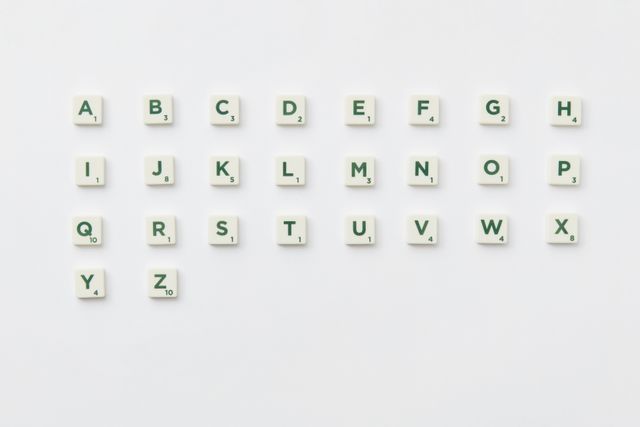
Why is the alphabet in that order? There is no logical reason why the alphabet is in the order it is in. It is mostly an accident of history and of the languages that used it. Before we begin, let’s be clear that I am talking about the Latin alphabet that has 26 letters and starts with ABC and ends with XYZ.
We need to start by looking at where the alphabet came from. It is a long journey, but we can trace the beginnings of the alphabet to Ancient Egypt. As we all know, the Ancient Egyptians used hieroglyphics to write, but the problem with hieroglyphics is that there are a lot of them and they are very difficult to remember and read. The earliest ancestor of our alphabet seems to have been created by Semitic-speaking people living in Egypt. They adapted Egyptian hieroglyphs so that each symbol represented a sound rather than a whole word. They took a hieroglyphic such as aleph, which meant ox, and they simplified it to a mark that looks something like our letter a and gave it a sound. And they took bet, the hieroglyphic for house, and turned it into something like our letter b and gave it a sound. And they did this for many of the hieroglyphics. They didn’t have the complete alphabet that we use, but they had a lot of the letters.
These marks were used by uneducated local people, while the official writing systems were hieroglyphics. Then, in roughly 1200 BC, the Bronze Age collapsed, and civilizations underwent drastic change. Over the following centuries, this simplified writing system spread through the Levant. Then, the idea of using marks to represent sounds was picked up by the Phoenicians, a trading and sailing nation, and carried around the Mediterranean. The Phoenicians spread many things, but their alphabet was one of them. When you are trading with a powerful trading nation, it is useful to be able to write in their language. Once that happens, it starts to spread from the port towns along trading routes. By the 8th century BC, a number of nations were using a form of this alphabet. In fact, the first two letters of the Phoenician alphabet were aleph and bet, which is where the word “alphabet” comes from, showing how important the Phoenicians were.
The next step was Greece. The Ancient Greeks adopted the alphabet from the Phoenicians. The remarkable thing is that they kept almost exactly the same order of the letters, but that is not the same order as all of the letters that we have today. They changed the sounds that the Phoenicians had used, and they added vowels. They had 24 letters. The Phoenicians and the early Greeks wrote from right to left, but after a while, the Ancient Greeks switched to left to right writing. The Etruscans, living in Italy, who would heavily influence the early Romans, picked up the alphabet from the Greeks. They added F and changed the shape of S to what we have today. The Romans inherited this alphabet, but it didn’t have G, J, U, W, Y, and Z. Within a short while, they had modified C to have a separate G. The Romans originally dropped Z because Latin no longer used its sound. Later, when they borrowed many Greek words, they reintroduced both Y and Z. Rather than rearranging the entire alphabet, they simply added them to the end, where they remain today.
Latin, through the church, became the written language in Anglo-Saxon Britain and the alphabet with it. There, as with most countries that adopt a foreign alphabet, they added letters to it that they were using. The Latin alphabet was created to write Latin, and Old English had sounds that couldn’t be written with that alphabet. A lot of Danish and Norse people were living in Britain from 900 AD onwards. They used a runic writing system, and some of their letters were used in Old English. Letters like thorn (þ), eth (ð), ash (æ), and wynn (ƿ) were used. When printing presses arrived from continental Europe, many didn’t have a thorn character. Printers substituted the similar-looking letter Y, giving us spellings such as “Ye Olde Shoppe,” even though it was still pronounced “the.” Wynn became “uu”, which evolved into “w” and is why it is called double u.
There were several different versions of the alphabet, and they were only really consolidated when the printing press was invented. Printing encouraged standardization, and once things were printed, that system became the alphabet we have. There is no real reason for the order. You could write the alphabet in any order, and it wouldn’t matter. Interestingly, we all learn the alphabet forwards, and we think of it as a unit. You can count from 1-26 forwards and then just as easily 26-1 backwards. You can say A-Z forwards easily, but there are very few people who can smoothly say Z-A backwards. And this is what I learned today.
Sources
https://www.smithsonianmag.com/history/inventing-alphabet-180976520
https://en.wikipedia.org/wiki/History_of_the_alphabet
https://www.stancsmith.com/blog/lifes-great-mysteries-why-is-the-alphabet-in-that-particular-order
https://langscape.org.uk/OEtutorial/thealphabet.html
https://en.wikipedia.org/wiki/Old_English_Latin_alphabet
https://www.dictionary.com/articles/letters-alphabet
Photo by DS stories: https://www.pexels.com/photo/scrabble-tiles-in-alphabetical-order-6005105/