
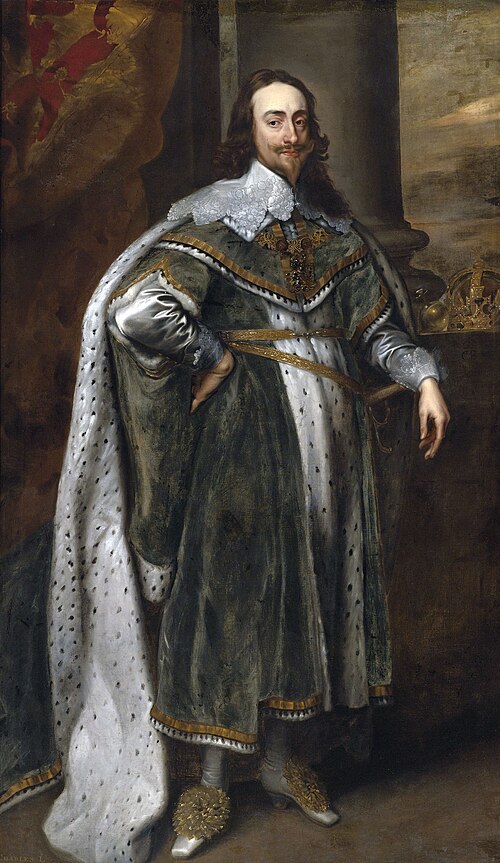
]Why did the English Civil War happen and why did the Interregnum only last 11 years? The English Civil War happened because King Charles I and Parliament couldn’t agree on the balance of power, finances, and religion. The Interregnum only lasted 11 years because Oliver Cromwell’s son, Richard, was not a good enough leader to carry it on.
There were three English civil wars, fought between 1642 and 1651. They were fought between the Parliamentarians, obviously on the side of Parliament, and the Royalists, on the side of the king. They resulted in the capture and execution of King Charles I in 1649, followed by the Interregnum (between kings), that lasted until King Charles II was restored to the throne in 1660 and Britain returned to being a monarchy. The Interregnum happened because King Charles I was executed, but the civil war hadn’t started with the intention of executing the king. The Parliamentarians only wanted concessions.
There were lots of small causes for the civil war, but there were three main ones. The first was the balance of power. King Charles I came to the throne in 1625 and he considered himself to have been created king by God and therefore had the God given right to rule without any checks or balances. He decreed that the monarch was subject to no earthly authority, including Parliament. The problem was, he was not a particularly good king. Many people increasingly questioned whether someone who ruled so poorly could truly claim an unquestionable divine right to govern. However, there was corruption, nepotism, and he was virtually bankrupt.
The role of Parliament was basically to raise money for the king. That is how he viewed it. Parliament’s main leverage came from controlling taxation, but Charles believed he should be able to rule without relying on it. They met when the king wanted, gave advice if he asked for it, raised money when he needed it, and disbanded when he no longer wanted them. Charles needed money and he called Parliament to raise it for him. They refused until he granted them some powers of their own. Charles didn’t like that and in 1629 he dismissed Parliament. Parliament had no power to call themselves and they didn’t meet again for 11 years.
During this time, Charles ruled on his own and he didn’t rule well. He raised unpopular taxes, he favored unpopular people, and he appeared to be heading back towards Roman Catholicism. He might have carried on if he hadn’t started a war with Scotland. He tried to impose the English prayer book on the Scottish Church and they rebelled. He had no money and no real army, so he led what troops he had himself. He was quickly defeated and Scotland occupied several northern towns, and Charles had to pay them not to come any further. Charles had no choice but to recall Parliament. Their first step was to ask him to pass a law saying that only Parliament had the authority to dismiss Parliament. Surprisingly, he passed it. The new Parliament arrested all of the unpopular people Charles had been supporting and pushed for more power.
Charles was not popular with Parliament, but he still had some supporters. This ended in 1642 when he marched into Parliament with 400 troops and tried to arrest 5 MPs. They escaped and Charles lost any support he had in Parliament. The first civil war started in 1642 and ended in 1646. There was a short pause and fighting restarted in 1647. Charles was captured and the war ended in 1649. Charles was tried for treason. Many of the people who had taken part in the civil war wanted concessions from Charles. Very few of them had considered what would happen if he was found guilty. Charles refused to recognize the court because he said it had no authority over him. The army controlled by the Parliamentarians kept all people loyal to Charles or people who opposed trying him out of the courtroom and he was found guilty, then sentenced to death. He was executed on 30th January, 1649.
England then became a commonwealth and it was led by Oliver Cromwell, who was titled the Lord Protector. He served as basically a military dictator and was able to keep control of the country because of the control he had over the army. However, in 1658 he died and he was replaced by his son Richard. Unfortunately, (or fortunately if you are a monarchist), Richard didn’t have the charisma or the leadership qualities of his father. He didn’t have military experience and he wasn’t respected by the officers. He wasn’t able to control the army and pretty soon he had lost all semblance of power. The army removed him and took control. People didn’t like the army being in control so they started to talk about bringing the king back and they approached Charles II. Charles II returned to Britain and took the throne in 1660. And this is what I learned today.
Sources
https://en.wikipedia.org/wiki/English_Civil_War
https://www.historic-uk.com/HistoryUK/HistoryofEngland/Origins-of-the-English-Civil-War
https://en.wikipedia.org/wiki/British_Interregnum
https://en.wikipedia.org/wiki/Commonwealth_of_England
https://en.wikipedia.org/wiki/Oliver_Cromwell
By Workshop of Anthony van Dyck – she-philosopher.com(original upload)Sothebys 2012 (higher resolution upload), Public Domain, https://commons.wikimedia.org/w/index.php?curid=3852590